











[ad_1]
Emily Liu’s life is a series of balancing acts.
She speaks Chinese with her father and Spanish with her mother. Visiting her parents’ homelands takes her to Harbin in northern China and a small town in the Mexican state of Zacatecas.
Perhaps most of all, it’s how she’s perceived by others, as if she were a living Rorschach test — Asian to some and Latina to others.
“Some friends say they see Asian features. I don’t see any,” the soft-spoken teenager said. “I also don’t see any Latina. I don’t see any of it.”
Asians and Latinos are the two fastest-growing ethnic groups in the country, making up about a quarter of the U.S. population, according to 2019 Census data.
But even in places like the San Gabriel Valley, where more than 80% of residents are either Asian or Latino, few people are both. To belong to both groups simultaneously can be a study in loneliness and confusion.
California is home to more Asian Latinos than any other state in the U.S. — at least 250,000, most of whom live in Los Angeles County. But that’s still a tiny slice of the nearly 40 million people who reside in the Golden State, 15% of whom are Asian and 39% Latino.
As the Asian and Latino populations continue to grow, fueled by both immigration and birthrates, mixed offspring will become increasingly common.
People like Liu may offer a glimpse of California and the nation’s future, with all its complexities of language, culture and identity.
Being Asian Latino can spark pride, especially for young people who spend much of their lives online. There are profiles, listicles and TikTok videos. Self-described “Lasians” can eat dim sum in the morning and enchiladas that night.
In a TikTok video with more than 1 million views, Nicole Ngo, an Angeleno, asks what you get when you mix a Chinese father with a Mexican mother: “2 kids with an identity crisis.”
It’s a joke, 24-year-old Ngo said, that’s rooted in truth.
Many young Asian Latinos are grappling with who they are, struggling with the stereotypes, judgments and expectations of the world, dealing with confusion that even their parents — one solely Asian, the other solely Latino — can be hard pressed to comprehend.
They’re also witnesses to a cultural identity shaped by each side, sometimes resulting in a unique blend.
Ngo’s Mexican mother told her kids to kiss and hug their Chinese grandmother, which is not customary in Asian culture.
“Because my mom was doing that, my cousins were told to do the same thing. As time went on, the next 10 years, now that’s how we greet each other,” Ngo said. “We go down the line and hug every single aunt and uncle, hug every single cousin, just like we do with our Mexican side. It somehow bled into my Chinese culture, because of my mom’s impact.”
::
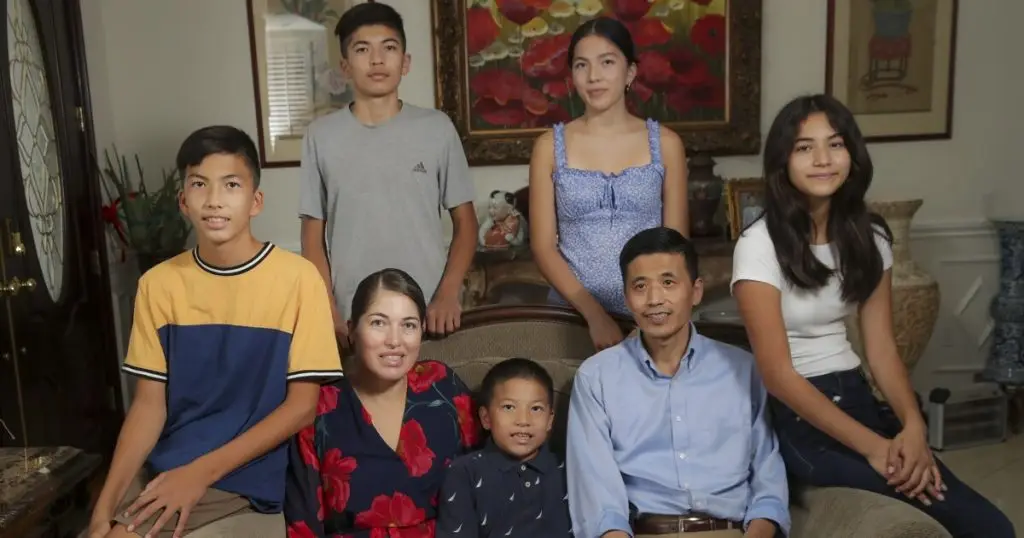
Liu’s parents met nearly two decades ago while attending English as a Second Language classes in Alhambra — a city that is 52% Asian and 35% Latino, according to census data.
In their engagement photos, Beatriz Ortega and Ivan Liu wore Chinese-style jackets, hers red, his blue.
Five kids later, sometimes their communication is still muddled. Liu doesn’t speak any Spanish and Ortega knows only a little Chinese. Their English is still a work in progress.
“I think that in love, language is not an issue,” Liu said. (And, as Ortega jokes, it helps prevent arguments.)
For other couples, the challenge was not a language barrier but a cultural one.
Grace Lee-Navarrete, who is Chinese American and grew up in Monterey Park, met her now-husband, Agustin, who is Mexican, through a mutual friend.
Although her parents wanted her to date someone Chinese, Lee-Navarrete never did. When it came time to tell her family about her serious relationship with Agustin, she said, “everything blew up.”
Her father flew to China to speak with his pastor, who “talked some sense” into him, according to Lee-Navarrete.
Her father walked her down the aisle, and she and Agustin have been married for more than 20 years.
Lee-Navarrete, 51, says that for her three kids, “nothing is forbidden. Nothing is hidden.” They “don’t have to sneak around.”
Despite not marrying someone Chinese, Lee-Navarrete made it a point to incorporate her culture into her children’s lives.
Her maternal grandfather chose her daughters’ middle names: Lauren’s is Yu-Lan, meaning “jade flower,” while Alyssa’s is Yu-Tzeng, meaning “precious jade.”
“I want them to understand their heritage and where they come from,” Lee-Navarrete said.
::
Mark Keppel High School in Alhambra is 70% Asian and 22% Latino. But students who are both are relatively rare.
At The Times’ request, a group of four — including Liu — gathered in the cafeteria last fall to talk about navigating their identity.

From left, Mark Keppel High School students Matthew Sy, Emiko Luna Hernandez, Emily Liu and Isaac Guo Meyer. All have both Asian and Latino heritage.
(Irfan Khan / Los Angeles Times)
Emiko Luna Hernandez’s mother is Japanese Mexican and her father Mexican; Isaac Guo Meyer’s father is Mexican and his mother Chinese; Matthew Sy’s mother is Chinese and his father Salvadoran.
The two girls and two boys, seated in a semi-circle, were quiet at first but quickly found common ground.
They described the Asian side of their families as more “formal,” whereas on the Latino side their relatives were more easygoing.
They pushed back on stereotypes of Asian parents being stricter about school. Liu said her Mexican mom is more disciplined when it comes to academics.
“When I usually tell people that my mom cares about my grades, they say, ‘I thought your dad would,’” Liu, now 18, who recently graduated, said later.
They shared the food fusions in their households, such as eating tamales and Mexican fried rice while making dumplings at the same table.
That, however, is where the similarities ended.
While Liu speaks Mandarin and Spanish, her classmates tended to have a firm grasp on only one of their parents’ languages. And how they’re perceived by others varies.
“I think I kind of look Filipino to some people,” said 10th-grader Luna Hernandez.
Just the day before, Sy said, someone in class had also asked him if he was Filipino.
“If I’m hanging out with my entire group of Asian friends, in that moment I feel like an Asian,” said 18-year-old Isaac Guo Meyer. “And sometimes I might just see my reflection and then I see, of everyone in the group, I just look different from other people.
“My friends don’t treat me any differently because of it,” Guo Meyer added, “but it makes me view myself differently, where I feel like, ‘Am I Asian enough to be with my group of friends?’”
::
Cristina Ruiz, 21, captured the experience of being Asian Latino in a series of profiles she wrote last year for UnidosUS, a Washington-based advocacy and civil rights group where she worked as a summer education policy intern.
Ruiz, who grew up in the San Gabriel Valley, is Mexican and Chinese. Her grandpa, who is Mexican, met her grandma, who is Chinese, while the two worked in the Sears building in Boyle Heights.
Her identity is something she’s discussed often with her twin sister, “the only one who really understands what it’s like to grow up in an Asian community, right next to a Mexican one, and being both but not really being either.”
For one profile, Ruiz connected with her friend Arie Lea Kuo, who is Taiwanese and Mexican.
“When Arie Lea was younger, kids in the Asian community where she grew up in Monterey Park only seemed to believe the part of her identity that was obvious,” Ruiz wrote.
“I definitely look more Latino than Asian,” Kuo told Ruiz, noting that even with her last name, kids often said, “No way you’re Asian.”
During their conversation, Ruiz and Kuo commiserated about their hesitation to join cultural clubs in high school, “because we wondered, ‘Are we going to appropriate our own culture?’”
“I think just talking about these issues with other people that I knew for a while just really showed me how common my experiences were,” Ruiz said. “Hopefully, other people realize that there’s others like them. I didn’t realize that for a long time.”
::
The signs outside the San Gabriel Valley church touted services in English, Cantonese and Mandarin.
Before Beatriz Ortega sent her children off to their youth groups, she instructed her youngest son, “Pórtate bien.” Behave.
When Ortega married Liu, she was Catholic, and he was an evangelical Christian.
Now, Ortega has been attending Liu’s evangelical church for more than a decade. She sits in the English service, the only Latina in the room, while her husband goes to the Mandarin service.
After the service, Ortega and daughter Emily walked arm in arm at Fiesta Alhambra, an event celebrating Latino and Hispanic Heritage Month.
When she’s out with her mom, Emily Liu said, people comment that she looks more Latina.
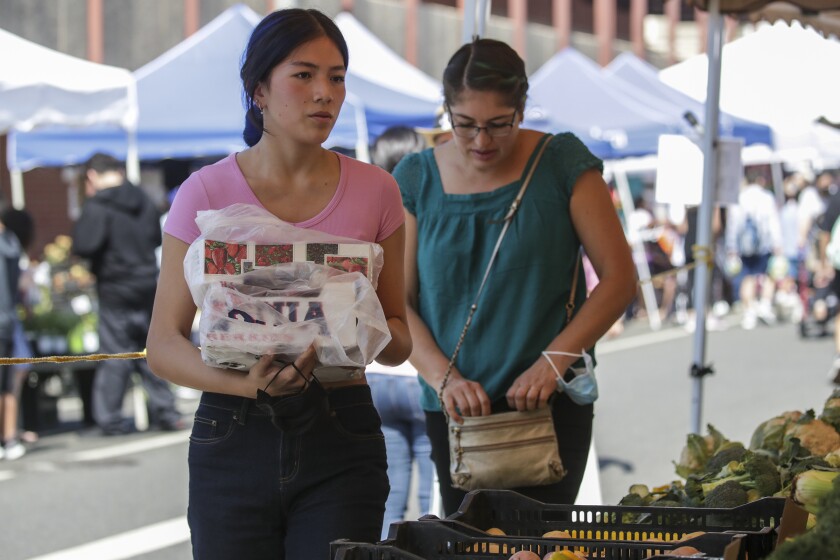
Emily Liu and her mother, Beatriz Ortega, shop during Fiesta Alhambra, which celebrates Latino and Hispanic Heritage Month.
(Irfan Khan / Los Angeles Times)
Mother and daughter bought strawberries and kale and browsed the handmade Mexican blankets. When the vendors spoke in Spanish, Emily Liu had no difficulty understanding.
In the Liu household, “Happy Birthday” is sung in Chinese, English and Spanish.
When she has kids, Emily Liu said, she plans to speak with them in Mandarin and Spanish — the languages bequeathed by her mother and father.
[ad_2]
Source link