












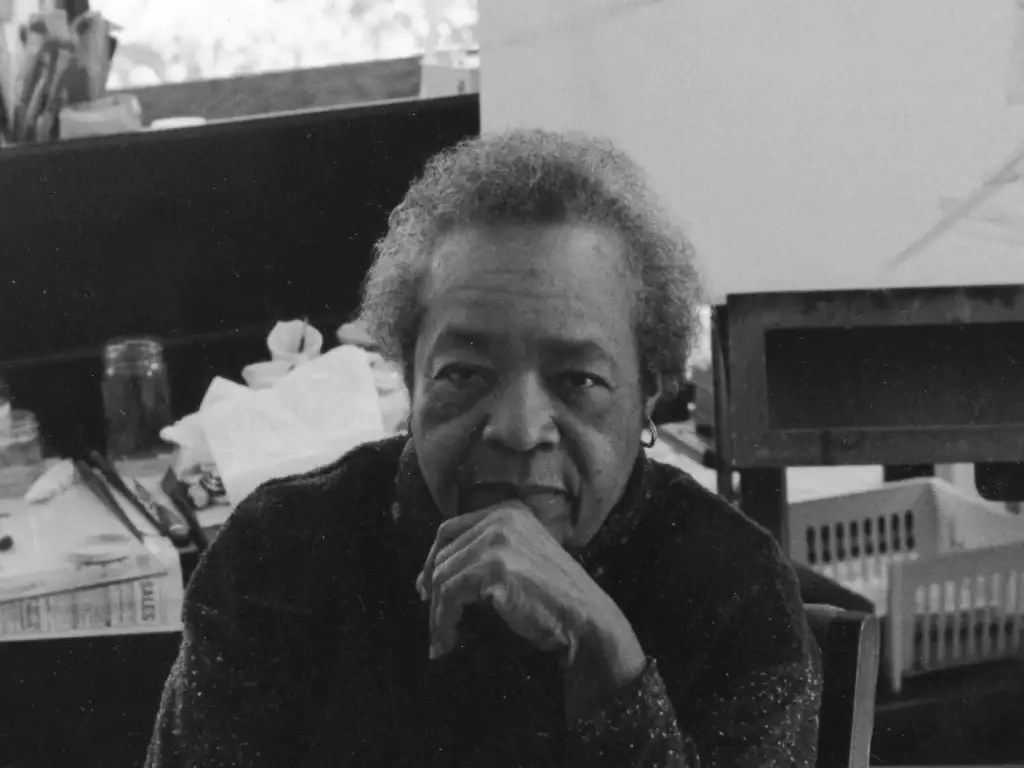
When Samella Lewis began teaching art history in the 1950s and ′60s, Black artists were often shut out of major American museums, passed over in favor of European masters and White abstract expressionists. Artists of color had few opportunities to reach a wide audience, she later recalled, and “there was no African American museum west of the Mississippi.
[ad_1]
So Dr. Lewis, a New Orleans native with a PhD in fine arts, began building alternative institutions, aiming to promote and preserve the work of Black artists like Sam Gilliam, Jacob Lawrence and her mentor, Elizabeth Catlett. Settling in Los Angeles in the mid-1960s, she founded three galleries for artists of color, created the city’s Museum of African American Art, published a landmark survey of contemporary Black art and wrote one of the first textbooks on African American art history.
“Art is not a luxury as many people think,” she said, according to the website Black Art in America. “It is a necessity. It documents history — it helps educate people and stores knowledge for generations to come.”
A tireless champion of African American art, Dr. Lewis was also an accomplished painter and printmaker in her own right, with works in the permanent collection of the Museum of Modern Art and the Metropolitan Museum of Art, both in New York City. She was 99 when she died May 27 at a hospital in Torrance, Calif., after suffering a kidney ailment, according to her son Claude.
In a life that was guided by her devotion to art and social justice, Dr. Lewis taught in Jim Crow-era Florida while working with a Tallahassee branch of the NAACP — enraging members of the Ku Klux Klan, who shot out the windows of her home, according to her gallery Louis Stern Fine Arts.
Her activism continued after she moved to Upstate New York, where she co-founded an NAACP chapter while teaching at the State University of New York at Plattsburgh in the late 1950s, and after she moved to Southern California a few years later. While coordinating education programs at the Los Angeles County Museum of Art, she picketed the museum, according to her son, “because they had hardly any African American art — or any art by anyone of color.”
To promote African American artists, Dr. Lewis made short documentary films about sculptors including Barthé and John Outterbridge. She also partnered with printmaker Ruth Waddy to interview dozens of artists for the book “Black Artists on Art” (1969), a two-volume survey of the contemporary scene that she released through Contemporary Crafts Gallery, a publishing house and exhibition space that she co-founded with actor Bernie Casey.
The book was intended “to promote change,” she wrote, “change in order that art might function as expression rather than as an institution” — and thereby serve entire communities, rather than amuse or enrich a privileged few. Her own work featured poignant depictions of African American life, including scenes of fieldworkers like the man portrayed in her 1968 linocut “Field,” who is shown raising his arms toward the sun and clenching one hand in a defiant fist.
“The artist is an interpreter,” Dr. Lewis later wrote, “a voice that makes intelligible the deepest, most meaningful aspirations of the people,” and “a channel through which their resentments, hopes, fears, ambitions, and all the other unconscious drives that condition behavior are expressed and become explicit.”
Dr. Lewis reached a wide audience with her 1978 textbook “Art: African American,” which built on the work of African American art historian James A. Porter and outlined more than two centuries of Black American art, beginning with the colonial era. Revised and expanded as “African American Art and Artists,” it became a staple of college classes, assigned in art and African American studies courses for years.
“Thanks to Samella Lewis,” artist and art historian Floyd Coleman wrote in a foreword for the book’s 2003 edition, “we gain deeper appreciation for and understanding of the richness and diversity that African American art adds to American civilization.”
The daughter of a farmer and a seamstress, Samella Sanders was born in New Orleans on Feb. 27, 1923. (Many sources give her birth year as 1924, although her son Claude said her birth certificate was given belatedly and incorrectly took a year off her age.)
While in high school, she met an Italian portrait painter, Alfredo Galli, after lingering at the window of his shop in the French Quarter. He spoke no English, she recalled in an oral history interview, but was impressed by her draftsmanship and taught her and a classmate free of charge for two years. “He really worked with us and warned us against the evils of modern art,” she said with a laugh. “But he taught us technique, and that was priceless.”
Dr. Lewis went on to study art at Dillard University in New Orleans, where she met Catlett and her then-husband, fellow artist Charles White. When the couple moved to Virginia to take a teaching job at the Hampton Institute (now a university), Dr. Lewis followed them, continuing her studies with further guidance from Viktor Lowenfeld, an influential art educator who taught her “to paint from the heart,” as she later told the Richmond Times-Dispatch.
She received a bachelor’s degree in 1945 and later studied fine arts at Ohio State University, earning a master’s degree in 1948 and a doctorate in 1951. Two years later, she helped organize the National Conference of Artists, a gathering of Black artists and teachers, while chairing the fine arts department at Florida A&M University.
Pursuing her interest in East Asian art, Dr. Lewis traveled to Taiwan on a Fulbright fellowship in 1962 and later moved to Los Angeles to study Chinese, getting a postdoctoral fellowship at the University of Southern California. By 1970, she had joined Scripps College in nearby Claremont, where she became the school’s first tenured African American professor and taught art history for more than 15 years.
Backed by a grant from the National Endowment for the Arts, she founded the Los Angeles Museum of African American Art in 1976. The museum acquired works by Barthé and painter Palmer Hayden, among other Black artists, and is now located inside a Macy’s shopping store at the Baldwin Hills Crenshaw mall, in line with Dr. Lewis’s mission to bring art to the people.
“The ordinary American sees museums as some people view church — a special occasion and not an everyday affair,” she told the Los Angeles Times in 1986. “I think if we’re going to ask people to be interested in the arts and culture and have them as a substantive part of their lives, we must make it available to them.”
Dr. Lewis also founded the journal Black Art: An International Quarterly, now known as the International Review of African American Art, and directed the Clark Humanities Museum at Scripps College. She donated part of her personal art collection to the school, including works by Catlett, Faith Ringgold and Carrie Mae Weems, and in 2007 Scripps launched the Samella Lewis Contemporary Art Collection in her honor.
Her husband of more than six decades, Paul Lewis, died in 2013. In addition to her son Claude, survivors include another son, Alan; and three grandchildren.
Dr. Lewis was awarded the Distinguished Artist Award for Lifetime Achievement last year by the College Art Association, a professional group for the visual arts. She was still working until her health deteriorated about three years ago, her son said, and had long viewed her books, documentaries, gallery exhibitions and artworks as a single unified project.
“I can’t stop,” she told the Times-Dispatch in 1997. “All of it is a work of art.”
[ad_2]
Source link
Trending Topics

Features
- Drive Toolkit
Download and distribute powerful vaccination QI resources for your community.
- Health Champions
Sign up now to support health equity and sustainable health outcomes in your community.
- Cancer Early Detection
MCED tests use a simple blood draw to screen for many kinds of cancer at once.
- PR
FYHN is a bridge connecting health information providers to BIPOC communities in a trusted environment.
- Medicare
Discover an honest look at our Medicare system.
- Alliance for Representative Clinical Trials
ARC was launched to create a network of community clinicians to diversify and bring clinical trials to communities of color and other communities that have been underrepresented.
- Reducing Patient Risk
The single most important purpose of our healthcare system is to reduce patient risk for an acute event.
Related Posts
Employers Pull Back on GLP-1 Coverage
- Victor Mejia
There’s Levels to High Cholesterol
- Jessica Wilson
World Alzheimer’s Month: Why Starting the Conversation About Memory Matters
- Trish Tabor