











[ad_1]
INTRODUCTION AND PURPOSE
Undocumented immigrant youth face significant threats to their well-being and are confronted with racism and discrimination in politically restrictive state contexts (Lacy & Odem, 2009). Approximately 10.5 million undocumented immigrants are in the United States, and 809,000 of them are undocumented children (Gelatt & Zong, 2018; Krogstad et al., 2019). Equal educational access to a free, public K12 education is one right undocumented students have. Plyler v. Doe (1982), a Supreme Court case decided by a 54 vote in the early 1980s, determined the Equal Protection Clause (i.e., 14th Amendment) of the U.S. Constitution covers undocumented children. The decision stands despite many attempts to thwart or undermine Plyler over the past four decades (American Immigration Council, 2016), especially in communities where immigration enforcement maintains relationships with law enforcement (Arriaga, 2017). Even though schools are allegedly a safe space for undocumented immigrant youth, schools are impacted by the multiple locations of Immigration and Customs Enforcement (ICE) raids in many communities (Verma et al., 2017).
Previous research instructs that the contexts of reception shape immigrant access to resources and mobility, and enhance or hinder belonging. Researchers have asserted that immigrants to the United States face contexts of reception that are unwelcoming (Portes & Rumbaut, 2001) and can be affected by discrimination and racism (Suárez-Orozco & Suárez-Orozco, 2001). For recently arrived immigrants (referred to as newcomers by some scholars), adapting to new social and cultural contexts, learning the U.S. educational system, attaining English proficiency, adjusting to school, and acquiring new academic skills may be especially challenging (Hernandez et al., 2009; Ruiz-de-Velasco et al., 2001; Suárez-Orozco et al., 2011).
This article explores the experiences of undocumented youth at two Title I public urban high schools in South Carolina, an anti-immigrant state in the U.S. South. I narrate how undocumented youth experience schooling and oppression in society to call attention to a growing, albeit hidden, population in todays public schools. I use data from interviews with 63 undocumented youth from a multiyear (20152018) critical ethnography to provide insight into how they resist community and school instances of discrimination. The data speak to how immigration policies intersect in communities and schools, and how policies shape students experiences. First, I situate this project within the previous scholarship on undocumented youth and education to show the macro-policy-level barriers they face, along with the meso-organizational-level barriers and micro-level interactions that promote or hinder belonging and access to resources. Second, I expand research by utilizing an interactional framework1 that analyzes undocumented youth perspectives from a multisite, multiyear ethnography on policy, school, and social processes across school and community contexts. I describe the methodology in depth later in this article, but three research questions guided this study and are addressed in this article: (1) How do undocumented youth talk about the policies that impact their daily lives? What levels of policy awareness do they exhibit, and what are the policy effects they experience? (2) What institutional structures exist to support recently arrived undocumented youth in their school and community contexts? (3) To what extent do undocumented youth articulate a sense of belonging to their schools and community in relation to their perception of citizenship/immigration status?
I expand research about undocumented students experience of illegality and how it is defined, lived, and resisted by them in the current study. Important to this analysis is not only how macro- and meso-level constraints disproportionately impact their opportunities, but also how their micro-level interactions with each other promote empowerment, civic-minded policy awareness, and resistance.
REVIEW OF RESEARCH LITERATURE AND CONTRIBUTION TO THE LITERATURE
The research on undocumented youth experiences continues to increase, especially with regard to their political activism and its interaction with the status of illegality (Gonzales, 2016). For the purposes of this article, I offer an overview of the literature on undocumented youth, and then I examine the literature on undocumented youths K12 experiences, identity and belonging, and then civic experiences and activism. Previous scholarship on undocumented youth examines general educational rights (Conchas & Hinga, 2016), barriers to higher education (Pérez, 2009), the ways in which the master status of undocumented impinges on their educational aspirations (Gonzales, 2016), and how these youth build social capital in communities through activism that exhibits forms of sociocultural citizenship (Gonzales et al., 2015).
To contextualize undocumented youths school experiences, it is first important to note that immigrant children have a right to access education; however, Plyler v. Doe has been interpreted differently in some locations, and its protections for educational opportunity have been thwarted. Second, I discuss how undocumented youths path of educational success hinges on their master status of illegality. Third, I share how immigration policies and initiatives like Deferred Action for Childhood Arrivals (DACA) remain controversial within undocumented communities. Youth in this study are ineligible for DACA because they do not meet the specific criteria. Additionally, some states ban access to higher education regardless of DACA (e.g., Alabama and South Carolina; Roth, 2017). Fourth, the topic of identity, citizenship status, belonging, and activism tends to show how undocumented youth grapple with the constraints on their everyday lives. This scholarship is emergent and focuses on the K12 experiences of disclosing status in schools (Jeffries & Dabach, 2014; Murillo, 2017), teachers and leaders encounters with undocumented students and students from mixed-status families (Dabach, 2015), and how youth navigate contested and unsafe school spaces through explicit activism and other subversive forms of resistance. These are pressing themes in the previous scholarship about undocumented students and education. In the following sections, I organize themes from the literature around macro-level policies; meso-organizational-level ideologies, systems, and impact on undocumented students lives; and micro-interactional-level dynamics in schools and communities. Rethinking the effects of immigration status across such levels, systems, and relations is a key contribution of this work.
MACRO-LEVEL POLICY BARRIERS AND UNDOCUMENTED STUDENTS
Related to the macro-policy level, federal and state policies provide some rights and protections for undocumented immigrant students. Plyler v. Doe (1982) determined that undocumented immigrants have the right to attend K12 public schools. Currently, undocumented students face discrimination and are caught up in a school culture that criminalizes young people of color (Conchas & Hinga, 2016, pp. 162163). These authors also argue that undocumented immigrants face dilemmas and barriers in policy, including access to higher education and the threat of deportation due to the cooperation of schools and law enforcement, despite having rights through Plyler. The youth in the current study are ineligible for the limited benefits of DACA because they did not meet the age requirements to qualify. DACA provides some benefits but sets up exclusion and inclusion, and perpetuates notions of deservingness within the undocumented community.2
At the state level, access to resources including higher education vary (Conchas & Hinga, 2016; Gonzales & Ruiz, 2014; Gonzales et al., 2015; Perez, 2009). Scholars note how various states attempt to circumvent students educational rights and deny entry to higher education through restrictive state policies, especially in the South (Roth, 2017). Even when undocumented youth can access higher education, through rights afforded under DACA, not all public universities allow for in-state resident tuition, ensuring a financial barrier for undocumented students (Roth, 2017). Abrego (2008) explores the specific context of California and the states Assembly Bill (AB) 540, which sought to extend in-state tuition to undocumented students. Abrego concludes that the descriptor of AB 540 student perpetuates notions of meritocracy and deservingness. As undocumented students manage their immigration status to navigate limited resources, they remain excluded from educational and social resources at state levels.
MESO-LEVEL SCHOOL AND MICRO-LEVEL INTERACTIONAL DYNAMICS
At the meso-organizational level and micro-interactional level, undocumented immigrant youth navigate processes of racialization and racialized illegality. Schools often do not understand how immigration status significantly inhibits belonging and success. Schools perpetuate inequality either through ad hoc responses to supporting these students or through no support at all (Dabach, 2015). Schools are failing to provide safe havens for undocumented youth, which contributes to immigrants fear, poor mental health, and absenteeism (Kirksey et al., 2020).
At the school level, undocumented students networks with school-based personnel as they maneuver through primary and secondary school can contribute to their resiliency and solidarity (Enriquez, 2011; Suárez-Orozco et al., 2009) and reduce anxiety (Gibson et al., 2004). In Suárez-Orozco and colleagues’ (2009) analysis of 407 newly arrived immigrant youth, both emotional and practical school-based support mattered to immigrant students performance and engagement in school.
In schools, teachers and counselors can be the primary relational and educational supports for undocumented students, and leaders may be aware of legal status but not know how to advocate (Jaffe-Walter et al., 2019). When personnel are aware of students statuses, they can help them access resources, make plans for college-going, or procure legal counsel (Jefferies, 2014). Leaders may be aware of students undocumented status and want to help their students in the event of ICE activitythereby working to ensure schools feel safebut may feel constrained in helping beyond school (Jaffe-Walter et al., 2019).
Teachers levels of support for undocumented students can be based on either their awareness of policies impacting these youth or the constraints teachers face within their schools and states (Rodriguez & McCorkle, 2020). Research by Mangual Figueroa (2011) and others (Jefferies & Dabach, 2014; Rodriguez & Monreal 2017) asserts that the Plyler (1982) ruling, while guaranteeing K12 educational access, leads to contexts in which educators do not inquire about students or families legal status. Jefferies (2014) argues educators lack of awareness or ignorance can coincide with routine school practices and educators beliefs that avoiding inquiry is protective, which creates what Jefferies terms the circle of silence. Students may feel uncomfortable or stressed, or perceive it as being too risky to discuss immigration status with school-based personnel (Menjivar & Abrego, 2012; Kam et al., 2018). Simultaneously, personnel like teachers may be unlikely to discuss undocumented student issues among themselves, which can be particularly true if school-based personnel do not know their colleagues positions or beliefs about immigration (Jefferies, 2014).
The scholarship about how policy, organizational, and interactional contexts affect the everyday lives of undocumented immigrant youth is evolving. To date, few studies have explicitly looked at the school-based experiences of high schoolaged, undocumented youth; the interplay between macro-level policy and meso-level school dynamics; and the micro-level interactional dynamics among educators and peers. This article centers youth voice and positions them as agentic.
CONTRIBUTION
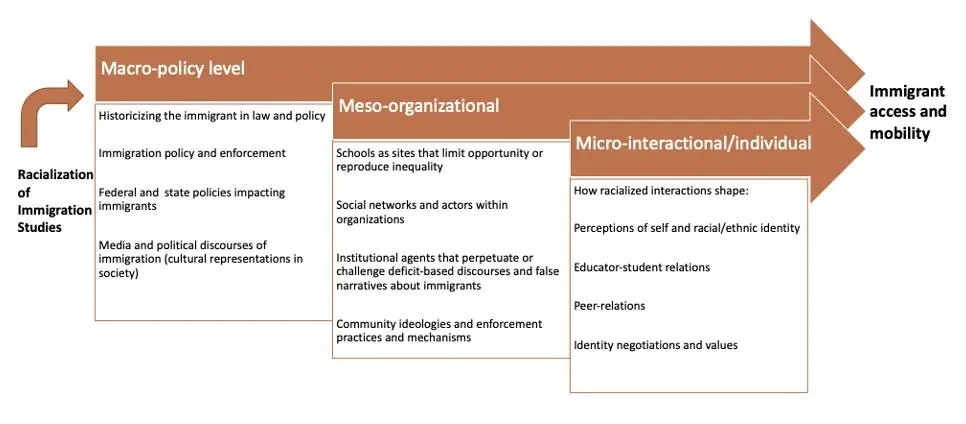
The current study showcases undocumented youth experiences in K12 settings and how they manage their undocumentednessa term I use to underscore the grassroots-level experiences of youth that disrupt essentialized, deficit-based views of them that are often perpetuated through school- and community-based racialization processes that other and exclude them from opportunities and resourcesand transform them in productive ways. Youth build solidarity, exploit discrimination, and access limited resources across multiple levels (i.e., micro-level interactions, meso-level school and community contexts, and macro-level policy constraints). This study contributes conceptually through the multileveled interactional framework, methodologically with the longitudinal ethnography, and populationally. This research is significant because an increasing number of undocumented youth struggle to navigate K12 school systems and develop a sense of belonging in U.S. society, and the assault on their very presence in schools and society is dehumanizing. My contribution bridges a gap between the study of how policies impact undocumented youth in K12 high schools and their communities. This is significant to paint a holistic picture of how policies and institutions interact with youths everyday lives and to show how racialization processes across all levels (Sáenz & Douglass, 2015), impacting youths everyday lives, educational access, and social mobility (see Figure 1).
CONCEPTUAL INFLUENCE(S): LEVELS OF ANALYSIS, CONSTRUCTIONS OF ILLEGALITY, AND RACIALIZATION
I expand our understanding of undocumented youth experiences by building a conceptual framework for analysis to understand the interplay of policies and youths lived experiences and everyday realities. I examine such foci at three distinct but related levels (macro-policy, meso-organizational (school), and micro-interactional; Ray, 2019) and the interplay with the undocumented immigrants racialized experiences. Similarly, Hamann and Vandeyar (2018) contend that what [education and social] policy is cannot be understood apart from what it does (p. 2). In other words, policies and practices are constituted, and then lived by those they impact. Thus, I center youth responses to policies and discourses at one (macro) level, racialized experiences in school and community contexts (meso level), and how they discuss their everyday resistance at the micro level. I advance this multileveled analysis (see Figure 1).
First, I examined how various policiesfederal and statelimited access to higher education and language learning supports in K12 and placed broader limits on social mobility (e.g., racial profiling through show me your papers laws akin to Arizonas law, and denying drivers licenses; Rodriguez & Monreal, 2017). Despite having a right to K12 education, broader state policies criminalized immigrants. In South Carolina, state policy revealed the difficulty for undocumented students to go to college (Roth, 2017). Additional barriers exist for undocumented students such as state policies that criminalize and target Latinx K12 education, which is of low quality across the state. This article shares youth perspectives about the impact of these macro-level policies and how they structure and hinder opportunity.
Second, I investigated the meso-organizational (school) level and how schools supported or failed to support undocumented youth. Third, the micro-level analysis provides youth experiences of discrimination, racism, and lack of quality educational opportunity in schools; youths relations with teachers and other similar youth; and how they enacted forms of resistance through everyday encounters in school. The empirical data that support this include ethnographic participant observation and semistructured interviews with youth, educators, and school and district personnel.
To expand research about undocumented youth experiences in K12 educational settings and society, these three levels ought to be viewed as interrelated, especially because othering and racialization occurred at all levels (i.e., in policy, in school systems and lack of supports, and within/across interactions with educators and community actors such as law enforcement and ICE). I draw from scholars such as Lamont and colleagues (2012), and more recently Victor Rays (2019) similar analytic framework of incorporating racialization processes into the study of organizations such as schools. Brint and Teele (2006) explain that experiences of schooling and advantage can be illuminated through macro (historical and policy), meso (institutional, i.e., school), and micro (interactional and relational) levels and illustrate perspectives of minoritized group disadvantage. I leverage this multilevel analysis to understand the intersection of how policies and schooling institutions bear on and constrain everyday lives and how youth utilize cultural tools to respond to and navigate their community. I utilize ethnographic evidence to show this problem framing [in federal and state policies] and institutional settings [two Title I public high schools] (Lamont et al., 2012, p. 45). Lamont and colleagues (2012) utilize this macro-, meso-, micro-level approach to conceptualize how minoritized groups respond to and negotiate constraints on their everyday lives and personalize accounts of exclusion (Lamont et al., 2012, p. 45). Similarly, Deaux (2006) calls for attention to macro (policy; immigration policy and practices), meso (social networks and links between individual and social structure), and micro (individual values and attitudes) for explaining immigrant experiences of exclusion. Adapting and building from these models, I provide a conceptual base for studying the undocumented youth perspectives that gives texture to the evolving realities and effects of policies and immigration enforcement on youths lives.
Figure 1-Multilevel Analytic Framework for Studying Undocumented Youth Experiences![[39_24000.htm_g/00002.jpg]](https://www.tcrecord.org/Html/39_24000.htm_g/00002.jpg)
This interactional framework shows the intersections of policies, school and community phenomena and practices (e.g., school systems and supports, networks, and ideologies within schools [Deaux, 2006; Ray, 2019]; interactions among undocumented youth, educators and school-based personnel, and peers). This work includes key concepts such as racializationan integral concept and yet underexamined in the immigration research (Omi & Winant, 2014; Ray, 2019). Racialization is a process of othering that reproduces inequality within and across social institutions and social life (Ray, 2019) and has relevance when discussing undocumented youth experiences. Racialization is important because it cuts across all the levels of analysis that impact undocumented youths lives and educational experiences; investigating such othering processes across levels provides insights into the multiple barriers and forms of resistance undocumented youth navigate and develop. Next, I define key concepts and share how I expand discussions of undocumented youth experiences.
THE FLUIDITY OF ILLEGALITY
To expand scholarship, I argue for a multileveled analysis of illegality that considers the interaction of contexts and processes of racialization (Omi & Winant, 2014). Menjivar and Kanstroom (2014) posit that illegality is a fluid concept. Similarly, I begin with the assumption that illegality can be experienced, defined, and lived differently across groups (p. 8). In the present study, I was concerned with youth perspectives and how they resisted the categorization of illegal undocumented immigrant and refused to be defined by their immigration status by challenging normative conceptions of citizenship and deficit-based frameworks circulating in their schools and communities. The data illustrate how this category of illegality is maintained through racialization in policy and practice. Specifically, this interactional framework (Figure 1) shows how the binary of illegal/legal when applied to undocumented youth is lived in punitive ways that impact their belonging because they constantly interface with policies, practices, systems, and ideologies that desire their marginalization. Further, showing how youth are racialized in/through policy and school practices sheds light on how the youth are actively categorized and targeted (De Genova, 2002). To connect the fluidity of illegality, Menjivar (2021) recently explained how policies and immigration enforcement regimes illegalize and racialize Latinas/os. She argues:
Scholars who point to the increasing use of undocumented legal status as a proxy for race and to the centrality of racialization processes in the immigration system argue that the status of illegality is not a race-neutral term; it has become synonymous with Mexicanness and with being Latina/o. And since race is a fundamental organizing principle of social relationships, illegality, like race, has become an axis of stratification with effects similar to those of other social hierarchies. The racialization of illegality, therefore, has real-life consequences for immigrants, their families, and communities. (p. 92)
In this analysis, I consider how the concept of racialization impacts undocumented youth across macro, meso, and micro levels. Next, I further define the concept of racialization in order to contextualize it in relation to undocumented youths educational experiences and mobility in this project.
RACIALIZATION
I call for including racialization as a core lens and process endemic to the experiences of Latinx immigrants broadly and undocumented youth in this study, which is reflected in how racialization influences all levels. Racialization, as a component of the conceptual orientation, also offers a way to understand the material effects of race and racism on racialized immigrant bodies. As Fassin (2011) argues, Racialization processes may be brutal or subtle. They may result in genocides or everyday racism, but also in consciousness and empowerment (p. 421).
Racialization is depicted as a process combining racial ideology and culture with an embodied form of discrimination linked to psychological processes of interiorization and symbolic violence. In other words, it means that individuals assign meaning through social practices and processes to phenotypic characteristics to understand race (Hochman, 2019), or it is seen as a process of racial classification (Omi & Winant, 2014).
In sum, understanding how undocumented youth experience social and legal contradictions, disrupt the binary of legal and illegal (Ybarra, 2018), and exploit racist ideologies and processes of racialization is an important step toward their empowerment. Important for educators and policymakers is linking policies and practices with the impact they have on the everyday lives of undocumented youth. The multilayered analysis here allowed for resistance at the micro level in which youth built their own positive sense of self and belonging by engaging in policy talk and coming to understand their perceptions of citizenship and belonging in a constrained context, accounting for youths racialized immigration status.
METHODOLOGY
DESIGN, CONTEXT, AND SITES
Critical ethnographic research (described below) involves building relationships with participants and a deep understanding of the social, cultural, and political worlds of participants as well as sharing our researcher roles during fieldwork.
South Carolina, an anti-immigrant state in the New Latino South, provided rich sociopolitical and anti-immigrant sentiments that were important to understanding undocumented youths experiences in school and the local community. Lacy and Odem (2009) contend the New Latino South relies on anti-immigration discourse to rationalize juridical and other forms of exclusion. Studying in South Carolina makes significant geographic contributions to the research literature because the state maintains restrictive policies toward immigrants and denies access to many public and social resources. A state saturated with the rich legacy of Jim Crow segregation and its impact on contemporary race relations in the South also renders a racial binary that often ignores the Latinx population (Guerrero, 2017). This unique legacy of segregation and the exploitation of immigrant labor inform the social fabric of the South in ways that reflect local ideologies (Rodriguez, 2018).
Denizen (pseudonym)3 is one of the South Carolina cities that has witnessed significant growth in the immigrant population between 2000 and 2013, with an increase of approximately 74%. Roth and Grace (2015) report that the majority of immigrants in South Carolina (91%) live in just 20 counties, but 10 of these counties account for 76% of the total immigrant population. Although the states immigrant population is concentrated in several counties and metropolitan areas, it is also increasingly geographically dispersed and growing rapidly in nonurban counties, which is reflected in the communities near the two schools in this study. Similar trends related to the increase of immigrant populations in the county where these two schools are located exist. Economic opportunity remains a challenge, with 83% of immigrants who are noncitizens living at the federal poverty line. The bulk of the immigrant population is made up of noncitizens from Latin America; the recently arrived undocumented students are from Central America.
SCHOOL DISTRICT
Denizen County School District (DCSD) serves almost 50,000 students and employs 5520 certified and support staff. From a demographic standpoint, the district serves 23,547 White students (47.1%), 19,536 Black students (39.1%), 4692 Hispanic students (9.4%), and 785 Asian students (1.6%). Additionally, 3851 students are identified as English language learners, and 4778 are identified as special education students. Geographically, the district spans 1000 square miles and incorporates 85 schools across urban, suburban, and rural communities. The district allows for a flexible school choice policy. The public schools such as those in this study had dwindling populations and were 80% or more minoritized populations with limited resources, high teacher and leader turnover, and low support for language learners due to deeply rooted segregation and lack of equity in Title I schools in DCSD. This context shapes immigrant access, outcomes, and mobility.
SCHOOL SITES: CITIZEN NORTH AND DENIZEN WEST
I chose the two sites for this study due to their rising population of Latinx undocumented students. Citizen North witnessed the number of designated English language learners (ELs) significantly increase between 2015 and 2018 from approximately 100 to more than 300 ELs. (This number increased to more than 600 in 2019 after I had completed the study.) Although Denizen West did not witness a significant increase in ELs, the late arrival language learners had limited to nonexistent language support services and zero bilingual staff. Youth at Denizen reported that they were frequently pulled from class to help school staff translate information to parents in Spanish for office staff and counselors, and I observed this in the front office. I also chose these two schools because they were in different parts of the city (i.e., one urban and one rural) and shared similar undocumented student population characteristics, variegated supports, and different forms of exclusion.
The first siteCitizen Northis a large, comprehensive Title I school with nearly 100% minoritized youth, including an influx of recently arrived undocumented immigrants from Central America (e.g., Honduras, Guatemala, and El Salvador). This population was Spanish dominant and had limited access to resources in the community, and many were unaccompanied (without a parent or guardian upon coming to the United States). These youth had been in the country 01 years when I met them. The school itself is located 10 miles north of the urban city center in a historically African American area with most residents living in poverty. The school is surrounded by old abandoned warehouses, gas stations, and car dealerships. It serves the largest area of students in the district, covering a zone of 15 miles, and extends into many rural areas. Many of the youth travel 4560 minutes to school by buses that are decades old. The newcomers at this school were highly isolated in ESL or Spanish classes all morning and segregated in the school building on the second floor without interaction with the rest of the student body.
Table 1. Citizen North High School Characteristics (2017)
|
Description
|
Urban, neighborhood school, Title 1
|
|
Enrollment Total; Number of Teachers
|
1310; 88
|
|
5-Year Graduation Rate
|
56.5%
|
|
Students with Disabilities
|
13.1%
|
|
Poverty Rate
|
81%
|
|
White
|
5%
|
|
African American
|
64%
|
|
Hispanic/Latino/x*
|
30% (20142015, 10%; 20152016, 18%; 20162017, 30%)
|
|
Asian
|
1%
|
|
Number of Students Labeled as ELL**
|
2015: 100; 2016: 140; 2017: 334
|
|
Number of English as a Second Language Teachers***
|
1
|
*The data for this focal racial/ethnic group was provided for all years of the study by school personnel to illustrate the stable increase in this population.
**The data for students designated as language learners was frequently referred to by school personnel to illustrate the increase in the more recently arrived immigrant student language learners. These youth were mostly undocumented.
***Three Spanish teachers were also in the school and often had language learners in their Spanish-as-a-foreign-language classes after completing beginning ESL classes.
The second site, Denizen West, is a uniquely small, rural school that youth refer to as the island school because it is situated on an island about 15 miles west of the urban city center. This island school also has mostly minoritized youth. The Latinx community is long-standing in the area surrounding the school due to the federally funded migrant farms and the nearby poultry industry; undocumented labor is common across the South, despite claims about immigrants threat to economic and national security in state law and policy efforts (Marrow, 2011). Given this history of undocumented labor, the Latinx undocumented youth in the present study have also attended elementary, middle, and now high school on the island together. There is no public transportation to this school. Youth informed me that most of them never leave the island because there is a grocery store and because many of their parents do not own cars; many are ineligible for drivers licenses under state law due to their immigration status (Rodriguez, 2018; Rodriguez & Monreal, 2017). Unlike the first site, the youth on the island live in nearby trailer parks tucked away from the main road and walk to the school.
Table 2. Denizen West High School Characteristics (2017)
|
Description
|
Rural, neighborhood school, Title I
|
|
Enrollment Total; Number of Teachers
|
313; 33
|
|
5-Year Graduation Rate
|
72%
|
|
Students with Disabilities
|
12%
|
|
Poverty Rate
|
74%
|
|
White
|
10%
|
|
African American
|
66%
|
|
Hispanic/Latino/x
|
24%
|
|
Asian
|
0%
|
|
Number of Students Labeled as ELL
|
2015: 86; 2016: 90; 2017: 104
|
|
Number of English as a Second Language Teachers
|
No ESL observed.
|
Lastly, the school district website provided limited information on the public schools and communities even about demographics. The youth helped me understand the context in which they lived and experienced school in relation to the larger structural barriers and inequalities in this community. For instance, youth from Denizen West described their island community as a white-topia, with an increase in subdivisions and new apartments. One of the Latinx youth commented on the shift, saying:
I dont care color of peoples skin thats moving here honestly. My problem with it is that they move here but wont send their kids here [to Denizen West], so the island is good enough for you to live but its not good enough for you to help? You see what Im saying? (interview, 5/7/17)
Meanwhile, youth described Citizen North as hidden from the rest of the beautiful landscape of Denizen. One youth said, You see what surrounds our school? We got ICE in the parking lots and car dealerships. Its not like the rest of Denizen (interview, 2/20/16).
RESEARCH QUESTIONS
The purpose of the study was to elicit Latinx undocumented immigrant youth experiences in a southern state to contribute to evolving research on their experiences in K12 schools in an understudied geographic location. The study employed a multisite critical ethnography methodology because it is useful when analyzing sensitive issues such as restrictive immigration policies and a lack of institutional support in a local district; such methodologies bring attention to power relations and marginalized voices (Hamann & Vandeyar, 2018; LeCompte & Schensul, 2010). The critical ethnographic study had three research questions that align with the levels of analysis described earlier:
1.
How do undocumented youth talk about the policies that impact their daily lives? What levels of policy awareness do they exhibit, and what are the policy effects they experience? (Macro-policy level and how youth navigate this level)
2.
How do youth perceive the organizational-level structures that exist to support recently arrived undocumented youth in their school and community contexts? (Meso-organizational level and youth responses to it)
3.
To what extent do undocumented youth articulate a sense of belonging through their community and school interactions in relation to processes of racialization and its impact on immigration status? (Micro-interactional level)
To answer these research questions, I conducted a multisite critical ethnographic study with nearly four years of fieldwork. With knowledge of the sociopolitical context, Atkinson et al. (2007) argue, the aim [of critical ethnography] is to theorize social structural constraints and human agency, as well as the interrelationship between structure and agency in order to consider paths towards empowerment of the researched (p. 193). Focusing on hidden youth voices reveals how policy affects their lived experiences and also provides insight into how youth are constrained and excluded within the multilevel framework of analysis that I pursued.
RESEARCHER ROLE AND DATA COLLECTION
Although I have extensively reflected on my role as a researcher and advocate for immigrant students elsewhere (Rodriguez, 2020a, 2020b, 2021), I entered the field as a former English-as-a-second language teacher in Chicago and English teacher in New York City public schools. I visited the sites multiple times to introduce myself and to talk with critical personnel, including ESL teachers and coordinators, social workers, and counselors. I shared my own struggles teaching in under-resourced public schools and volunteered to help students with homework or assignments at both schools in ESL classes and in the social workers office, where many youth spent much of their day for support (Rodriguez, 2020b). To connect with youth, I shared my own experiences growing up as a child of a foreign-born immigrant (my father came to the United States from Cuba). Although growing up mixed race and in poverty had its differences from the undocumented youth in the studynamely that I had the privilege of U.S. citizenshipthe stories we shared in common outweighed our differences. However, I centered youth as experts of their experience and interrogated power differentials among us. I learned the policy landscape they navigated and shared research with them to help them advocate for their educational rights (Rodriguez & McCorkle, 2020),
The data collection process involved extensive fieldwork at the two school sites from 2015 to 2018. The data sources included: (1) field notes from approximately 800+ hours of participant observations at two Title I high schools; (2) semistructured group and individual interviews with undocumented Latinx youth (n = 63); (3) semistructured interviews with district personnel who worked with language learners, teachers, and school principals; (4) questionnaires related to policy awareness and immigrants rights; (5) student artifacts such as their projects in classes; (6) a statewide survey of public school teachers awareness of policies impacting undocumented students (Rodriguez & McCorkle, 2019, 2020); and (7) discourse analysis of state-level policies impacting undocumented immigrants (Rodriguez, 2018; Rodriguez & Monreal, 2017).
Fieldwork
Ethnographic research involves extensive fieldwork to understand the cultural worlds and social relations of participants, and to see, hear, and feel the social life subjects see (Atkinson et al., 2007, p. 32; LeCompte & Schensul, 2010); my study also looked to understand how undocumented youths everyday lives were impacted by macro-, meso-, and micro-level policies and interactions. An example is observing the newcomers bringing their immigration paperwork to Ms. Rojas or Ms. Ava and asking them to interpret it, and seeing their tears as they asked, Ms. Ava, Puedo ir a la escuela? Qué significa eso? [Can I come to school? What does this mean?] (fieldnotes, 2/2015). After the 2016 election, many did not attend school out of fear; they would ask, Sin papeles, sere deportardo? [Im without papers, will I get deported?]. These insights were critical for understanding the impact of policies and laws on their everyday lives.
I engaged in participant observation primarily at the school sites and occasionally at community or activist events during the study. I attended information sessions with attorneys and local community members regarding immigrants rights and deportation proceedings. Aligned with critical ethnographic research, I positioned myself as an advocate and a resource, so I also would connect school-based personnel with attorneys, if needed. Some students from Denizen West had parents deported during and prior to the study; at Citizen North, several students in the classes I had observed were deported. Typically, I spent two to three days a week at the schools, either visiting both in the same day for three to four hours or alternating days for longer periods. After the 2016 election, I spent more extensive time at each school and in classrooms discussing the election and what it meant for the youth and their families. Many undocumented youth did not come to school in the weeks following the 2016 election out of fear, given the local immigration surveillance in the community (Rodriguez et al., 2020).
Semistructured Interviews
I conducted individual (n = 63) and group semistructured ethnographic interviews with youth at each school. All were interviewed by me one time, and then a subset of youth was interviewed multiple times to expand on previous interviews and participant observations. Questions were provided to youth in Spanish and English. Typically, interviews lasted between 45 and 60 minutes; in the latter months of the study (postelection), group interviews lasted 60120 minutes in social worker or counselor offices, or at various other locations in the schools. I developed an interview protocol with questions related to immigration journeys, policy awareness, identity, and belonging. Group interviews with youth utilized a semistructured interview protocol to elicit standard answers across particular domains of inquiry (e.g., policy awareness, immigrants rights, and border crossing stories). I also interviewed educators and leaders who worked directly with students and district-level employees.
YOUTH-PARTICIPANT CHARACTERISTICS
The larger sample (n = 63) included youth from Ecuador, Guatemala, Honduras, El Salvador, Mexico, and Peru. The youth selected for this article represent the larger sample insofar as they are undocumented and attend the two public schools in South Carolina. Most of the students at Denizen West identified as Mexican and spoke English with Spanish as their native language. Meanwhile, the newcomers at Citizen North were largely from Guatemala, Honduras, and El Salvador and were Spanish-dominant. Given the number of instances in which these youth directly dealt with ICE and immigration, or had had family members deported or with pending hearings, these youth also provided insight into the broader forms of exclusion of the undocumented populations at their schools and thus were ripe to narrate.
DATA ANALYSIS
The analysis in this project was iterative. All data sources were uploaded into the qualitative software program NVivo. I stored data by school site in order to effectively manage it with nodes labeled by school and then within school subfolders with labels such as FN for fieldnotes by date, interviews, student artifacts, and policies. Coding is an important strategy in ethnographic studies (Saldaña, 2013).
First, I used an open-coding strategy to analyze field notes from participant observations and all interviews. Open coding allowed me to identify the codes such as policy, migration journeys, the better life narrative, identity, and belonging without any restrictions. Other open codes that emerged initially included equity, access, and youth policy talk, meaning instances in which youth ask questions about or articulate and challenge current immigration or education policy that they felt impacted them. The additional codes such as instances of discrimination or racial/ethnic oppression, inclusion in or exclusion from school or society, bullying, teacherstudent relations, citizenship, and immigration status were also marked during phase one. Phase one also included many of my initial interviews with youth, so the emergent codes related to migration journeys, better life, identity related to immigration status, and belonging to school and society were important to explore in order to understand the lifeworlds of participants and the slices of social life recorded in the data (Saldaña, 2013, p. 15). This process of grouping multiple codes that are interrelated is important because it allows the researcher to create families (p. 15) of codes to grasp and then later render meaning (Geertz, 1973, p. 10).
During the second phase I drew on the research literaturespecifically for my theoretical framing of youth responses to macro-, meso-, and micro-level perspectives, incidents, and interactions and racializationand applied these conceptual influences to youth meaning-making processes and articulations (LeCompte & Schensul, 2010). I linked the data and the conceptual framework of the three tiers of analysis showing the interaction among policy, schoolcommunity experiences, and relationships among youth and educators to identify four themes that correspond with the levels in my conceptual framework and the research questions (Table 3).
Table 3. Thematic Analysis, Conceptual Framework, and Research Question Alignment
|
Theme
|
Corresponding Level of Analysis from Conceptual Framework
|
Research Question
|
|
1.
Policy awareness
|
Macro-policy level (youths perceptions of the impact of policy)
|
RQ 1
|
|
2.
Encounters and risks in their lives/constraints on everyday lives
|
Macro-policy level (how policies and enforcement practices impact youth)
|
RQ 1
|
|
3.
Organizational/institutional supports in schools and community
|
Meso-organizational level
|
RQ 2
|
|
4.
Identity negotiations: disrupting normative views of citizenship
|
Micro-interactional level
|
RQ 3
|
This paper presents findings from each of these themes. In discussing policy awareness, risks/constraints, and lack of supports in schools, youth were responding to frameworks of illegality. In other words, I report their perceptions of how their immigration status and immigration policies and practices affect them. This means the category of illegalityimposed from macro-level policies and immigration enforcement practicescreated challenges in their everyday lives and perceptions of belonging and identity, and they felt excluded and criminalized. Through the multilayered analysis here, I show how youths mobility and belonging were inhibited by state and federal policies as well as by school-based practices and interactions. In the final theme presented below, I argue that youth resist and disrupt the frames of illegality and racialization. Although these research questions are significantly in-depth, it became critical to paint the full picture of this southern context of South Carolina, a unique constellation of relationships, policies, and school systems (macro, meso, and micro contexts) that impede undocumented immigrants rights and educational and social mobility.
FINDINGS
POLICY AWARENESS (MACRO)
Scholars have noted that many undocumented youth do not know their immigration status, the policies that create the categories related to status, or the deeper effects of that status until later in their adolescence (Gonzales, 2016). However, the high schoolaged youth in this study were aware of their status and the U.S. ideologies and policies shaping their experience in South Carolina. Discussing this topic, newly arrived youth at Citizen North reported (Y = youth; I = interviewer):
Y1: This state is racist.
Y2: Yeah, I break the law everyday. I have to [to drive to work].
Y3: The state wants Hispanics to do their work for them, but we cant go to school without being afraid? That is ignorance.
Y4: I am like stuck. I have scholarships to four state schools and cannot attend any of them. Here, they are ignorant of Hispanics. I dont have papers, but I am smart. Coming here when I did is just different.
Y1: Its just hard here. Were free [from the problems in Honduras] but not free at the same time.
Y2: Immigration knocks at the door; they raid the apartments like were criminals.
Y1: They dont want to have a real solution for us being here, but they want us to do the work
they dont want to do. (group interview, 2/2016)
Similarly, a group of youth from Denizen West, both new arrivals and those who had been in the United States for 12 years, commented:
Y2: The state is racist. I came here because of my family.
Y3: Well for mine its because they have a lot of friends working for the company here and thats where the most work is here and its a city here.
Y2: Because here the majority of the jobs follow minimum wage.
I: So, it sounds like primarily work reasons to come to South Carolina?
Y3: Okay Ill explain it to you, the majority of the people who have the Mexicans, well the Hispanics, work for them but they dont like to pay them. Why? Because they like the effort Mexicans put into the work. The white people like like to have them because they work well but then they dont want to help us live better.
I: Uh-huh.
Y3: When an American doesnt know how to do something they leave it. Why? They dont want to have a real solution for us being here, but they want us to do the work they dont want to do.
I: Uh-huh.
Y1: Yeah.
Y3: Why? The Hispanics work; they work for their family, and they work . . . they dont care about anything more than providing food for their family, send them money and it doesnt matter to them to be in the sun and go home late to count the money they send to their family and they never complain they just work and work and they make sacrifices for their children.
Y4: We were feeling free after my dad got deported, being free and we could drive and be calm. But, my dad has now come back. Since he was already deported now he cant drive and he cant . . . he didnt have anything not even his name. Its just hard here. Were free [from the problems in Honduras] but not free at the same time. (group interview, 4/2016)
At both school sites, undocumented youth spent time trying to understand their rights in South Carolina. Their policy awareness was evident in how they talked about how the United States and the state enacted racist policies from their perspectives and how they didnt have solutions for us. In addition, youth also pointed out the paradoxical positioning of being in the United States for a better life but then feeling stuck, being both problems to be dealt with and potentially useful economically. They would often bring immigration paperwork to the teachers or school social workers to help interpret it, not knowing if they had rights, the risk of deportation, or threat of family separation. Confounding their experience was the obtuse immigration system and set of practices that they also had to navigate. Related to policy awareness and rights, youth (Y) reported:
From Denizen West:
Y1: No, we dont have rights. No because . . . because here no one follows through with what they say they will do. During the elections everyone says they will do a lot of things but at the moment no one does what they say they will do and only want to do harm, especially to the Hispanics just for being Hispanic.
Y2: The hope of us, including myself, is that they will make us legal, recognizing our effort because all of us Hispanics work very hard. (fieldnotes, 5/2017)
From Citizen North:
Y1: The hope of all of us Hispanics is that that our effort will be considered for how much it matters and the value of it, when we go to the hospital we will be attended to like everyone else, like everyone else someday we will have equality.
Y2: Well, regarding rights, everyone whether or not they have documents has rights; they do not have to humiliate us. Some policies help us, like here in school they give us resources and support us with tools for school. But, then, we leave school and we have no help. (group interview, 5/2017)
RISK THEIR LIVES/CONSTRAINTS ON EVERYDAY LIVES: IMMIGRATION ENFORCEMENT AS POLICY PRACTICE (MACRO)
Along with expressing policy awareness about the impact of their status, youth also reported how specific policies and practices enacted by law and immigration enforcement affected their everyday lives. In some cases they felt they were risking their lives to do very mundane activities, such as going to the grocery store or driving in a car with a family member. For example, youth from Denizen West and Citizen North reported:
Denizen West:
Egalite (Eggie): I didnt know about the drivers license thing here, and me and Amelia were talking about it. She was telling me about how her brother got pulled over, and I thought, Yeah, hes living on the edge. Hes risking everything just to go to work.
Amelia: Yeah, my mom cant read English and when my brother got pulled over, I was so mad. The first thing they asked is if he was a criminal cuz you know he looks really Hispanic and apparently, hes a criminal. But, also was breaking the law cuz he doesnt have a license and cant get one.
Amelia: There are such a lot of people out here that are like, Oh you know, when I go to the grocery store I get everything I need so I wont have to go much, or I get gas and everything so I wont have to stop. My dad is always like, The cops are always in the mornings, just because theres a lot of traffic and crazy people being late. Theyre always right by the gas station here so we dont get gas or groceries in the morning, ever [impact on their timing to go to the store]. (group interview, 3/2017)
Citizen North:
Manny: Yea, I break the law every day to drive my family to work, sin papeles [without papers]. (interview, 4/2016)
Here, youth refer to South Carolinas show me your papers law (Rodriguez & Monreal 2017), which is similar to the law in Arizonatwo of the most restrictive states toward immigrants, both of which maintain policies that disproportionately target Latinx immigrants and increase the impact of immigration enforcement (IE) through legally sanctioned racial intimidation laws. Continuing to explain how policies constrain the everyday lives of undocumented youth at the community level, Amelia explained:
Amelia: My dad got pulled him over and the cop was like, You just did this and this and that, and my dad was like, I had the right to do that, thats okay, I have the right to do that [related to him turning at an intersection as the light turned red]. He was like, No, no you didnt, you didnt have the right. I caught you. He takes him out the car, takes pictures of him on his phone, and is like Be ready for a call, my buddies are going to call you, which is immigration. And I was like [silent and shakes her head] . . . I was so mad.
I: Did they ask him for his papers? [SB 20, papers please provision]
Amelia: No, they just asked him for identification.
I: Did he have identification?
Amelia: Yeah, but of course not real but he had one. . . .
I: Hmm.
Amelia: That was crazy. I thought that was just insane, I was like Youre going too far with this. They take you out the car, taking pictures of you on his phone, and then say Youre waiting on a call, my buddies are gonna call you, immigration will call you. What the *%$&?! (interview, 3/2017)
Similarly, Gabby, along with Juan and Ana, described how she and undocumented immigrants in her community encountered local law enforcement and ICE in this restrictive, anti-immigrant state. She explained an incident in which ICE was waiting outside her house.
Gabby: My mom was gonna drop off my sister at school. Then, I just hear everybody running back in the door. And Im like, What’s going on? And theres some people out there, white guys in blacked out Tahoes, and we dont know whats going on. My mom said, Its immigration. Just open the door. I didnt know anything. We had to go to courts, after courts, after courts. We were tired. There was a time where my mom had to be by the phone every single Thursday from a certain time. I dont know if you heard about that. Immigration does that. To make sure youre still here. You havent left.
Ana: The way they control you.
Gabby: Right. Then they would stay outside our house at three in the morning, two in the morning, parked outside just watching in case we left. Were already scared. You know, were not gonna leave. Why are you outside my yard at three in the morning?
I: Did you have an attorney?
Gabby: We did but he wasnt very good. I feel like that whole system . . . That whole time was just . . . You dont understand anything thats going on. And there was like . . . When I remember going to the immigration office when it used to be downtown. They were just so mean. So racist. It was insane. You could . . .
Juan: You could feel it.
I: Can you describe that a little more?
Gabby: Yeah, you could see it. They didnt care. They would just do it. But, you being so scared and being so little, you do what they say. We werent really aware. We were so . . . now that I think about it, Im like, Dang, if they would come to my house now . . . Hell no, Im not gonna open the door.
Juan: But, you dont know your rights.
Gabby: I have my rights. You need a warrant. You need something. You cant just come.
Ana: Dont open your door. You can say, Slide it under the door. Show it through the window.
Gabby: And then when my dad was deported, they were waiting for him outside at the stop sign leaving my neighborhood. We needed to know our rights. (interview, 03/22/17)
This excerpt shows how Gabbys family was under surveillance in the Denizen community and struggled at times to know their rights. While Gabby shared this particular incident, Juan and Ana listened and affirmed similar experiences and encounters with local law and immigration enforcement, underscoring the intersection of anti-immigrant policies at the state levels (macro), trickling down into the community (meso) level and generating discriminatory affects upon the youth and their families everyday lives. The youth felt surveilled in their community and also explained the racist and discriminatory undertones used by immigration and law enforcement, which made basic activities such as running errands stressful.
ORGANIZATION/INSTITUTIONAL SUPPORTS/CONSTRAINTS (MESO)
As youth articulated the effects of policies and immigration and law enforcement practices, they also described the meso-level supports they did and did not feel existed. At both school and community levels, youth reported contested experiences about how school personnel, educators, and systems hindered or helped them access educational or social resources. In other words, in school they felt support, usually emotional or empathetic, from some educators and school social workers (Rodriguez, Monreal & Howard, 2020), but they also encountered many educators who did not understand the impact of their undocumented status or who did not have adequate or accurate knowledge of policies impacting undocumented communities (such as the restrictive state laws (Rodriguez, 2018). Some educators lack of awareness was felt by the youth and reported throughout the study. In the examples at the school levels, at Denizen West, one youth (Louisa) said:
I feel like theres no real understanding. Maybe if there was an understanding of whats really going on, there would be help. I feel like that plays a lot towards nobody helping. Theres really no real support. I feel like the students that just arrived or are here and really need that extra help and things like that, I feel like there really is no help for them. We have each other. (interview, 2016)
I observed no ESL classes or language programs despite the language-learning population at the schools. While we were in Cookies (a school social workers) office, I asked students if they had any language support classes. Louisa, Amelia, and Ana laughed, and Ana said, Were supposed to have some lady come to help us. She goes to different schools (fieldnotes, 4/2017). When I followed up with Cookie about this lady, she said that the district assigned a teacher who came to Denizen West once a week. The youth reported they had not met her, and I did not meet her in the nearly four years I studied at the school. Moreover, when I interviewed the district-level ESL employee about the lack of language services, he said: Look, [Sophia], my hands are tied, in terms of his ability to advocate for language learners who had significant needs that the district was not prepared to address (interview, 1/2018).
Similarly, Alma discussed how she had to take the ESL test every year but I never had an ESL class at school (interview, 3/2018). Several youth also commented that even if they take AP classes or higher classes, we dont have a lot of options (interview, 3/2018). This latter example speaks to the limited supports in school, but Alma also offered that without Social Security numbers it is challenging for undocumented youth to take community-college courses, which links to how these meso-level systems (i.e., lack of course options, lack of ESL, lack of access to postsecondary education) restrict their mobility.
Another meso- or systems-level constraint was the lack of bilingual support staff in the district and these schools. Pablo shared:
The other day the guidance counselor was asking me for help cuz she was trying to get a student, who was undocumented, . . . if they could receive financial aid and I was like I kinda know the overall, but I dont know the details. And I dont know all South Carolina policies. Like, she didnt even know anything or what the immigration status part was about, and this Latino was in her office. Like [rolls eyes]. (interview, 3/2017)
Pablo explained that he was often pulled out of classes to translate for the guidance counselors at Citizen as well, which other students experienced as part of the assumption that they all have the same immigration issues without regard for the privacy of individual students.
Despite institutional inequities, youth at Denizen West noted strong relationships and specific networks of support. For example, the school social worker, Cookie, often went above and beyond her role to help them navigate the law without breaking it, as she said. One youth, Alicia, explained: With Cookie, I can talk more in depth of more personal stuff. With my teachers I kinda feel mmm, not really sure how to talk to them about it cuz I dont know what they know (interview, 2/2016). Contributing to youths lack of trust in the school context at Denizen West, I observed four principals in the 3.5-year study, which challenged the implementation of change and equity-oriented services for Latinx youth. In the final three months of the study, a bilingual White male principal started; the youth thought he was better than the previous ones who leave, citing his previous work with Latinx youth as a reason he could understand the families (Cookie, 2/2018). Despite reports of systems-level inequities (i.e., lack of ESL, bilingual staff, and academic supports), the youth shared that some teachers and other school actors cared or helped try to figure out how to go to college without papers (Pedro, 3/2018).
One youth at Denizen West explained an incident about a Latinx student returning to school from Mexico.
He said:
A kid returned from visiting Mexico, hes a U.S. citizen by the way, and the teacher said, They let you back in the country? in front of the class. Amelia was like What did you say [to the teacher]? The teacher said, You know how Muslims are not let back into the country under Trump? We [Amelia speaking] were like, Whaaattt! This is the problem. You will never know what its like to have to forget or defend WHO YOU ARE because of the COLOR of your SKIN! [emphasis added where youth raised their voices] (fieldnotes, 3/22/17)
In another incident, the youth described similar microaggressions:
The teacher kept telling the student to sit down and stop talking. This was a student who wasnt born here, too. Maria said, I will do it, just chill. The teacher got upset and said, That is why they are building a . . . . She didnt finish the sentence, but it was obvious what she was trying to say. The student said, finish what you were gonna say. (fieldnotes, 3/22/17)
The references to building a wall and asking if a student was let back into the country are deeply troubling incidents that discourage youth from building relationships and feeling a sense of belonging to the school.
Although these examples are innocuous to some extent (well-meaning guidance counselors removing Pablo from a class because they assumed he was undocumented and could speak Spanish to a parent about financial aid struggles), they illustrate school-based personnels lack of awareness at school levels about immigration status, policies impacting students, and potential fears and challenges in the community of students. Research shows how lack of awareness correlates with educators negative attitudes and inequities in resource distribution based on actual needs of students, and can preclude youth from tapping into important social networks within meso-level organizations (Deaux, 2006). Undocumented youth reported significant negative experiences within schools related to the lack of language services, access to resources, and anti-immigrant or color-evasive attitudes and sentiments. Youths sense of belonging and school engagement was limited by negative encounters with educators, which to them reflected a lack of overall awareness and understanding (as Louisa noted earlier).
IDENTITY NEGOTIATIONS: DISRUPTING NORMATIVE VIEWS OF CITIZENSHIP AS RESISTANCE (MICRO)
Youth grappling with the topic of citizenship arose frequently in several ways. First, youth referred to citizenship as a problematic category that determines which resources, if any, are available. This was echoed by youth earlier when they said, They want us to do the work they dont want to do, but they dont want to have a solution for us? (group interview, 2/2016). As youth reflected upon and gained awareness about how immigration policies and citizenship status impacted them, they expressed citizenship as narrowly defined. Amelia said, How are we illegal while others said, We do the work they dont want to do, which exploits the hypocrisy of normative definitions of citizenship (i.e., the legal/illegal binary). For instance, a youth at Denizen West said, We misuse our citizenship. Like give it to my dad. I feel like he deserves a lot more than he has. Alicia then reflected on how citizenship (a normative status) is a policy problem for undocumented families (interview, 2/2015).
Second, citizenship was not necessarily seen as a privilege, as youth witnessed the criminalization of immigrants in South Carolina and the larger U.S. context. This sentiment complicates traditional definitions of citizenship and points to how categories and processes of citizenship are racialized (FitzGerald, 2017), which is important to the conceptual framework and contribution in this project. In the context of the South, normative citizenship definitions are employed to set up categories of deservingness, excluding immigrants from resources that support mobility. In this way, Gabby illustrates the complexity and racialization of citizenship toward Latinx immigrants, saying, I feel like for society, its like, Whos a different color? Oh, youre Hispanic, and then thats, Oh, you’re probably not a citizen. Even if you are, youre still going to be pointed as if youre not, you know? Even being a citizen is not a privilege here (interview, 3/2017).
In addition to youth expressing views about citizenship, I asked about how they see themselves as part of a larger community and what, if any, opportunities for social justice they hope to work toward. I asked youth why they chose to share their stories throughout the study. Gabby explained:
I didnt talk about my familys situation before because I was scared of risking my familys legal case and fear of being deported. I also didnt have anyone to talk about my familys situation and when youre put through something so traumatic as that its hard to trust anyone, so I didnt trust anyone. Though that fear and trust issues (I guess you can say) became less of a problem as I grew older and started to see more situations like mine and only to come to find out that their stories were being hushed just like mine. Our conversations are helpful. They only made me realize the importance of telling my story and the rush to get it out there because with all the injustices happening around us and only being hushed, that just couldnt keep on happening and thats when I understood I had to step up and speak up but most importantly that its ok to do so. I feel like the main reason I wanted to share my experiences in your research context was because Im seeking justicesetting a platform, to encourage others to do the same because that way we are bound to make great changes. (interview, 4/2017)
This youth is troubled by her status and how it deeply connects with her identity. She has to negotiate being proud of it and wanting to help others as part of a larger social movement of undocumented resistance; however, she is ineligible for DACA because she did not meet the age requirements for the program, and youth are restricted in South Carolina regardless of eligibility (Roth, 2017). She and others feel as though gaining policy awareness and building solidarity is a form of resistance. Amelia commented:
We are building a movement even if small, were here. I feel like just the situation that I was in. It was just like no justice. I feel like thats just what drove me to be an activist. What we are doing here with you in Cookies office is getting more knowledge about our rights. We can change what they think about us. (interview, 5/2017)
These perspectives about citizenship were varied and show the ways youth perceive the privilege and precariousness of citizenship.
DISCUSSION AND IMPLICATIONS
SYSTEMS FAILURE
The previous data address the three overarching research questions and speak to how youth experience various forms of systemic oppression, racialized surveillance, and increased risks to their engagement in everyday activities, and how their identities are influenced by factors contributing to racialization (i.e., encounters with immigration enforcement and educators in community and school contexts). The topical and conceptual contributions in this article offer researchers and educators a window into the everyday lives of undocumented youth by examining how the racialization of the illegality is deeply impacted by policies, organizational practices and ideologies, and interactions. Specifically, the intersection of macro-level policies, at state and local levels, meso-level organizations and their actors and networks of support, and micro-level lived experiences offer a critical contribution to the field. Moreover, the multileveled analysis, aligned to the research questions, enables us to see the racialized policy effects on undocumented youths lives, well-being, and educational and social mobility.
The critical insights contribute to research on immigrant youth and education, including policy awareness and how policies constrain everyday lives; institutional supports (or lack of), including at school and community levels; and how youths perceptions and interactions disrupt normative views of citizenship. From these themes, key findings first show how policies enshrine a deep culture of surveillance and targeting of Latinx immigrants in Denizen, as well as how youth perceive policies and their effects. For instance, youth noted, This state is racist, commenting, They dont want to have a real solution for us being here, but they want us to do the work they dont want to do. This awareness of policy and how it impacts youth exposes an important contradiction in the United States treatment of immigrant labor as valuable but then dehumanizing them and restricting access to resources.
Second, the effects of anti-immigrant, racialized policies are significant. Gabby noted how ICE [w]ould stay outside our house at three in the morning, parked outside just watching. This effect of immigration enforcement made youth feel like they risk everything just to go to work, as Egalite said. These insights contribute to the burgeoning research on the effects of immigration experience on school attendance (Ee & Gándara, 2019; Verma et al., 2017) and overall school and community belonging, and the impact of immigration enforcement and surveillance, constraining youths everyday lives and seemingly mundane activities like going to work or the grocery store and driving a car.
Third, and compounding the unbelonging youth feel at the societal and community level, the ethnographic evidence of the variation of school support and, in many instances, the lack of educator awareness about policies impacted students well-being and belonging, called into question potential aspirations and postsecondary opportunities. These latter items are consistent with previous studies that investigated teachers encounters with and support for undocumented students (Dabach, 2015; Jefferies & Dabach, 2014). Support varied, and in some cases, youths responses revealed exclusionary and/or racialized views from educators in their schools, such as when youth reported a teacher saying, They let you back into the country, to a U.S. citizen with a Mexican background. In other cases, youth did not have adults in the building they trusted aside from a select few. For example, Alicia commented on a school social workers help, saying, With [Cookie], I can talk about personal stuff. With my teachers, Im not really sure how to talk to them about it cuz I dont know what they know. This decision-making around when and to whom to disclose immigration status, especially in hostile or anti-immigrant school and community spaces, warrants further inquiry because it is another way inequity toward undocumented students is reproduced in schools, resources are restricted, and access limited. Although K12 supports are needed, and recent research shows the importance that key personnel play in helping immigrant youth navigate resources (Murillo, 2017), this study provides direct evidence of the harmful effects of educators lack of awareness and of their racial ideology on youth. This research shows the need for further understanding of how educators can increase awareness and advocacy for immigrant youth and leverage networks of support, such as with other school-based personnel, to promote equity (Mangual Figueroa, 2017).
Fourth, negotiating identitiesand the conflated status marker of and ideologies about their undocumentednessis a continual component of undocumented youths lives (Rodriguez, 2020a). They contend that their Latinx (racial/ethnic) identity makes them unwanted in South Carolina as Hispanics even though they do the work others dont want to do. They also grapple with the meaning of immigration and citizenship status, what it means for their identity, and whether or not it is a privilege. Youths perspectives, and policy and civic awareness, disrupt normative views of citizenship. Although previous research shares how teachers talk about citizenship with undocumented students and challenges they have and mistakes they make (Dabach, 2015), or how citizenship becomes normative within the classroom context despite a lack of educator awareness or precariousness of mixed-status-ness in families (Mangual Figueroa, 2017), I showed what undocumented youths perceptions of the category of citizenship mean and the limits beyond the legal/illegal citizen/noncitizen binaries that are often discussed. From youth perspectives, the category of citizenship is problematic in two ways, the obvious one being how it directly limits their everyday experiences (e.g., ICE threats/deportation or accessing school resources such as paid jobs or future postsecondary opportunities) given that Denizen is in a restrictive policy context. But surprisingly, and thus far not reported in prior research, youth disrupted normative views of citizenship by exploiting the larger criminalization and racialization of Latinx immigrants in the community, city, and larger state context. As youth argued, Even being a citizen is not a privilege if youre an immigrant here, which refers to the larger criminalization of immigrants and racialization of Latinx in anti-immigrant contexts. This finding provides a more nuanced account of undocumented youths perceptions of citizenship as a normative category and its precarity in both nontraditional receiving contexts like the U.S. South (Hamann et al., 2015) and the larger anti-immigrant racialized political climate. Youth acknowledge the importance of citizenship status, but also indicate that it is a set of social and relational practices that build capital (i.e., community organizing and building youth coalitions in their school and community), rather than a privilege within the Latinx community. This complicates our understanding of the status of undocumented immigrant youth and their hopes for systemic immigration policy reform amid dire policy realities and restrictive contexts like states in the New Latino South, especially because undocumented newcomer populations such as those in this study are ineligible for even the most precarious programs like DACA. Similar to Abregos (2019) recent discussion, citizenship is relational and socially constructed through familial and communal understandings for the undocumented youth here. Additional research should seek deeper understandings of how citizenship is a racialized category (FitzGerald, 2017; Molina, 2014).
Additionally, this studys conceptual framework offers a key contribution and implications from which to examine undocumented immigrants and education, specifically the productive use of the conceptual framework of the racialization of contexts of reception; the deep investigation of macro, meso, and micro levels of analysis; and their implications for educators and school-based personnel. The need to have an interactional framework that accounts for racialization advances the conversation beyond just pointing out that contexts of reception matter and vary, which is the commonplace approach in sociology and anthropology of immigration and education studies. There must be more focus on how racialization processes manifest in policy-making/enactment, school- and community-level practices, and interactions among peers and educators in schools. To date, scholarship has analyzed policies at federal and state levels, the impact of immigration enforcement on school attendance, and educator encounters with undocumented students, but less has focused on high school youth and their experiences in policy, school, and relational contexts. Looking across levels shows youth also reflected on the larger criminalization and surveillance apparatus that reinforces racialized identities and structures that youth experienced and commented about.
In this article, I outlined school- and community-based examples of racialization and how youth made sense of and responded to these incidents. The results demonstrate how participants displayed resistance to racial ideology in local policies and actions of law enforcement, their school, and the community by understanding the embodiment of their racialized identities, interpretation, and agency. In other words, youth articulated how macro-, meso-, and micro-level policies, practices, and relations supported or hindered their belonging and connection to schools and communities. These articulations illustrate how they are perceived and what these identities mean in the larger racialized social structure and anti-immigrant policy landscape. Understanding policy effects, institutional supports (or lack thereof), and interactions at institutions and communities that increase belonging or equitable access to resources is critical for increasing youths sense of belonging and potentially reducing inequalities they face. In addition, youths interpretations and responses to the larger racialized contexts are crucial information for policymakers and educators so they can gain awareness, shift attitudes, promote equity in schools, and combat racist policies and practices.
To reiterate, first, this study fills a gap in examining the intersection of policy and lived experience. Much scholarship has examined migrant young adults who are college-going and DACAmented (Gonzales, 2016) and the impact of immigration status on postsecondary aspirations and adulthood. Instead, this study shows the impact of status and enforcement policies and practices on families and high-school-aged youths everyday experiences of belonging and the racialized and discriminatory nature of policies and practices.
Second, the studys interactional framework examines multiple tiers of analysis in relation to undocumented youth at the grassroots level. This framework moves beyond the commonly used context of reception and master status of illegality work in sociocultural and educational research to account for racialization processes that target Latinx undocumented youth in policy and school contexts, and how their ethnographic narratives disrupt normative views of citizenship and inequitable policymaking and school practice.
Third, the utility of this framework is evident because it views policy as something more than an abstraction. It underscores the significant effects of policy that can be empirically understood with the ethnographic evidence (Ball, 1994; Foucault, 1985). A fourth implication of this framework is that it allows researchers to investigate nuanced geographies. This study took place in a southern state, but other states policies range from inclusive to restrictive and can implicate undocumented youth by opening or closing pathways to resources. Understanding these multilevel/scalar anti-immigrant policies and sentiments is critical as they trickle down into schools, communities, and relationships, and youth, when centered, articulate the impact of these effects across geographies of power (Turner & Mangual Figueroa, 2019).
The implications for policymakers, educators, and school-based personnel is significant because we are also in an anti-immigrant political and societal (and global) climate as migration remains a feature of our global world, more recently due to civil unrest, violence, natural disasters, and global poverty. Centering youth voices and experiences provides potential policy windows of opportunity to disrupt processes of racialization at the micro, meso, and macro levels, which was the rationale for the interrelated research questions that necessitated this multilevel analysis of policy and school contexts and the interaction with undocumented youths lived realities. Although legal status may impose certain limitations on undocumented students educational opportunities, their educational trajectories are still highly determined by school structures (i.e., curriculum tracks, lack of language learning, lack of socioemotional support and advocacy; Murillo, 2017). Thus, this study took a deeper look at the multileveled effects of racialization and resistance from youths perspectives and how they navigate racialization processes across the macro, meso, and micro levels. In addition, the momentum of undocumented activism potentially overshadows the thousands of more recently arrived undocumented students, such as those in this study, who exist largely in southern states where they are ineligible for DACA due to newcomer status or due to severe restrictions in state policies. These concerns remain and warrant continued critical investigation so that thousands of undocumented youth are not abandoned or forgotten.
As with any study, limitations persist. In this qualitative ethnographic study, I do not intend to provide generalizations from a sample to a population, but I offer analytic generalizations from a case to a theory (Firestone, 1993). This is important given the conceptual framework offered here. To mitigate limitations, I engaged in a multiyear, multisite, and multimethod study. Collecting multiple data sources across time is important for triangulating data sources in ethnographic research (LeCompte, 2000). Although I cannot make claims beyond the data presented here, undocumented youth face increasing barriers in school and community contexts and encounter racialization processes and detrimental racial attitudes as Latinx immigrants. This ethnographic sample of 63 youth across two high schools builds case knowledge about how policies impact their everyday lives and transcends locations to which undocumented youth are migrating in new diasporas (Hamann et al., 2015).
CONCLUSION
Utilizing a multilevel framework and thinking through the concept of racialization alongside ethnographic data provides a unique opportunity to listen and respond to the multitude of oppressive systems that bear on undocumented youths lives. Importantly, racialized illegality pushes scholarship beyond the legal/illegal binary to understand the multiple ways immigration/citizenship status, race, and geography impact an increasingly diverse population of undocumented young people and how they thrive, settle, and navigate system failure and miseducation. Continued research from sociological and anthropological perspectives will help in understanding how immigration/citizenship status, laws, and policies organize social and educational life. The use of ethnographic research supplies the often ignored or underrepresented focus on how policy and contexts are felt, lived, and resisted so that undocumented youth are humanized.
Acknowledgements
The author wishes to thank Betty Malen for feedback on earlier drafts of this manuscript and Ricardo Stanton-Salazar for clarifying conversations about this manuscript. The author is indebted to the youth, educators, and school-based personnel who committed time and energy to this research. All mistakes remain with the author.
Notes
1.
By interactional, I mean that it is important for scholars to look across the macro (policy and enforcement practices), meso (organizational, i.e., school systems or community-level systems), and micro levels (interactions between teachers and students or students and students) to understand the depth and impact of immigration policy and enforcement on undocumented youth as well as how racialization processes occur at multiple levels to impede their belonging and access to resources.
2.
The Deferred Action for Childhood Arrivals (DACA) provides some benefits to those who are eligible, such as a temporary work permit and stay from deportation. One of the guidelines to apply for DACA requires that a person have not been convicted of a felony, significant misdemeanor, or three or more other misdemeanors, and do not otherwise pose a threat to national security or public safety (U.S. Citizenship and Immigration Services, n.d.). Of course, this moral character requirement is not newit is reminiscent of the racial logics that persist throughout our history (Kornegay & Lee, 2017; Molina, 2014). For example, questions of moral character appeared in the Immigration Act of 1924 (Johnson Reed Act), which was also known for its emphasis on literacy tests and the Asiatic Barred Zone. In addition, questions of moral character are often embedded into immigration legislation. President Obama introduced the Deferred Action for Childhood Arrivals (DACA) policy to assist undocumented immigrants in acquiring temporary work authorizations and some protections from deportation. Immigrants had to qualify for DACA and meet certain criteria (e.g., prove they were under the age of 31 as of June 15, 2012, came to the United States before age 16, lived here for at least five years continuously, attended or graduated from high school or college, and had no criminal convictions).
3.
All names in this document are pseudonyms.
References
Abrego, L. (2008). Legitimacy, social identity, and the mobilization of law: The effects of Assembly Bill 540 on undocumented students in California. Law & Social Inquiry, 33(3), 709734.
Abrego, L. J. (2019). Relational legal consciousness of U.S. citizenship: Privilege, responsibility, guilt, and love in Latino mixed-status families. Law & Society Review, 53(3), 641670. https://doi.org/10.1111/lasr.12414
American Immigration Council. (2016). Fact sheet: Public education for immigrant students: Understanding Plyler v. Doe. https://www.americanimmigrationcouncil.org/research/plyler-v-doe-public-education-immigrant-students
Arriaga, F. (2017). Relationships between the public and crimmigration entities in North Carolina: A 287(g) program focus. Sociology of Race and Ethnicity, 3(3), 417431.
Atkinson, P., Coffee, A., Delamont, S., Lofland, J., & Lofland, L. (2007). Handbook of ethnography. Sage.
Ball, S. J. (1994). Education reform: A critical and post-structural approach. Open University Press.
Conchas, G. Q., & Hinga, B. M. (2016). Cracks in the schoolyard: Confronting Latino educational inequality. Teachers College Press.
Dabach, D. (2015). My student was apprehended by immigration: A civics teachers breach of silence in a mixed-citizenship classroom. Harvard Educational Review, 85(3), 383412.
Deaux, K. (2006). To be an immigrant. Russell Sage Foundation.
De Genova, N. (2002). Migrant illegality and deportability in everyday life. Annual Review of Anthropology, 31(1), 419447.
Ee, J., & Gándara, P. (2020). The impact of immigration enforcement on the nations schools. American Educational Research Journal, 57(2), 132. https://doi.org/10.3102/0002831219862998
Enriquez, L. (2011). Because we feel the pressure and we also feel the support: Examining the educational success of undocumented immigrant Latina/o students. Harvard Educational Review, 81(3), 476500.
Fassin, D. (2011). Racialization: How to do races with bodies. In F. E. Mascia-Leses (Ed.), A companion to the anthropology of the body and embodiment (1st ed., pp. 419434). Blackwell.
Firestone, W. A. (1993). Data as applied to qualitative research. Qualitative Research, 22(4), 1623.
FitzGerald, D. S. (2017). The history of racialized citizenship. In A. Shachar, R. Bauböck, I. Bloemraad, & M. Vink (Eds.), The Oxford handbook of citizenship (pp. 128152). Oxford University Press. https://doi.org/10.1093/oxfordhb/9780198805854.013.6
Foucault, M. (1985). The use of pleasure: The history of sexuality (Vol. 2). Random House.
Geertz, C. (1973). The interpretation of cultures. Basic Books.
Gelatt, J., & Zong, J. (2018, November). Settling in: A profile of the unauthorized immigrant population in the United States. Migration Policy Institute. https://www.migrationpolicy.org/research/profile-unauthorized-immigrant-population-united-states
Gibson, M. A., Gándara, P., & Koyama, J. P. (2004). School connections: U.S. Mexican youth, peers, and school achievement. Teachers College Press.
Gonzales, R. (2016). Lives in limbo: Undocumented and coming of age in America. University of California Press.
Gonzales, R. G., Heredia, L., & Negron-Gonzales, G. (2015). Understanding Plylers legacy: Undocumented students, schools and citizenship. Harvard Educational Review, 85(3), 318341.
Gonzales, R. G., & Ruiz, A. (2014). Dreaming beyond the fields: Undocumented youth, rural realities and a constellation of disadvantage. Latino Studies, 12, 194216.
Guerrero, P. M. (2017). Nuevo South: Latinas/os, Asians, and the remaking of place. University of Texas Press.
Hamann, E., Wortham, S., & Murillo, E. (Eds.). (2015). Revisiting education in the New Latino diaspora (Education policy in practice: Critical cultural studies series). Information Age.
Hamann, E. T., & Vandeyar, T. (2018). What does an anthropologist of educational policy do? Methodological considerations. In A. Castagno & T. McCarty (Eds.), The anthropology of educational policy (pp. 4361). Routledge.
Hernandez, D. J., Denton, N. A., & Macartney, S. (2009). School-age children in immigrant families: Challenges and opportunities for Americas schools. Teachers College Record, 111(3), 616658.
Hochman, A. (2019). Racialization: A defense of the concept. Ethnic and Racial Studies, 42(8), 12451262. https://doi.org/10.1080/01419870.2018.1527937
Jaffe-Walter, R., Miranda, C. P., & Lee, S. J. (2019). From protest to protection: Navigating politics with immigrant students in uncertain times. Harvard Educational Review, 89(2), 251276.
Jefferies, J. (2014). Fear of deportation in high school: Implications for breaking the circle of silence surrounding migration status. Journal of Latinos and Education, 13, 278295.
Jefferies, J., & Dabach, D. (2014). Breaking the silence: Facing undocumented issues in teacher practice. Association of Mexican-American Educators, 8(1), 8393.
Kam, J. A., Gasiorek, J., Pines, R., & Steuber Fazio, K. (2018). Latina/o adolescents family undocumented-status disclosures directed at school counselors: A latent transition analysis. Journal of Counseling Psychology, 65(3), 267279.
Kanstroom, D., & Menjívar C. (Eds.). (2014). Constructing immigrant “illegality”: Critiques, experiences, and responses. Cambridge University Press.
Kirksey, J. J., Sattin-Bajaj, C., Gottfried, M. A., Freeman, J., & Ozuna, C. S. (2020). Deportations near the schoolyard: Examining immigration enforcement and racial/ethnic gaps in educational outcomes. Aera Open, 6(1).
Kornegay, L. M. & Lee, E. T. (2017). Why deporting immigrants for crimes involving moral turpitude is now unconstitutional. Duke Journal of Constitutional Law & Public Policy, 13, 47116. https://scholarship.law.duke.edu/djclpp/vol13/iss1/3
Krogstad, J. M., Passel, J. S., & Cohn, D. (2019, June 12). 5 facts about illegal immigration in the U.S. Pew Research Center. https://www.pewresearch.org/fact-tank/2019/06/12/5-facts-about-illegal-immigration-in-the-u-s/
Lacy, E., & Odem, M. E. (2009). Popular attitudes and public policies: Southern responses to Latino immigration. In M. Odem & E. Lacy (Eds.), Latino Immigrants and the transformation of the US South (pp. 143163). University of Georgia Press.
Lamont, M., Welburn, J. S., & Fleming, C. M. (2012). Introduction. Du Bois Review: Social Science Research on Race, 9(1), 4349. https://doi.org/10.1017/S1742058X12000057
LeCompte, M. D. (2000). Analyzing qualitative data. Theory into Practice, 39(3), 146154. https://doi.org/10.4324/9780203413081
LeCompte, M. D., & Schensul, J. J. (2010). Designing and conducting ethnographic research: An introduction. AltaMira Press.
Mangual Figueroa, A. (2011). Citizenship and education in the homework completion routine. Anthropology & Education Quarterly, 42(3), 263280.
Mangual Figueroa, A. (2017). Speech or silence: Undocumented students decisions to reveal their citizenship status in school. American Educational Research Journal, 54(3), 485–523.
Marrow, H. B. (2011). New destination dreaming: Immigration, race, and legal status in the rural American South. Stanford University Press.
Menjívar C. (2021). The racialization of “illegality.” Daedalus, 150(2), 91105.
Menjivar, C., & Abrego, L. J. (2012). Legal violence: Immigration law and the lives of Central American immigrants. American Journal of Sociology, 117(5), 13801421.
Molina, N. (2014). How race is made in America: Immigration, citizenship, and the historical power of racial scripts. University of California Press.
Murillo, M. (2017). The art of the reveal: Undocumented high school students, institutional agents, and the disclosure of legal status. The High School Journal, 100(2), 88108.
Omi, M., & Winant, H. (2014). Racial formation in the United States: From the 1960s to the 1990s. Routledge.
Pérez, W. (2009). We are Americans: Undocumented students pursuing the American
dream. Stylus
Plyler v. Doe, 457 U.S. 202 1982.
Portes, A., & Rumbaut, R. G. (2001). Legacies: The story of the second generation. University of California Press.
Ray, V. (2019). A theory of racialized organizations. American Sociological Review, 84(1), 2653.
Rodriguez, S. (2018). Good, deserving immigrants join the Tea Party: How South Carolina policy excludes Latinx and undocumented immigrants from educational opportunity and social mobility. Education Policy Analysis Archives, 26(103), 133. https://doi.org/10.14507/epaa.26.3636
Rodriguez, S. (2020a). I was born at the border, like the wrong side of it: Undocumented Latinx youth experiences of racialization in the U.S. South. Anthropology & Education Quarterly, 51(1), 496526. https://doi.org/10.1111/aeq.12357
Rodriguez, S. (2020b). Youre a sociologist, I am too . . . : Seducing the ethnographer, disruption, and ambiguity in fieldwork with (mostly) undocumented youth. Journal of Contemporary Ethnography, 49(2), 257285. doi:10.1177/0891241619882075
Rodriguez, S. (2021). They let you back in the country?: Racialized inequity and the miseducation of Latinx undocumented students in the New Latino South. The Urban Review, 53, 565590. https://doi.org/10.1007/s11256-020-00594-8
Rodriguez, S., & McCorkle, W. (2019). Examining teachers awareness of immigration policy and its impact on attitudes toward undocumented students in a southern state. Harvard Journal of Hispanic Policy, 31(1), 2144.
Rodriguez, S., & McCorkle, W. (2020). On the educational rights of undocumented students: A call to expand teacher awareness and empathy. Teachers College Record, 123(5). https://doi.org/10.1177/016146812012201203
Rodriguez, S., & Monreal, T. (2017). This state is racist . . : Policy problematization and undocumented youth experiences in the New Latino South. Educational Policy, 31(6), 764800. https://doi.org/10.1177/0895904817719525
Rodriguez, S., Monreal, T., & Howard, K. J. (2020). Its about hearing and understanding their stories: Teacher empathy and socio-political awareness toward newcomer undocumented students in the New Latino South, Journal of Latinos and Education, 19(2), 181198. doi: 10.1080/15348431.2018.1489812
Roth, B. (2017). When college is illegal: Undocumented Latino/a youth and mobilizing social support for educational attainment in South Carolina. Journal of the Society for Social Work and Research, 8(4), 539561.
Roth, B. J., & Grace, B. L. (2015). Access: Serving immigrants in South Carolina. University of South Carolina.
Ruiz-de-Velasco, J., Fix, M., & Clewell, B. C. (2001). Overlooked and underserved: Immigrant students in U.S. secondary schools. Urban Institute
Sáenz, R., & Douglas, K. (2015). A call for the racialization of immigration studies on the transition of ethnic immigrants to racialized immigrants. Sociology of Race and Ethnicity, 1(1), 166180.
Saldaña, J. (2013). The coding manual for qualitative researchers (3rd ed.). Sage.
Salinas Jr., C. (2020). The complexity of the x in Latinx: How Latinx/a/o students relate to, identify with, and understand the term Latinx. Journal of Hispanic Higher Education, 19(2), 149168. https://doi.org/10.1177/1538192719900382
Suárez-Orozco, C., Yoshikawa, H., Teranishi, R. T., & Suarez-Orozco, M. M. (2011). Growing up in the shadows: The developmental implications of unauthorized status. Harvard Educational Review, 81(3), 438–473.
Suárez-Orozco, C., Pimentel, A., & Martin, M. (2009). The significance of relationships: Academic engagement and achievement among newcomer immigrant youth. Teachers College Record, 111(3), 712–749.
Suárez-Orozco, C., & Suárez-Orozco, M. (2001). Children of immigration. Harvard University Press.
Turner, E. O., & Mangual Figueroa, A. (2019). Immigration policy and education in lived reality: A framework for researchers and educators. Educational Researcher, 48(8), 549–557.
U.S. Citizenship & Immigration Services. (n.d.). Consideration of Deferred Action for Childhood Arrivals (DACA). https://www.uscis.gov/DACA
Verma, S., Maloney, P., & Austin, D. (2017). The school to deportation pipeline: The perspectives of immigrant students and their teachers on profiling and surveillance within the school system. Annals of the American Academy of Political and Social Science, 673(1), 209–229.
Ybarra, M. G. (2018). ‘Since When have people been illegal?’: Latinx youth reflections in Nepantla. Latino Studies, 16(4), 503–523. https://doi.org/10.1057/s41276-018-0148-5
[ad_2]
Source link