












[ad_1]
PROVIDENCE — When state officials announced a new heat pump rebate program two years ago, aiming to steer residents away from fossil fuels, they included a bold promise. At least 40% of the funding awarded for the program, called Clean Heat Rhode Island, would go toward the state’s frontline communities, as outlined by the Biden administration’s Justice40 Initiative.
But 14 months after the program launched in September 2023, it’s falling seriously behind on its goals. Much of the rebates, ecoRI News has learned, have instead trended toward Rhode Island’s wealthier and whiter neighborhoods, despite an income-eligibility program that can pay for the complete cost of a heat pump installation.
The program, which is actually administered by the Massachusetts-based company Abode Energy Management, was announced in 2022 as a way to spur heat pump adoption in Rhode Island. The $25 million funding the program was sourced primarily through the state’s share of American Rescue Plan Act dollars.
Rebates are calculated based on the size of the system being installed, and are available for homeowners and businesses. The amount of the rebate typically ranges between $2,000 and $5,000.
The program also has income-eligible rebates, which cover the complete cost of a heat pump system and installation, making it free for low-income residents. It’s this category that supports Rhode Island’s environmental justice communities, according to the program website.
Between September 2023 and the end of October 2024, Clean Heat R.I. issued or reserved 3,191 total individual rebates to homeowners and business owners, according to data obtained by ecoRI News via a public records request. The number includes rebates the program has paid out, as well as rebates it calls “reserved,” meaning applications that have been accepted into the program but have not had their projects completed.
Of that total, 1,167 — well over a third of all rebates counted by the program — went to just 10 zip codes in Rhode Island, which represent some of the state’s wealthiest enclaves.
In terms of actual dollars, by the end of October, the 10 communities represented by the zip codes received $3.74 million in rebates from the program’s funding, around 34% of the total money paid out. Another $0.93 million is pending, according to data provided by the state Office of Energy Resources (OER).
Those 10 zip codes receiving the lion’s share of CHRI funding include communities such as Barrington, Bristol, East Greenwich, Narragansett, South Kingstown, and Providence’s East Side, each with median household incomes well above the state average of $81,860 annually.
“The Justice 40 Initiative seeks to ensure that program benefits, including both financial and non-financial resources, reach disadvantaged communities,” Natalie Bishop, OER’s communications coordinator, said. “The CHRI program team has conducted research and built relationships in order to enhance targeted outreach to disadvantaged communities in the second and third program years.”
Meanwhile, the income-eligible incentives haven’t kept pace with promises made by state officials. Latest data from the CHRI dashboard shows the program has paid out $2.1 million in income-eligible incentives, with another $1.174 million yet to be paid out.
Bishop said the commercial program in its first year had come closest to meeting the 40% benchmark, when 38.5% of business incentives were spent in environmental justice communities, according to Bishop. The rest of the results were much lower: only 5.4% of the residential incentives, and 9.4% of income-eligible incentives, were spent in environmental justice communities, for a total of only 12% of incentives in the first year getting spent in environmental justice communities.
Bishop said OER remained focused on reaching the 40% goal. “CHRI dedicated significant resources to disadvantaged communities through consultations, contractor support, and site visits, offering personalized support to help these communities transition to clean heating,” she said. “These efforts, though not fully reflected in incentive data, represent a critical part of our commitment to equity and support for vulnerable populations. We anticipate the Justice 40 benefits will reflect our year one investment in building relationships and trust in these communities.”
Getting home heating to net-zero
Heat pumps are a key part of the state’s renewable energy transition away from fossil fuel infrastructure. Similar to other states in the Northeast, Rhode Island is heavily reliant on natural gas from distribution pipelines and delivered heating oil to provide heat.
Until recently, most residents did not have many green options for heating their homes or businesses during the winter, unless they wanted to invest in a wood stove, which has its own drawbacks as a heating source.
Around 53% of state residents rely on natural gas to heat their homes, with another 29% relying on home heating oil, according to the federal Energy Information Administration. In addition, 4.7% use propane. Only 11.6% of state residents heat their home with electricity.
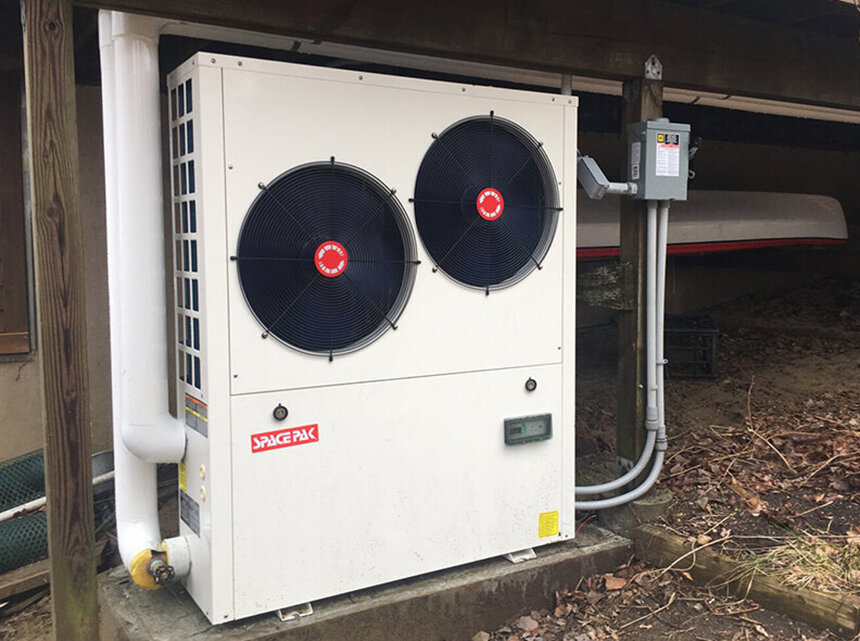
Heat pumps are an attractive alternative. They fit well into existing ductwork from central air, or mini-split units can be easily installed in the walls of a home. In addition to providing heat during the winter, they can also provide cooling in the summer.
A significant advantage, and disadvantage, is the system’s reliance on electricity. It’s what can reduce a business or home’s heating emissions since they aren’t burning fossil fuels. The downsides are it’s ultimately only as emission-free as the electricity that’s being produced, and most electricity consumed in New England is derived from natural gas-fired power plants.
The other disadvantage is cost. Heat pump units can be expensive to put in, it’s not an easy home improvement project for most people to knock off in a weekend, and they ideally should be installed by qualified HVAC professionals.
It also ties the homeowner to electricity costs. Electricity use will go up with every heat pump unit put in, and several can be required for even modest homes. This ties a resident to electricity prices, which are often cheaper than home heating oil, but are often more expensive than comparative natural gas rates.
Electricity prices are likely a key reason why wealthier communities have received the bulk of the rebates. The program’s design excludes income-eligible participants of the program from participating if they currently heat their homes with natural gas. State officials told ecoRI News last year the exclusion was to avoid saddling the program’s participants with utility bills much higher than they paid previously.
The state’s housing crisis is also likely dampening the impact of the program on Rhode Island’s frontline communities. Homeownership is a prerequisite for the residential side of the program; you have to own the building you live to make such significant investments in its heating and cooling infrastructure. Lower-income residents in Rhode Island are less likely to own a home, especially as the cost of housing has skyrocketed since the COVID-19 pandemic.
A tale of two cities: Providence
How the rebates have been distributed in Providence so far shows how much affluent areas have benefited. Providence as a whole has been the top rebate-getter, with 315 rebates awarded to Providence addresses by the end of October.
But nearly half those rebates, 153, have been awarded to addresses in one zip code, 02906, which includes the city’s East Side, College Hill, and other affluent neighborhoods. Addresses on that side of the city have been paid $447,075 in program money, with another $67,000 held in reserve.
It’s the zip code with the highest median income in the city, around $98,000 a year, according to estimates from the 2022 American Community Survey.
The comparison with other areas of Providence is staggering. Area code 02905 includes Washington Park, waterfront neighborhoods in Providence, and the Cranston neighborhood of Edgewood. Since the program’s start, 49 rebates have been awarded or assigned to addresses in this zip code, but only seven of them are for south Providence addresses; the remaining 42 were given to Cranston residents.
The Providence side of the area code is one of the state’s most notorious sacrifice zones, with high populations of Black people and Hispanics, and lower-than-average median household incomes compared to the rest of the city.
It’s also an area facing well-known issues of environmental justice, with a long history of pollution from businesses and industries in and around the Port of Providence that have wrought serious public health impacts to nearby neighborhoods.
But the good news is there’s still plenty of time left in the program to meet the environmental justice goals. Clean Heat R.I. is running for a three-year period, until Oct. 31, 2026, or until the program runs out of money, whichever comes first.
[ad_2]
Source link