











Peptide safety depends on what peptide is being used, how well it has been studied and where it comes from. Some peptides are well-studied medicines, including insulin and GLP-1 drugs. However, many peptides promoted online for healing, muscle growth and anti-aging have limited human research and are not FDA-approved for those uses. Patients should check the evidence, FDA status and source before using a peptide.Quick Answer: Are peptides safe?
Peptides are showing up across social media, podcasts and wellness clinics. Some are promoted for weight loss. Others promise faster healing, more muscle or even slower aging. The claims can sound convincing, but doctors say there is a big difference between a promising idea and a treatment proven to work.
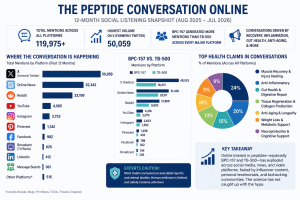
New social listening data shows just how large the conversation has become. An analysis by NMQF found more than 50,000 peptide-related posts on X over the past 12 months. It also found more than 23,000 Reddit posts and 4,500 YouTube posts. BPC-157 generated more mentions than TB-500. Common themes included injury recovery, inflammation, gut health, tissue repair and anti-aging.
The popularity of those claims does not mean the science supports them. That was one of the main messages from a recent Association of Health Care Journalists webinar, “Everyone’s Talking About Peptides: What Reporters Should Know.”
Speakers Rachel Frank, M.D., Professor in Orthopaedic Surgery at the University of Colorado School of Medicine, and Dhruv Khullar, M.D., M.P.P., Associate Professor of Health Policy and Economics at Weill Cornell Medical College, discussed what researchers know about peptides and where questions remain. The webinar was moderated by Karen Blum, AHCJ’s Health Beat Leader for AI and Patient Safety, and Anna Medaris, AHCJ’s Freelance Beat Leader.
Peptides are small chains of amino acids. Our bodies make thousands of them, and they help control many important processes. Some peptides are also proven medicines. Insulin is one example. GLP-1 drugs used for diabetes and obesity are another. These medicines have been studied in people for specific medical uses. But many peptides promoted online have far less evidence behind them.
Peptide Safety: When the Hype Moves Faster Than the Science
Consider someone with a knee injury who sees a video about BPC-157. The video says the peptide can help the knee heal faster. The person searches online, finds an injectable product and orders it. It may look like medicine, but strong human evidence for that claim is limited.
The FDA has raised concerns about BPC-157. The agency says it has limited safety information and lacks enough information to know whether the substance could harm people when used in proposed ways.
Frank said patients are already asking her about peptides for sports injuries. Products such as BPC-157 and TB-500 are promoted for muscles, tendons and ligaments. She said some patients have also used peptides around the time of surgery. Doctors have treated infections and abscesses after some patients injected peptide products, Frank said during the webinar.
Khullar raised another concern: people may not always know what is inside products bought online. While reporting on peptides, he said he purchased three products and had them independently tested. According to Khullar, one contained some lead. Another contained bacterial material. A third contained less than half the amount of peptide advertised.
That does not mean all peptides are dangerous. Insulin and GLP-1 medicines show how useful peptide-based drugs can be. Instead, the question is whether a specific product has good evidence behind it and whether patients know what they are getting.
Compounding can make this harder to understand. Compounded medicines can serve an important purpose for patients with special medical needs. But compounded drugs are not FDA-approved. The FDA does not review compounded drugs for safety, effectiveness and quality before they reach patients.
This difference became especially important in July 2026, when an FDA advisory committee considered several peptides for possible use in pharmacy compounding. An advisory committee recommendation is not the same as FDA approval. It also does not prove that a peptide works for every condition promoted online.
ALSO READ ON FYH.NEWS
Why Your “Ozempic” May Not Be Ozempic
As more people turn online for GLP-1 medicines, counterfeit and unapproved products are creating new safety concerns. Learn what the FDA says patients should watch for.
Read the story →
BPC-157 is a useful example. During the webinar, Khullar explained that the FDA committee considered BPC-157 in connection with ulcerative colitis. That is different from proving it can heal a sports injury, repair a tendon or help someone recover faster after exercise.
The issue also connects to the growth of GLP-1 medicines. Their success has made peptide-based treatments familiar to millions of people. But an experimental peptide promoted online should not be assumed to have the same evidence as an FDA-approved GLP-1 medicine.
That distinction is at the heart of Health Not Hype. The campaign helps people understand the differences between FDA-approved medicines, compounded products and treatments promoted through online marketing. This information can be especially important for communities that face barriers to trusted health information and medical care.
Before trying a peptide or another treatment found online, patients should ask basic questions. What am I taking? Has it been studied in people? Is it FDA-approved for this use? Where did it come from? A viral video or personal testimonial cannot answer those questions.
Patients can learn more about medication safety and how to separate evidence from marketing at HealthNotHype.org Readers can also watch the Association of Health Care Journalists webinar, “Everyone’s Talking About Peptides: What Reporters Should Know,” for a deeper look at the science and safety questions surrounding peptides.
Peptides may lead to important new treatments, and some already have. But popularity is not proof. As peptide marketing grows, patients need clear information to tell promising science from proven medicine.
Stay Informed. Stay Empowered.