








[ad_1]

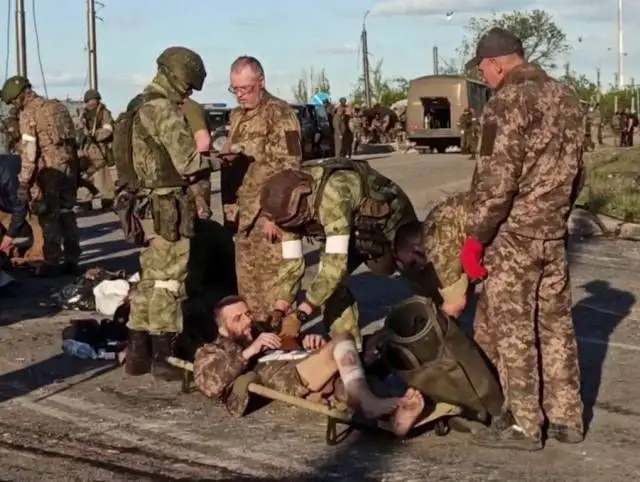
Although the number is a closely guarded secret by Vladimir Putin’s government, among the thousands of Russian soldiers killed in Ukraine, many are very young, poor and sometimes from ethnic minorities, experts say.
The Kremlin has not communicated on the issue since March 25, that is, a month and a day after the start of the war.
The Russian government had admitted that 1,351 soldiers were killed in combat, compared to a previous official balance of 498 soldiers killed, published on March 2.
– Advertisement –
After seven weeks of destructive fighting and several Ukrainian videos showing heavy losses on the enemy side, the Ukrainian government puts the death toll at 27,000. A high figure according to multiple Western military and analysts, for whom Russian evaluations are highly underestimated.
“Russia probably suffered losses corresponding to a third of the ground combat force dispatched in February,” the British defense ministry observed on Sunday, or 50,000 Russian soldiers wounded or killed.
At the rate of three wounded per dead recognized by Moscow at the beginning of the conflict, it would then reach 12,500 Russian dead in less than three months of “special operation”.
In other words, very close to the 15,000 Soviet dead during a decade of war in Afghanistan (1979-1989), which caused national trauma and the collapse of the USSR.
“We bow down to our comrades-in-arms who died bravely in a just fight for Russia,” Vladimir Putin stressed, in a tribute paid on May 9, Victory Day.
“irreplaceable loss”
“The death of each soldier or officer is a cause of sorrow for us and an irreplaceable loss for those close to them,” he added, announcing a series of measures to help the families of the wounded and dead.
The Russophone site Mediazona said it had confirmed the deaths of 2,099 Russian soldiers in combat as of May 6, solely from open sources. A large part of them were between 21 and 23 years old, and 74 were not even 20 years old, that medium specified.
Few of them hail from Moscow or St. Petersburg, two cities richer than the Russian average.
Most of the dead come from southern Russia, especially the predominantly Muslim North Caucasus region, as well as central Siberia, according to the same source.
The highest number of deaths (135) was confirmed in soldiers from the Muslim North Caucasus region of Dagestan, followed by Buryats (98), a Mongolian minority from Buryatia, a Siberian province.
Dmitro, interviewed by AFP in April in Zaporizhia (southern Ukraine) after living through the invasion and bombing in Mariupol for more than a month, spoke of “three waves” of occupiers in his city.
The pro-Russian separatists of Donbass were succeeded by the Buryats, who “looted everything”, then the Chechens guilty of “hunting human beings”, according to this doctor who gave testimony anonymously.
“The largest number of soldiers and officers of the army infantry come from small towns and villages in Russia. That is related to socio-economic and educational stratification,” says Pavel Luzin, commentator for the online information site Riddle Russia.
Heroism
Well, “the demands for military service” in that armed body are “relatively low,” he specified.
The best soldiers and future officers prefer other forces such as “space air, strategic ballistic forces and the navy,” he added.
Local media and social media in Dagestan, one of Russia’s poorest regions devastated for years by an Islamist insurrection, are filled with images of grieving parents receiving condolences from those responsible.
Kamil Iziiev, head of Dagestan’s Buinakski district, posted a video on Telegram in May showing rewards being handed out to the families of five fallen soldiers at the front, greeted by grieving wives and mothers wearing Muslim mantles. .
The first Russian soldier whose death was officially confirmed by Russia is Nurmagomed Gadzhimagomedov, a young Dagestani who, according to state media, died saving comrades.
He was posthumously awarded the Heroes of Russia order on March 4 by Vladimir Putin.
The Russian president then praised the role played by ethnic minorities in Ukraine, and was “proud to belong to this world, this powerful, strong and multinational people that is Russia”.
[ad_2]
Source link