












[ad_1]
,
,
,
,
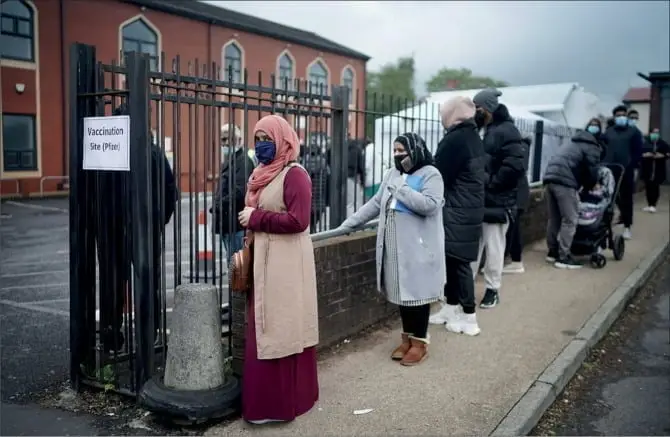
COVID-19 vaccination rates also remain lowest in these communities compared with white people in the UK. Among people older than 18 years, the proportion who have had three COVID-19 vaccinations in England in March, 2022, was lowest among Black Caribbean (38%), Black African (45%), and Pakistani (45%) ethnic groups.
These disparities are likely to be attributed to the intersection of key social determinants, including socioeconomic factors such as deprivation, overcrowding, and working patterns and conditions, alongside discrimination and structural violence in the health-care system and society. Applying an intersectional lens brings into focus the multiple power structures that are deepening protracted inequities, and acknowledges the heterogeneity across minority ethnic communities and the multiple interconnected factors that underpin exclusion.
and the delivery of third and fourth COVID-19 booster vaccinations, it is crucial to recognise that COVID-19 vaccine delivery and uptake are far from fixed or equal. Better understanding is needed about how to support minority ethnic groups and how best the government, health-care providers, and public health teams can work alongside community leaders. This will be vital for promoting public health messaging, openly discussing perceived risks by these groups, and improving health access where there is already deep mistrust, anger, loss, and fear due to structural racism and the inequities these communities have experienced in health care and society.
However, such understanding will continue to be inhibited by simplistic and homogenising conceptualisations of ethnicity, with a need to recognise the multiple factors that drive both the health and structural inequities in these communities.
to research, public health measures, and policy must be integrated to address the compounding of key factors associated with disparities in COVID-19 vaccine delivery and uptake. These factors include ethnicity, socioeconomic status, migration background and legal status, gender identity, disability, and existing health needs, alongside the multiple levels at which disadvantage can be experienced. Such an approach must address structural and systemic inequities, and understand the drivers of concerns about vaccines without further marginalising or stigmatising minoritised communities. Crucially, this approach must be prioritised over politicisation of the vaccine, rhetoric denouncing anti-vax or conspiracy beliefs, and stigmatising assumptions around limited education, scientific knowledge, or engagement with the right information sources. Instead, key decision makers in health care, research, and policy must seek to understand diverse health, knowledge, and values systems, and recognise the positive health agency and pro-health and risk-averse concerns that underlie decisions around vaccinations.
This approach will be vital for addressing loss of trust, driven by long-standing marginalisation of minority ethnic communities and coercion and violence in our health systems.
Furthermore, minority ethnic populations experiencing intersecting areas of marginalisation continue to face compounded inequities. There is a need to produce and evaluate health education messages that are culturally appropriate and acknowledge diversity and inequities within minority ethnic communities. Rather than increasing mechanisms for coercion and control to address disparities experienced by these communities—eg, through compulsory vaccination—next steps should instead centre around long-term co-produced solutions to address structural and systemic inequities by building trust and prioritising meaningful inclusion. These solutions can be facilitated by use of primary care networks to implement culturally relevant interventions—eg, virtual platforms that are sustainable and adjustable to the changing needs of communities—and to build trust. Minority ethnic groups and other communities that have been historically disadvantaged in public health should be engaged as early as possible in the inception and development of plans for research, policy, and practice,
with an emphasis on involving networks of trusted representatives identified by these communities, utilising evidence-based participatory approaches, and acknowledging and acting upon their contributions to ensure under-represented and silenced voices are included.
,
The integrated and coordinated role of health-care providers, policy makers, researchers, and community representatives will be important in collaboratively identifying effective strategies to address concerns that acknowledge intersectionality and prioritise building trust around COVID-19 vaccination, health services, and public health systems.

MP declares grants to his university from Gilead, Sanofi, and Qiagen, and a consultancy with Qiagen, a molecular diagnostics company, to advise on a presentation about occupational health screening for latent tuberculosis. The other authors declare no competing interests.
References
- 1.
Coronavirus (COVID-19) latest insights.
- 2.
Disparities in the risk and outcomes of COVID-19.
- 3.
Ethnicity and clinical outcomes in COVID-19: a systematic review and meta-analysis.
EClinicalMedicine. 2020; 29100630
- 4.
COVID-19 vaccination uptake amongst ethnic minority communities in England: a linked study exploring the drivers of differential vaccination rates.
J Public Health (Oxf). 2022; ()
- 5.
Ethnic differences in SARS-CoV-2 vaccine hesitancy in United Kingdom healthcare workers: results from the UK-REACH prospective nationwide cohort study.
Lancet Reg Health Eur. 2021; 9100180
- 6.
Intersectionality and why it matters to global health.
Lancet. 2018; 391: 2589-2591
- 7.
COVID-19 response: living with COVID-19.
- 8.
Overcoming COVID-19 vaccine hesitancy among ethnic minorities: a systematic review of UK studies.
Vaccine. 2022; ()
- 9.
Adopting an intersectionality framework to address power and equity in medicine.
Lancet. 2021; 397: 857-859
- 10.
Towards a more inclusive and dynamic understanding of medical mistrust informed by science.
Behav Med. 2019; 45: 79-85
- 11.
Rethinking vaccine hesitancy among minority groups.
Lancet. 2021; 397: 1863-1865
- 12.
Putting the voices and insights of migrants and diverse ethnic groups at the centre of our response to COVID-19.
Public Health. 2021; 197: e1-e3
- 13.
Participatory approaches in the development of health interventions for migrants: a systematic review.
BMJ Open. 2021; 11e053678
- 14.
Mitigating ethnic disparities in COVID-19 and beyond.
BMJ. 2021; 372m4921
- 15.
Intersectionality and developing evidence-based policy.
Lancet. 2022; 399: 355-356
Article Info
Publication History
Identification
Copyright
© 2022 Elsevier Ltd. All rights reserved.
ScienceDirect
[ad_2]
Source link