











[ad_1]
CNN
—
Ashley Martinez has four sons and is pregnant with the daughter she has wanted for years.
Last month, she posted a video online asking doctors to prioritize her life, not the life of her unborn child, if complications arise when she’s in labor, and it comes down to that choice.
The San Antonio, Texas, resident is due in May and is one of a number of pregnant women who have recently posted “living will” videos on TikTok.
Martinez had an emergency C-section during her last pregnancy after her umbilical cord came out before her baby, a rare but dangerous condition known as an umbilical cord prolapse that can deprive a baby of vital blood flow and oxygen.
Martinez described her last birth as terrifying. Eight months after the Supreme Court overturned Roe v. Wade, ending a constitutional right to abortion, she said she worried what would happen if she faced similar challenges again.
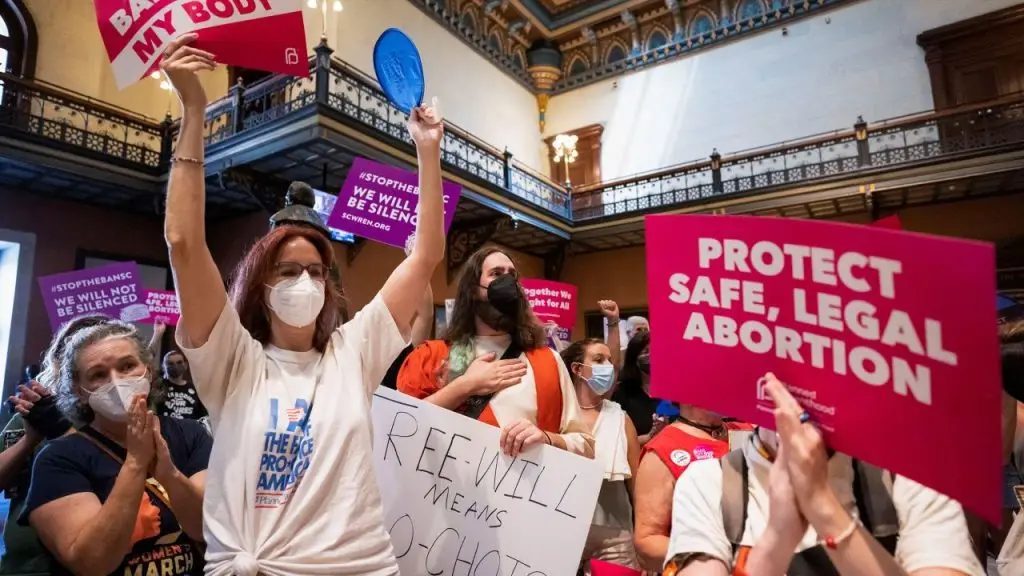
Since the ruling in June, a number of US states have criminalized abortions, leading to some fears that doctors would prioritize the life of the unborn child during a medical emergency.
Martinez lost her mother to non-Hodgkin’s lymphoma at a young age, and the thought of her children going through a similar tragedy terrifies her.
“Going into another birth where I have to have a C-section, that’s scary for me,” the 29-year-old said. “My fourth pregnancy was my only C-section. I always thought about not being here for my kids, just because of what I went through growing up without my mom.”
More than a dozen US states have banned or severely restricted access to abortions following the Supreme Court ruling eight months ago. The abortion bans have led to legal chaos as advocates take the fight to courtrooms.
Still, several ob/gyns told CNN that a difficult choice between saving a mother and baby’s life at birth, like the one described in the TikTok videos, is highly unlikely.
This trend on TikTok has sparked a flurry of dueling videos between pregnant women and other people. Some have posted videos telling doctors in such situations to put their unborn babies first and criticizing those who expressed a different opinion.
Martinez admits that her mother, who died at 25, probably would have chosen to save her child first if she could.
“My mom, she didn’t have a choice, you know?” Martinez said. “The message that I want to send is just basically that nobody is wrong or right in this situation. In either situation, choosing your children over your unborn child is a difficult decision.”
In Texas, where Martinez lives, abortions are prohibited at any stage of pregnancy – unless there is a life-threatening medical emergency.
Dr. Franziska Haydanek, an ob/gyn in Rochester, New York, who shares medical advice on TikTok, said she’s noticed a lot of “living will” videos in recent months.

In most of the videos, a woman appears next to a written message that says something like, “If there are complications during childbirth, save me before the baby.” Some people, including Martinez, refer to their children in their decision and even feature them in the video.
One was posted by Tuscany Gunter, 22, a woman whose baby is due in April. Abortion after 20 weeks of pregnancy is illegal in her home state of North Carolina, and Gunter told CNN she filmed her message in solidarity with others who said they would choose themselves first.
“I wanted to make it known where I stand and to stand up with other women who are being torn apart online for saying they’d rather be saved first over their baby,” said Gunter, who lives in Fayetteville.
“As a mother of three young children, I cannot dump the emotional trauma of losing their mother on them as children and expect them to cope. Although I would be devastated to lose a baby, I also have to think about my other living children … And I know that the baby who passed would be safe without ever having to experience pain or sorrow.”
Another woman, Leslie Tovar of Portland, Oregon, said that although her state has no legal restrictions on abortion, she posted her video because she feared doctors would prioritize saving her unborn child to avoid legal consequences in the era after Roe v. Wade.
“I have two other children at home who need a mother. I cannot bear the thought of my two young boys aged 6 and 4 without their mother,” she said.
All three women said they have had these conversations with their partners, who agreed they needed to be rescued first.
Of her husband, Tovar said, “His exact words were, ‘We could always have another baby later in life, but there’s never a replacement for my boys’ mom, I couldn’t do this without you.’”
It is true that complications occasionally crop up during a pregnancy that prompt doctors to recommend delivery to save the mother’s life, medical experts said.
If this is done before a fetus is viable—under 24 weeks—the chances of the baby’s survival are low, said Dr. Elizabeth Langen, a maternal-fetal medicine physician at the University of Michigan Von Voigtlander Women’s Hospital.
The reversal of Roe v. Wade made it more complicated to terminate such pregnancies, Langen and Haydanek say.
In cases involving a baby who is not viable, this could mean that even when the baby is unlikely to survive and the mother’s health is at risk, the priority will be to save the baby because of fear of legal consequences, said Long.
But both doctors say these scenarios do not occur during the birth of a viable baby. In that case, Roe v. Wade is “less involved,” Haydanek said.
“We are doing everything in our efforts to save both (mother and baby),” she said. “I can’t think of a time when the medical team has had to make a decision about who to save in a viable, working patient. That’s just not a real scenario in modern medicine – just one we see played out on TV .”
Hospitals have enough resources – e.g. obstetrics and neonatal intensive care units — to meet the needs of both the mother and the baby, Haydanek and Langen said.
“We usually do our best to take care of both mother and baby. And there is very rarely a circumstance where we would do something to harm the mother to benefit the child,” Langen added.
“If the mother’s health deteriorates, she will ultimately be unable to support the baby’s well-being,” Langen said. “And generally what we encourage people to do is really support the health of the mother because it’s in the best interest of both the mother and the baby.”

Both doctors said it’s important for patients to talk to their health care providers about their medical concerns and share their “living” wishes with loved ones in case there are complications during labor that require partners to make medical decisions.
But those decisions won’t involve doctors asking your partner whose life should come first, they said.
“Before you get into a fight with your partner about who they choose to save, know that there’s no situation where we’re going to ask them that,” said Haydanek, who has called the TikTok trend “horribly anxiety-inducing. ”
She said it has come up so many times in recent months that she made her own TikTok video to reassure expectant parents.
“Please don’t feel like you have to make this choice,” she says in the video. “I know firsthand how much anxiety there can be during pregnancy … but it’s just not a situation you’re going to be in.”
[ad_2]