









- By FYH News Team
[ad_1]
Abstract
Citation: Brooks RA, Nieto O, Santillan M Jr, Landrian A, Fehrenbacher AE, Cabral A (2022) Beyond HIV prevention: Additional individual and community-level benefits of PrEP among Latino gay and bisexual men. PLoS ONE 17(6):
e0269688.
https://doi.org/10.1371/journal.pone.0269688
Editor: Douglas S. Krakower, Beth Israel Deaconess Medical Center/Harvard Medical School, UNITED STATES
Received: November 8, 2021; Accepted: May 25, 2022; Published: June 13, 2022
Copyright: © 2022 Brooks et al. This is an open access article distributed under the terms of the Creative Commons Attribution License, which permits unrestricted use, distribution, and reproduction in any medium, provided the original author and source are credited.
Data Availability: All relevant data are within the paper and its Supporting Information files.
Funding: This work was supported the US National Institute of Mental Health under Grant # R21MH107339 and Grant # P30MH058107. The funders had no role in study design, data collection and analysis, decision to publish, or preparation of the manuscript. Author Ronald Brooks received salary from grant #R21MH107339 and grant #P30MH058107. Authors Omar Nieto, Amanda Landrian, and Alejandra Cabral received salary from grant #R21MH107339.
Competing interests: The authors have declared that no competing interests exist.
Introduction
Latino gay and bisexual men (GBM) comprise one of the largest groups adversely affected by HIV in the United States. In 2017, at the time of this study, the rate of HIV diagnosis was 38% among Black GBM, 28% among Hispanic/Latino GBM, and 27% among White GBM [1]. As indicated in the technical notes within the CDC surveillance report, Hispanic/Latinos can be of any race (we use the term “Latino” in this manuscript) [2]. In addition, the CDC estimated that 1 in 2 Black GBM and 1 in 4 Latino GBM are projected to contract HIV in their lifetime compared to 1 in 11 for White GBM [3]. Further, while HIV diagnoses among Black and White GBM saw a period of stabilization from 2011 to 2015, diagnoses among Latino GBM did not see similar improvements [2]. To reduce new HIV infections among Latino GBM will require facilitating uptake of the most effective HIV prevention strategies, such as Pre-Exposure Prophylaxis (PrEP).
PrEP is a highly effective HIV prevention strategy with the ability to help curtail incident HIV infections among all at-risk populations [4]. As a result, PrEP has been listed as a key strategy in the Ending the HIV Epidemic: A Plan for America initiative [5]. Unfortunately, disparities persist in the adoption of PrEP among racial/ethnic sexual minority men, including Latino GBM [6]. Nationally, in 2017, only 31% of Latino GBM used PrEP in comparison to 42% of white GBM [6]. In California, a study in 2016 reported that only 6.6% of Latino GBM were using PrEP compared to 13.9% of white GBM [7]. In addition to suboptimal rates of adoption, there are also high rates of PrEP discontinuation in this population. In prior research among racial/ethnic sexual minority men, including Latino GBM, the median length of time using PrEP was only about 5 months [8, 9]. Further, a study surveying a racially and ethnically diverse sample of MSM and transgender women found that only about 38% of PrEP initiators continued using PrEP over a period of 12 months [10]. Facilitating greater uptake and persistence of PrEP may require moving beyond the biomedical focus on HIV prevention as a motivating factor for PrEP adoption, and, instead, highlighting other additional benefits of using PrEP for individuals and their community.
A primary benefit of PrEP is its effectiveness in preventing HIV infection. However, a growing body of research has identified additional benefits GBM receive from using PrEP, that go beyond HIV prevention, which include reduced anxiety and fear, improved sexual pleasure, and greater comfort with HIV-positive sex partners [11–22]. This research has been done with primarily White GBM and may not accurately reflect the experiences of Latino GBM. While some of benefits may be similar across all GBM populations, it is important to explore if these benefits are present among Latino GBM PrEP users, and if any unique benefits exist that could inform development of new types of messaging to facilitate greater PrEP adoption and persistence in this population. The present study addresses this gap in the existing research literature by uncovering the additional benefits of using PrEP specifically among Latino GBM PrEP users.
Materials and methods
Study overview
The LA [Los Angeles] PrEP Stories project was a qualitative study aimed at exploring the positive and negative experiences of using PrEP for HIV prevention among Latino and Black gay/bisexual men and other men who have sex with men. The focus of the study was on assessing the negative experiences resulting from anticipated, enacted, and internalized PrEP-related stigma. Those findings have been reported elsewhere [23–25]. A secondary focus was on investigating the positive experiences of using PrEP in the study population. For this article, we focus on the additional benefits of using PrEP experienced by Latino GBM. The added benefits of using PrEP among Black GBM is covered in the available literature [18, 26].
Data analysis
An inductive thematic analysis approach was used in analyzing the data [27]. Using this approach, we identified the added benefits from the participants’ reported experiences. The process began with the study team familiarizing itself with the data by conducting a line-by-line review of the transcripts and noting down any initial ideas. Initial codes were then generated using the interview guide, field notes, and the line-by-line review of transcripts, and included both descriptive and interpretive codes. Data analysis was performed by members of the study team, comprised of the study Principal Investigator (RAB), the project director/study interviewer (ON), and a doctoral student in Public Health (AL), all with years of experience analyzing qualitative data. The study team reviewed, discussed and modified the codes and their definitions, and identified exemplar quotes associated with each code before reaching consensus on the final codebook. In constructing themes, the team reviewed and clustered coded data that was similar and represented a meaningful pattern in the data. Themes were then reviewed in relation to the coded data to ensure that they represented the most important and relevant components of the data. ATLAS.ti (version 8.0.42), a qualitative data management and analysis software, was used in analyzing the data.
Results
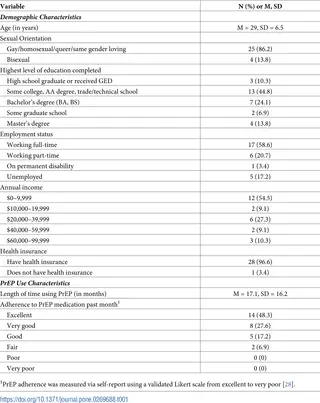
A total of 29 Latino GBM completed the study interview. Table 1 provides sociodemographic and PrEP use characteristics of the participants. The average age was 30 years (SD = 6.5; median = 29.8; range = 21–49). The vast majority identified as gay (86.2%) and reported completing at least some college (89.6%), working full or part-time (79.3%), and having an annual household income of $40,000 or less (79.2%). The mean length of time using PrEP was 17.1 months (SD = 16.2; median = 12.0; range = 0.25–68). Three-quarters (75.9%) self-reported “very good” or “excellent” PrEP medication adherence.
While HIV prevention was a primary motivator for starting PrEP among study participants, interviews with Latino GBM revealed additional benefits of using PrEP. From the data, we constructed five primary themes that represented these supplementary benefits: (1) reduced fear, anxiety, and stress about HIV, HIV testing, and sex; (2) feeling empowered and in control of their HIV risk; (3) greater awareness of sexual risk behaviors and sexual health; (4) greater sexual exploration and pleasure, and comfort having condomless sex; and (5) a greater connection to community and a feeling of contributing to the elimination of HIV. Exemplar quotes for each theme are presented and contextualized below. All names included in quotes are pseudonyms.
Discussion
The added benefits of using PrEP identified in the present study represent a range of advantages that go beyond HIV prevention (e.g., reduced stress and anxiety, greater sexual exploration and enjoyment, feeling empowered). These additional positive effects of PrEP helped to improve the quality of the sexual lives of the Latino GBM in the study. While many of our findings align with prior research done with other populations of GBM [11–22], these findings provide the empirical evidence documenting the benefits of using PrEP exclusively in a population of Latino GBM living in a high HIV prevalence jurisdiction. In addition, we identified a unique benefit in our cohort of Latino GBM that has not been reported elsewhere: a feeling of greater connection to community and a sense that the men were helping to eradicate HIV. We expound on each benefit and explore how they can inform messaging in future PrEP campaigns and interventions to facilitate greater uptake and persistence among at-risk Latino GBM.
In our findings, Latino GBM described how PrEP helped reduce the fear, anxiety, and stress associated with contracting HIV, getting tested, and having sex. As described in the narratives, HIV represents “a dark cloud” that looms over the lives of Latino GBM, and HIV infection is perceived as an inevitable consequence for Latino GBM who are having sex with other men. However, PrEP helped to lift that dark cloud and provided Latino GBM with a sense of relief and reassurance that they will remain HIV uninfected. This newly acquired reduced stress and anxiety facilitated greater sexual experimentation and pleasure allowed the men to have the sex lives they desired. In agreement with other research [19, 29], we believe that PrEP promotional efforts can be improved by focusing on sexual pleasure in their messaging to Latino GBM. This type of messaging (e.g., one that highlights increased sexual fulfillment) may help motivate Latino GBM to initiate and persist on PrEP, particularly among those who experience persistent anxiety when having sex. It is important to find ways to remove the fear of sex and replace it with enjoyment.
The Latino GBM also described how PrEP made them feel empowered and in control of their sexual health. This occurred because the men no longer had to rely on their partners to protect them from HIV, thus reducing their vulnerability to potential exposure. In many ways, the introduction of PrEP changed the landscape of HIV prevention by offering GBM new opportunities for how they can explore their sexual lives. Prior to PrEP, HIV prevention options were limited and varied in efficacy (e.g., condom use, sero-sorting, and strategic positioning) [30–32]. To be effective, these strategies required trust and cooperation of a sexual partner. In contrast, PrEP alone is a highly effective prevention strategy, providing a level of sexual freedom that has not been available since before the onset of the HIV epidemic. Therefore, PrEP may be an optimal prevention method for Latino GBM who have difficulty negotiating safer sex practices with partners (e.g., asking about HIV status or requesting condoms be used). In this way, PrEP provides individuals with protection without them having to engage in sometimes uncomfortable and awkward conversations about HIV risk, HIV status, or condom use.
In addition, Latino GBM in this study had a greater consciousness and understanding of their HIV and STI risk behaviors because of the mandatory screenings for these infections required to maintain a PrEP prescription. This allowed some participants to feel comfortable taking calculated risks with their sexual partners (e.g., engaging in condomless sex). In addition, STIs were largely viewed as treatable infections. According to Tang et al. [33], the quarterly screenings required of all PrEP users play an important role in the early detection of STIs to prevent future infections among GBM. In addition, routine PrEP follow-up appointments keep Latino GBM engaged in medical care and that will hopefully translate to greater healthcare utilization for other health needs in this population.
A unique benefit identified in the present study was the reported feeling of a greater connection to community and of contributing to the elimination of HIV. The men spoke of community in different ways, sometimes referring to their connection to the broader gay/LGBTQ community and other times referring to the more intimate community of gay male PrEP users. This benefit was not noted in other research. Participants spoke of a camaraderie they had with other PrEP users and how being part of this community of PrEP users compelled them to actively disseminate PrEP information to peers in their community or social network in the hopes of increasing uptake. In effect, many of the participants became PrEP champions serving to educate, advocate, and promote PrEP [34]. This outcome highlights the significance of community-level diffusion in encouraging PrEP uptake in this population. In prior research, Page et al. (2017) noted the importance of involving community members and community-based organizations in promoting PrEP among Latino GBM. They described the use of Promotores/as (i.e., trusted community members) who work as health educators to disseminate information about PrEP. They also serve the role of peer navigators to help address barriers or concerns to initiation and retention in care. Page et al. (2017) further suggest the use of peer networks to promote information sharing [35]. These types of community activities will be important in promoting PrEP to Latino GBM as well as helping to destigmatize its use in the population at large.
The added benefits of using PrEP experienced by Latino GBM may help inform future PrEP promotion campaigns or interventions targeting this population. As a way of motivating Latino GBM to use PrEP, future messaging targeting this population should highlight the supplementary positive effects PrEP affords users that go beyond the strictly biomedical focus on HIV prevention. Overall, the added benefits identified in the present study speak to a reduced fear, anxiety, and stress associated with HIV and having sex, as well as greater sexual exploration and enjoyment. As such, PrEP messaging to Latino GBM should focus on providing men the opportunity to have the sex life they desire. Drawing from the narratives of the Latino GBM in the study, we offer the following suggestions of possible messages that would resonate with the population (i.e., “I’m having more fun now than I ever had before, because I don’t live with fear.,” “It’s okay for you to be attracted to other men. Here’s this pill that will take away a lot of fear and anxiety.” “I’m able to have more fun without worrying about HIV.” “I enjoy sex more now.” “When I’m having sex, I’m enjoying the moment.” “Mentally and emotionally, it gives me peace of mind.” “I feel more in control.” “I’m doing something, rather than relying on somebody else to [protect me from HIV].” “It’s made me worry less about HIV.” “I’m less nervous when having sex.” “It allows me to have the sex life that I want.”). These messages can be delivered in the form of personal testimonials of Latino GBM PrEP users. They can be used in PrEP campaigns, shared on social media platforms of community-based organizations or PrEP programs serving Latino GBM, or used by local public health departments in PrEP campaigns seeking to target this population.
Another important component of PrEP messaging to Latino GBM should center on the connection to community and helping to eradicate HIV in the community. Drawing on a quote from a study participant, a potential message can center on Latino GBM contributing to eradication of HIV in the community (e.g., “I’m doing my part to eliminate HIV.”). A community-level approach to PrEP promotion may resonate with Latino GBM, in particular, given the collectivist nature of Latino culture [36]. In a collectivist culture, group activities are dominant, responsibility is not individually based but shared, and accountability is collective [37]. In addition, as noted in prior work, among Latinos, the individual is subordinate to the group (i.e., the “we” takes precedence over “I”) [38]. As such, new PrEP promotion efforts may be more effective if they draw on community members (e.g., Latino LGBT community in particular) to motivate Latino GBM to use PrEP in support of a healthier community.
These findings should be interpreted in consideration of the study limitations. Our sample was recruited in Los Angeles County with a large Latino population, and, therefore, results may not reflect the experiences of Latino GBM PrEP users in other settings (e.g., rural settings with smaller Latino populations). In addition, the sample consists exclusively of English-speaking Latino GBM and may not reflect the experiences of Spanish-speaking Latino GBM PrEP users. Research with monolingual Spanish-speaking Latino GBM is needed to assess if positive experiences and benefits gained from PrEP use differ based on language and other related cultural nuances associated with monolingual Spanish-speaking populations. A final limitation is that the data were collected in 2017 and uptake has changed since the study took place. A 2020 CDC report noted that there has been an increase in PrEP use across all racial/ethnic groups of 25%; however, uptake remains lower among Latinos (16%) compared to Whites (66%) [39].
References
- 1.
Centers for Disease Control and Prevention. HIV Surveillance Report, 2017. [Internet]. 2018. Available from: https://www.cdc.gov/hiv/pdf/library/reports/surveillance/cdc-hiv-surveillance-report-2017-vol-29.pdf - 2.
Centers for Disease Control and Prevention. Estimated HIV incidence and prevalence in the United States, 2015–2019. 2021;26(1):81. - 3.
Centers for Disease Control and Prevention. 2016 CROI Press Release: Lifetime HIV Risk [Internet]. 2018 [cited 2022 May 5]. Available from: https://www.cdc.gov/nchhstp/newsroom/2016/croi-press-release-risk.html - 4.
Spinner CD, Boesecke C, Zink A, Jessen H, Stellbrink HJ, Rockstroh JK, et al. HIV pre-exposure prophylaxis (PrEP): a review of current knowledge of oral systemic HIV PrEP in humans. Infection. 2016 Apr 1;44(2):151–8. pmid:26471511 - 5.
HIV.gov. What is ‘Ending the HIV Epidemic: A Plan for America’? [Internet]. HIV.gov. 2020 [cited 2021 Oct 4]. Available from: https://www.hiv.gov/federal-response/ending-the-hiv-epidemic/overview - 6.
Pitasi MA, Beer L, Cha S, Lyons SJ, Hernandez AL, Prejean J, et al. Vital Signs: HIV Infection, Diagnosis, Treatment, and Prevention Among Gay, Bisexual, and Other Men Who Have Sex with Men—United States, 2010–2019. MMWR Morb Mortal Wkly Rep. 2021 Dec 3;70(48):1669–75. pmid:34855721 - 7.
Pulpisher C, Montoya J, Curtis P, Holloway IW, Leibowitz A. Addressing PrEP Disparities among Young Gay and Bisexual Men in California [Internet]. 2016. Available from: https://aplahealth.org/wp-content/uploads/2016/09/APLA_PrEP_FullReport_WEB.pdf - 8.
Liu A, Coleman K, Walker N, Vittinghoff E, Turner C, Vinson J, et al. Assessing the PrEP Continuum in the San Francisco Bay Area: The Quickie Mobile Survey. In: Conference on Retroviruses and Opportunistic Infections (CROI)Conference on Retroviruses and Opportunistic Infections (CROI)Conference on Retroviruses and Opportunistic Infections (CROI) [Internet]. Seattle, WA; 2019 [cited 2021 Sep 15]. Available from: https://www.croiconference.org/abstract/assessing-prep-continuum-san-francisco-bay-area-quickie-mobile-survey/ - 9.
Rao DW, Carr J, Naismith K, Hood JE, Hughes JP, Morris M, et al. Monitoring HIV Preexposure Prophylaxis Use Among Men Who Have Sex With Men in Washington State: Findings From an Internet-Based Survey. Sex Transm Dis. 2019 Apr;46(4):221–8. pmid:30870322 - 10.
Spinelli MA, Scott HM, Vittinghoff E, Liu AY, Gonzalez R, Morehead-Gee A, et al. Missed Visits Associated With Future Preexposure Prophylaxis (PrEP) Discontinuation Among PrEP Users in a Municipal Primary Care Health Network. Open Forum Infect Dis. 2019 Apr;6(4):ofz101. - 11.
Grant RM, Koester KA. What People Want From Sex and PrEP. Curr Opin HIV AIDS. 2016 Jan;11(1):3–9. pmid:26569183 - 12.
Grov C, Westmoreland DA, D’Angelo AB, Pantalone DW. How Has HIV Pre-Exposure Prophylaxis (PrEP) Changed Sex? A Review of Research in a New Era of Bio-behavioral HIV Prevention. J Sex Res. 2021 Sep;58(7):891–913. pmid:34180743 - 13.
Haire B, Murphy D, Maher L, Zablotska-Manos I, Vaccher S, Kaldor J. What does PrEP mean for ‘safe sex’ norms? A qualitative study. PLOS ONE. 2021 Aug 5;16(8):e0255731. pmid:34352034 - 14.
Hammack PL, Toolis EE, Wilson BDM, Clark RC, Frost DM. Making Meaning of the Impact of Pre-Exposure Prophylaxis (PrEP) on Public Health and Sexual Culture: Narratives of Three Generations of Gay and Bisexual Men. Arch Sex Behav. 2019 May;48(4):1041–58. pmid:30874978 - 15.
Keen P, Hammoud MA, Bourne A, Bavinton BR, Holt M, Vaccher S, et al. Use of HIV Pre-exposure Prophylaxis (PrEP) Associated With Lower HIV Anxiety Among Gay and Bisexual Men in Australia Who Are at High Risk of HIV Infection: Results From the Flux Study. J Acquir Immune Defic Syndr 1999. 2020 Feb 1;83(2):119–25. pmid:31935203 - 16.
Koester K, Amico RK, Gilmore H, Liu A, McMahan V, Mayer K, et al. Risk, safety and sex among male PrEP users: time for a new understanding. Cult Health Sex. 2017 Dec;19(12):1301–13. pmid:28415911 - 17.
Pantalone DW, Holloway IW, Goldblatt AEA, Gorman KR, Herbitter C, Grov C. The Impact of Pre-Exposure Prophylaxis on Sexual Communication and Sexual Behavior of Urban Gay and Bisexual Men. Arch Sex Behav. 2020 Jan;49(1):147–60. pmid:31628628 - 18.
Quinn KG, Christenson E, Sawkin MT, Hacker E, Walsh JL. The Unanticipated Benefits of PrEP for Young Black Gay, Bisexual, and Other Men Who Have Sex with Men. AIDS Behav. 2020 May;24(5):1376–88. pmid:31768688 - 19.
Van Dijk M, De Wit JBF, Guadamuz TE, Martinez JE, Jonas KJ. Quality of Sex Life and Perceived Sexual Pleasure of PrEP Users in the Netherlands. J Sex Res. 2021 Jun 15;1–6. pmid:34128741 - 20.
Whitfield THF, Jones SS, Wachman M, Grov C, Parsons JT, Rendina HJ. The Impact of Pre-Exposure Prophylaxis (PrEP) Use on Sexual Anxiety, Satisfaction, and Esteem Among Gay and Bisexual Men. J Sex Res. 2019 Dec;56(9):1128–35. pmid:30777781 - 21.
Yang C, Krishnan N, Kelley E, Dawkins J, Akolo O, Redd R, et al. Beyond HIV prevention: a qualitative study of patient-reported outcomes of PrEP among MSM patients in two public STD clinics in Baltimore. AIDS Care. 2020 Feb;32(2):238–41. pmid:31146549 - 22.
Zapata JP, Petroll A, de St Aubin E, Quinn K. Perspectives on Social Support and Stigma in PrEP-related Care among Gay and Bisexual Men: A Qualitative Investigation. J Homosex. 2020 Sep 22;1–23. pmid:32960750 - 23.
Brooks RA, Landrian A, Nieto O, Fehrenbacher A. Experiences of Anticipated and Enacted Pre-exposure Prophylaxis (PrEP) Stigma Among Latino MSM in Los Angeles. AIDS Behav. 2019 Jul 1;23(7):1964–73. pmid:30649635 - 24.
Brooks RA, Nieto O, Landrian A, Fehrenbacher A, Cabral A. Experiences of Pre-Exposure Prophylaxis (PrEP)–Related Stigma among Black MSM PrEP Users in Los Angeles. J Urban Health [Internet]. 2019 Jun 18 [cited 2019 Aug 23]; Available from: http://link.springer.com/10.1007/s11524-019-00371-3 - 25.
Brooks RA, Cabral A, Nieto O, Fehrenbacher A, Landrian A. Experiences of Pre-Exposure Prophylaxis Stigma, Social Support, and Information Dissemination Among Black and Latina Transgender Women Who Are Using Pre-Exposure Prophylaxis. Transgender Health. 2019 Aug 30;4(1):188–96. pmid:31482134 - 26.
Huang W, Lockard A, Kelley CF, Serota DP, Rolle CPM, Sullivan PS, et al. From declining PrEP to PrEP initiation as “first nature”—what changes PrEP initiation decisions among young, Black MSM. AIDS Care. 2022 Mar;34(3):284–93. pmid:34369230 - 27.
Braun V, Clarke V. Thematic analysis. In: APA handbook of research methods in psychology, Vol 2: Research designs: Quantitative, qualitative, neuropsychological, and biological. Washington, DC, US: American Psychological Association; 2012. p. 57–71. (APA handbooks in psychology®). - 28.
Feldman BJ, Fredericksen RJ, Crane PK, Safren SA, Mugavero MJ, Willig JH, et al. Evaluation of the Single-Item Self-Rating Adherence Scale for Use in Routine Clinical Care of People Living with HIV. AIDS Behav. 2013 Jan 1;17(1):307–18. pmid:23108721 - 29.
Mabire X, Puppo C, Morel S, Mora M, Rojas Castro D, Chas J, et al. Pleasure and PrEP: Pleasure-Seeking Plays a Role in Prevention Choices and Could Lead to PrEP Initiation. Am J Mens Health. 2019 Feb;13(1):1557988319827396. - 30.
Eaton L, Kalichman S, O’Connell D, Karchner W. A strategy for selecting sexual partners believed to pose little/no risks for HIV: Serosorting and its implications for HIV transmission. AIDS Care. 2009 Oct 1;21:1279–88. pmid:20024704 - 31.
Gafos M, Horne R, Nutland W, Bell G, Rae C, Wayal S, et al. The Context of Sexual Risk Behaviour Among Men Who Have Sex with Men Seeking PrEP, and the Impact of PrEP on Sexual Behaviour. AIDS Behav. 2019 Jul;23(7):1708–20. pmid:30306439 - 32.
Van de Ven P, Kippax S, Crawford J, Rawstorne P, Prestage G, Grulich A, et al. In a minority of gay men, sexual risk practice indicates strategic positioning for perceived risk reduction rather than unbridled sex. AIDS Care. 2002 Aug;14(4):471–80. pmid:12204150 - 33.
Tang EC, Vittinghoff E, Philip SS, Doblecki-Lewis S, Bacon O, Chege W, et al. Quarterly screening optimizes detection of sexually transmitted infections when prescribing HIV preexposure prophylaxis. AIDS Lond Engl. 2020 Jul 1;34(8):1181–6. pmid:32205724 - 34.
Brooks RA, Nieto O, Landrian A, Fehrenbacher A, Cabral A. Experiences of Pre-Exposure Prophylaxis (PrEP)-Related Stigma among Black MSM PrEP Users in Los Angeles. J Urban Health Bull N Y Acad Med. 2020 Oct;97(5):679–91. pmid:31214977 - 35.
Page KR, Martinez O, Nieves-Lugo K, Zea MC, Grieb SD, Yamanis TJ, et al. Promoting Pre-exposure Prophylaxis to Prevent HIV Infections Among Sexual and Gender Minority Hispanics/Latinxs. AIDS Educ Prev Off Publ Int Soc AIDS Educ. 2017 Oct;29(5):389–400. pmid:29068715 - 36.
Elder JP, Ayala GX, Parra-Medina D, Talavera GA. Health communication in the Latino community: issues and approaches. Annu Rev Public Health. 2009;30:227–51. pmid:19296776 - 37.
Gudykunst WB. Bridging differences: Effective intergroup communication, 3rd ed. Thousand Oaks, CA, US: Sage Publications, Inc; 1998. xv, 351 p. (Bridging differences: Effective intergroup communication, 3rd ed). - 38.
Ramirez-Valles J. The Quest for Effective HIV-Prevention Interventions for Latino Gay Men. Am J Prev Med. 2007 Apr 1;32(4):34–5. pmid:17386334 - 39.
Centers for Disease Control and Prevention. Core indicators for monitoring the Ending the HIV Epidemic initiative (preliminary data): National HIV Surveillance System data reported through June 2021; and preexposure prophylaxis (PrEP) data reported through March 2021 [Internet]. [cited 2022 May 13]. Available from: https://www.cdc.gov/hiv/pdf/library/reports/surveillance-data-tables/vol-2-no-4/cdc-hiv-surveillance-tables-vol-2-no-4.pdf
[ad_2]
Source link
Trending Topics

Features
- Drive Toolkit
Download and distribute powerful vaccination QI resources for your community.
- Health Champions
Sign up now to support health equity and sustainable health outcomes in your community.
- Cancer Early Detection
MCED tests use a simple blood draw to screen for many kinds of cancer at once.
- PR
FYHN is a bridge connecting health information providers to BIPOC communities in a trusted environment.
- Medicare
Discover an honest look at our Medicare system.
- Alliance for Representative Clinical Trials
ARC was launched to create a network of community clinicians to diversify and bring clinical trials to communities of color and other communities that have been underrepresented.
- Reducing Patient Risk
The single most important purpose of our healthcare system is to reduce patient risk for an acute event.
- Jessica Wilson
- Jessica Wilson
- Jessica Wilson