










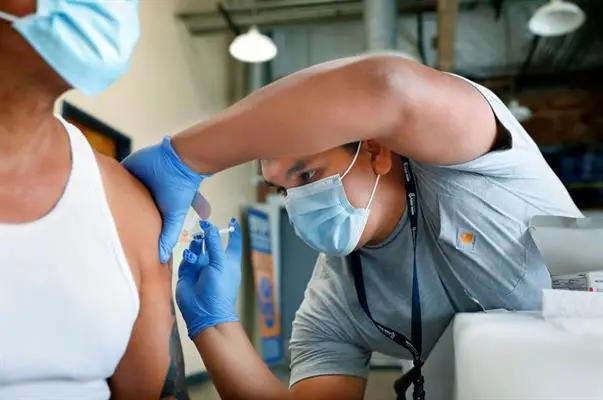
Booster coverage is lowest among Black and Hispanic Americans: CDC

[ad_1]

Thursday, September 01 2022
ABC News Radio

(NEW YORK) — The CDC report also found that booster coverage was highest among white and Asian Americans.
Fewer Black and Hispanic Americans have gotten a first or second COVID-19 vaccine booster compared to people of other races and ethnicities, new federal data finds.

The report, published by the Centers for Disease Control and Prevention Thursday, looked at the share of eligible Americans aged 5 and older who’ve received a primary booster and those aged 50 and older who’ve received a second booster.

As of Aug. 5, 2022, about half of the eligible U.S. population has received a first booster and one-third has gotten a second booster.

Among eligible Black Americans, 42.9% have received a first booster dose and 28.1% have received a second booster. Hispanic Americans had even lower percentages at 37.3% of those eligible with a first booster and 24.4% with a second booster.

By comparison, white and Asian Americans had much higher percentages. Data showed 54.7% of eligible white people had a first booster and 36.6% of those eligible had a second booster.

Meanwhile, 58.5% of eligible Asian Americans had a first booster and 36.1% were given a second booster.

Also found in the CDC report to have lower booster coverage were younger Americans, regardless of race or ethnicity.

However, when looking at the racial and ethnic breakdown of boosters among children between ages 5 and 11, 9.8% of eligible Black children and 10.4% of Hispanic children had received a booster.

About twice as many eligible white and Asian children were boosted, at 17.7% and 20.6%, respectively.

“This is once again an indication that this pandemic has exposed incredible disparities, first in access to testing, treatment and vaccines,” said Dr. John Brownstein, an epidemiologist at Boston Children’s Hospital and an ABC News contributor. “Now, certain populations are not getting access to important, life-saving boosters.”

Brownstein said one reason for the low percentages, especially with the second booster, may be because of the innovative methods used to vaccinate people earlier in the pandemic that have since disappeared.

“There was a huge drive to get people that primary series and meeting people where they were with pop-up sites and drive-through vaccination, and much of that infrastructure has gone away,” he said. “We’re now relying on more traditional measures, like pharmacies and primary care.”

Research has shown people of color are more likely to live in pharmacy deserts with less geographic access to primary care physicians.

“They may mean some populations get left behind and unfortunately, that often means minorities,” Brownstein added.

The authors wrote understanding what is contributing to lower booster coverage and addressing interventions “is crucial to ensuring equitable access to COVID-19 vaccination.”

Brownstein said increasing uptake is even more vital as autumn approaches with colder weather and more people heading indoors increasing the risk of COVID-19 infection.

“There is urgency to try to figure this out ahead of a surge,” he said. “We expect emergence of a new variant and as we see limited masking and full mobility, that increases the risk.”

“Some minority populations will feel the impact the greatest. We have a new opportunity with a new booster to avoid getting to a point with unnecessary hospitalizations and deaths among Black and Hispanic Americans,” Brownstein continued.

Copyright © 2022, ABC Audio. All rights reserved.

Article is invalid or is no longer published.

[ad_2]

Source link

Trending Topics

Features

Download and distribute powerful vaccination QI resources for your community.

Sign up now to support health equity and sustainable health outcomes in your community.

MCED tests use a simple blood draw to screen for many kinds of cancer at once.

FYHN is a bridge connecting health information providers to BIPOC communities in a trusted environment.

Discover an honest look at our Medicare system.

ARC was launched to create a network of community clinicians to diversify and bring clinical trials to communities of color and other communities that have been underrepresented.

The single most important purpose of our healthcare system is to reduce patient risk for an acute event.

Related Posts
The Communities Most Burdened by Disease Should Be the First to Benefit from Artificial Intelligence
Black and Asian Cancer Patients Wait Longer for Pain Relief in New Study
What Is Cyclosporiasis? The Foodborne Illness Showing Up in the News
Scroll to Top
Featured Articles
The Communities Most Burdened by Disease Should Be the First to Benefit from Artificial Intelligence
The Communities Most Burdened by Disease Should Be the First to Benefit from ...
Cancer Pain Care Access Gap Hits Black, Asian Patients
Black and Asian Cancer Patients Wait Longer for Pain Relief in New Study
What Is Cyclosporiasis Symptoms, Food Safety, and Reasons
What Is Cyclosporiasis? The Foodborne Illness Showing Up in the News
Why Minority Mental Health Awareness Month Matters More Than Ever
From Childhood Cancer to Alzheimer’s and ALS Celebrity Health Stories Spark National Conversation on Disease, Caregiving, and Equity
From Childhood Cancer to Alzheimer’s and ALS Celebrity Health Stories Spark N...
Learn How NMQF Is Transforming Early Disease Detection in Flint
Categories
AI
ATTR-CM
BIPOC News
Cancer
Clinical Trials
Covid19
Diseases of the Body
Environment
Health Data
Health Equity Events
Health Policy
Health Tips
Subscribe to our newsletter to receive our latest news​
All Stories
The Communities Most Burdened by Disease Should Be the First to Benefit from Artificial Intelligence
The Communities Most Burdened by Disease Should Be the First to Benefit from ...
Cancer Pain Care Access Gap Hits Black, Asian Patients
Black and Asian Cancer Patients Wait Longer for Pain Relief in New Study
What Is Cyclosporiasis Symptoms, Food Safety, and Reasons
What Is Cyclosporiasis? The Foodborne Illness Showing Up in the News
BIPOC News
The Communities Most Burdened by Disease Should Be the First to Benefit from Artificial Intelligence
The Communities Most Burdened by Disease Should Be the First to Benefit from ...
Why Minority Mental Health Awareness Month Matters More Than Ever
From Childhood Cancer to Alzheimer’s and ALS Celebrity Health Stories Spark National Conversation on Disease, Caregiving, and Equity
From Childhood Cancer to Alzheimer’s and ALS Celebrity Health Stories Spark N...
Environment
UV Safety Awareness Month Raises Urgency on Skin Cancer Prevention and Sun Protection Equity
UV Safety Awareness Month Raises Urgency on Skin Cancer Prevention and Sun Pr...
Extreme Heat Safety Tips 5 Ways to Protect Your Health This Summer fyh.news
5 Heat Safety Tips That Could Protect Your Health This Summer
Lupus Awareness Event in Baltimore Aims to Support Research and Shine a Light on Health Disparities
Lupus Awareness Event in Baltimore Aims to Support Research and Shine a Light...
Work Force
A multigenerational Black and Hispanic family sitting together in a park, showing how Social Security helps support older adults, people with disabilities, and families across generations.
Millions of Older Americans Could Face Smaller Social Security Checks by 2032...
dreamstime_s_243253251
The Caregiver Journey: The Hidden Backbone of American Healthcare
Families gather at a Bronx community festival with live music, kids’ activities, and health booths sharing SOMOS social care resources and free screenings.
Celebrating Hispanic heritage while learning about health care

[xyz-ips snippet=”Output-Source-Name”]

Clinical Trials
Clinical Trial Diversity Remains a Critical Challenge in Alzheimer’s Research
Healthcare professional collecting a blood sample from a diverse patient as part of multicancer early detection screening.
Bridging the Gap: How Multicancer Early Detection Can Advance Health Equity i...
dreamstime_s_174488289
PCOS to PMOS: Why the 2026 Name Change Matters for Women’s Health

[xyz-ips snippet=”Output-Source-Name”]

Vaccines and Outbreaks
A parent checking a child's temperature during summer, illustrating the changing RSV patterns and year-round respiratory virus risks.
Can You Get RSV During the Summer?
Michelle Lam, MBA, of NYC Health + Hospitals/Elmhurst & Amy Harris of NYC Health + Hospitals/Elmhurst
Healthcare Leaders Spotlight Vaccine Equity and Adult Immunization Strategies...
Measles Outbreaks Surge: Essential Facts and Prevention Strategies
Other Categories
AI
Read the latest AI News stories trending around the world
ATTR-CM
Cancer
Read the latest Cancer stories trending around the world
Covid19
Diseases of the Body
Read about the latest Diseases of the Body trending around the world
Friday Webinars
Every Friday, we bring you insightful webinars covering critical topics in healthcare, data equity, and policy reform.
Health Data
Read the latest Health Data stories trending around the world
Health Equity Events
Read the best Health Equity Events around the country.
Health Policy
Read the latest Health Policy stories trending around the world
Health Tips
Heart Health
Read the latest on Heart Health News, Stories and Tips.
kidney Health
Read more trending News about Kidney Health, Stories and Tips.