













[ad_1]

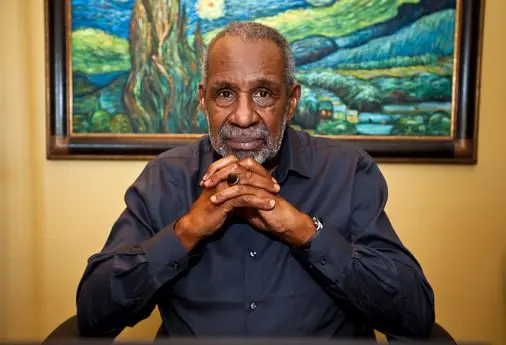
A pioneering Black journalist who was the first editor of The Bay State Banner and later a diversity consultant to corporations, Mr. Rollins was 84 when he died at home in Jacksonville, Fla., on May 27 of stage IV esophageal cancer and stage IV AL cardiomyopathy.
“From birth, I received powerful messages every day that I was inferior because of the color of my skin,” he wrote in “The Meaning of Race,” a 1997 Globe essay.
“Racial separation, and the pain and anger that comes from it, seemed expected when I was spat on and beaten by whites at a public swimming pool in the West End, or called ‘dirty’ by whites in Roxbury, and humiliated by teachers in school,” he wrote. “Anger seemed a proper response when Tom Yawkey humiliated me at Fenway Park by refusing to shake my hand and greet me as he did all other new members of the Baseball Writers’ Association. And on and on, every day facing another subtle or blatant experience.”
While Mr. Rollins made no secret of his anger at racism, he worked as a diversity consultant to heal divisions in the workplace.
Over the years, clients of his Mountaintop Ventures and StetsonRollins consulting firms included major corporations, universities, government agencies, churches, and philanthropic organizations.
“Day after day, I have the honor of being in the room as women and men of all classes and complexions engage each other, face up to their own prejudices, biases, and bigotry, and experience personal transformations,” he wrote in a 1998 Globe essay.
“People change, often in little ways, opening up with new curiosity, wanting to learn more about cultures different from theirs,” he added. “Sometimes the changes are more profound, as when white women and men who don’t even know they are white suddenly understand what it means to be privileged in this culture, experiencing a fundamental shift in world view, self-perception, and personal identity.”
Among those whose eyes he helped open were colleagues dating back to his days as a Globe reporter.
“I quickly learned to pay attention when he was talking because he not only knew Roxbury and the minority neighborhoods and their interests, but he was wiser than me,” said Jim Doyle, who worked with Mr. Rollins covering the State House and went on to be the Globe’s Washington bureau chief.
In the years before court-ordered desegregation of Boston’s schools, “I learned more from listening to Bryant in the car than watching the news,” Doyle said. “He explained to me how deep the pain and resentment was, what the reparations movement was about, and how far the society still had to change.”
Mr. Rollins “had such a depth of character,” said former Globe writer Jack Thomas. “And when it came to writing, he was ahead of me. I aspired to his level.”
Their friendship began when they were English High School students, and they last saw each other earlier this year in Florida. They thought of it as a goodbye lunch; Thomas had been diagnosed with cancer, but Mr. Rollins had not yet received his own cancer diagnosis.
“I almost fall into tears when I talk about him,” Thomas said. “In the lobby of the restaurant, after the lunch, we embraced. I said, ‘I love you, Bryant.’ He said, ‘I love you, Jack.’ “
Edward Bryant Rollins Jr. was born in Boston on Dec. 13, 1937, and grew up in Roxbury and Dorchester.
His parents, Edward Bryant Rollins Sr. and Edith Wade Rollins, met as vaudeville dancers and settled in Boston. Stymied by racial barriers that prevented him from higher-paying work, Edward Sr. drove a cab and did odd jobs. Edith sewed fur coats for the affluent.
Mr. Rollins would later recall that the family’s home was filled with books as his father studied for exams for jobs that ended up being closed off to Black men.
After graduating from English High and Northeastern University, Mr. Rollins worked at the Globe, where he wrote a well-regarded series about the career of then-attorney general Edward Brooke, who later was the first Black candidate popularly elected to the US Senate.
Mr. Rollins subsequently was the first editor of The Bay State Banner at a time when, he recalled in a 1981 Globe interview, the Banner’s news staff was only him.
He went on to serve as editor of the New York Amsterdam News and work as an editor at The New York Times before turning to consulting full-time.
At the time of his death, Mr. Rollins was completing a memoir, “The Slave in My Mirror.” He also wrote two novels and cowrote Cab Calloway’s autobiography, “Of Minnie the Moocher & Me.”
Mr. Rollins’s marriages to Judith Coleman and Elizabeth Rollins Moskowitz ended in divorce.
In 1983, he met Shirley Stetson when they were working on a consulting project in Massachusetts. They married in 1995 and moved two years later to Jacksonville, where they ran StetsonRollins Consulting.
“People were drawn to listen to him,” she said.
“He was magnetic,” she added. “He would ask the question that was beneath the surface, and then he would keep going deeper. He wanted to get to the deepest ‘why’ of what I was talking about or anybody was talking about.”
A memorable laugh also enlivened every encounter with Mr. Rollins, Thomas said.
“He had the best laugh in the world,” Thomas said. “If you ever heard that laugh, you’d want to go to Henny Youngman’s joke book and stock up so you could hear it again.”
A service was held in Florida for Mr. Rollins, who in addition to his wife leaves his daughter, Malikkah of Washington, D.C.; his son, Salim of Nairobi, Kenya; his stepdaughter, Kaitlin Schroeder of Petaluma, Calif.; his stepson, Stephen Kessler of Moultonborough, N.H.; his sister, Judith of Jamaica Plain; and seven grandchildren.
In his letter to McDonough, Mr. Rollins said that when he went to Boston Garden to cover a Celtics game, guards forced him to call the Globe’s sports editor to prove he hadn’t stolen a press pass.
There was racism in the newsroom, too. Mr. Rollins wrote that he was ostracized by Globe sportswriters when he “complained in writing” to the sports editor after overhearing a white reporter use the n-word while grousing to a colleague that Black players were “taking over pro basketball” in the era of Bill Russell and Sam Jones.
“Half the department stopped talking to me,” Mr. Rollins noted.
In his 1997 Globe essay about race, he wrote about his vision “of a gathering of healers” to address racial divisions.
“The grand contradiction of race requires a grand intervention,” he said, and “the way to change our beliefs is through the deepest forms of communication and sharing; by identifying and acknowledging beliefs that do not serve us as a community, and by deciding, consciously, to change.”
Bryan Marquard can be reached at bryan.marquard@globe.com.
[ad_2]
Source link