














- By FYH News Team
[ad_1]
Opioid mortality rates continue to increase throughout the United States1; however, growth in buprenorphine hydrochloride treatment for opioid use disorder (OUD) might be limited to communities with higher income and low percentages of racial/ethnic minorities.2 Buprenorphine, a partial opioid agonist, is 1 of 3 evidence-based medications for treating OUD and can legally be prescribed in office-based settings.
To our knowledge, no national studies have examined the differences in the receipt of buprenorphine prescription by race/ethnicity and payment in office-based settings, in which most patients with buprenorphine prescription receive care.3 In this article, we present changes in buprenorphine treatment at office-based visits in the United States since 2004 as well as the race/ethnicity and payment characteristics currently associated with its receipt.
We combined data from the National Ambulatory Medical Care Survey and the National Hospital Ambulatory Medical Care Survey outpatient department component from 2004 to 2015. The surveys, which provide nationally representative estimates of ambulatory care provided in the United States by non–federally employed physicians, capture physician-reported medications prescribed during each office visit as well as demographic characteristics and expected source of payment. The University of Michigan Institutional Review Board did not require approval for this study, given that secondary analysis of publicly available, nonidentifiable data set is not regulated. Informed consent was not applicable for this type of study.
We limited our sample to visits in which buprenorphine was prescribed, and we aggregated the sample into 4-year periods. We estimated buprenorphine prescription rates by race/ethnicity and payment. We chose the most recent period (2012-2015) to test the association of race/ethnicity with receipt of buprenorphine prescription using logistic regression adjusted for age, sex, and payment method. Analyses were completed in Stata, version 15.1 (StataCorp LLC), and accounted for complex survey design elements to generate nationally representative estimates.
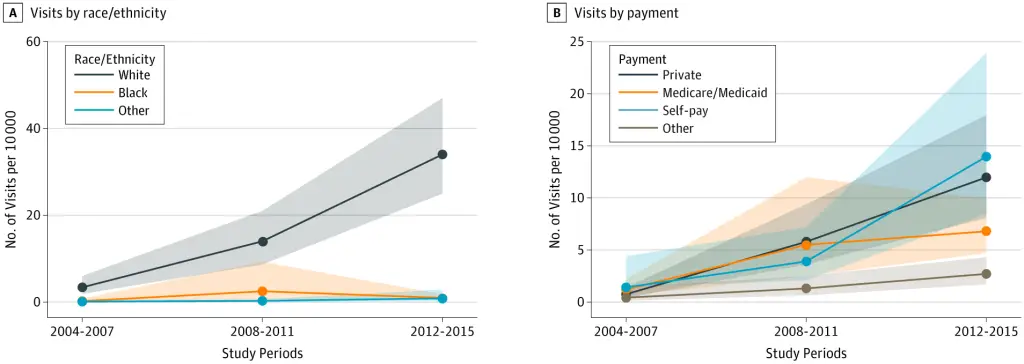
From 2004 to 2015, the number of buprenorphine visits rose from 0.04% to 0.36% of all ambulatory visits, representing 13.4 million visits between 2012 and 2015. From 2012 to 2015, buprenorphine prescription was received at considerably more visits by white patients than patients of other races/ethnicities (12.7 million [95% CI, 8.6 million-16.8 million] vs 363 000 [95% CI, 134 000-594 000]) (Figure). Self-pay and private insurance were the most common payment methods across all years (Table). The number of buprenorphine visits by self-pay patients dramatically increased from 585 568 (95% CI, 0-1.3 million) visits in 2004 to 2007 to 5.3 million (95% CI, 2.5 million-8.5 million) visits in 2012 to 2015, accounting for 39.6% of the visits. After accounting for payment method, sex, and age, we found that black patients had statistically significantly lower odds of receiving buprenorphine prescription at their visits (adjusted odds ratio, 0.23; 95% CI, 0.13-0.44).
This study demonstrates that buprenorphine treatment is concentrated among white persons and those with private insurance or use self-pay. This finding in nationally representative data builds on a previous study that reported buprenorphine treatment disparities on the basis of race/ethnicity and income in New York City.2 It is unclear whether the appearance of a treatment disparity may reflect different prevalence in OUD by race/ethnicity. We did not restrict the analysis to individuals with OUD because the National Ambulatory Medical Care Survey and the National Hospital Ambulatory Medical Care Survey are unlikely to accurately capture OUD prevalence, but a recent analysis of the National Survey on Drug Use and Health suggests that the prevalence of opioid misuse is similar for black (3.5%) and white (4.7%) adults.4
Despite the enactment of both mental health parity legislation and Medicaid expansion, the proportion of self-pay buprenorphine visits remained relatively steady across the study period.5 A recent study demonstrated that half of the physicians prescribing buprenorphine in Ohio accepted cash alone,6 and our findings suggest that this practice may be widespread and may be associated with additional financial barriers for low-income populations.
This study provides a snapshot of the national differences in buprenorphine treatment for OUD. With rising rates of opioid overdoses, it is imperative that policy and research efforts specifically address racial/ethnic and economic differences in treatment access and engagement.
Accepted for Publication: March 12, 2019.
Corresponding Author: Pooja Lagisetty, MD, MSc, NCRC B16-Floor 2, 2800 Plymouth Rd, Ann Arbor, MI 48109 (lagiset@med.umich.edu).
Published Online: May 8, 2019. doi:10.1001/jamapsychiatry.2019.0876
Author Contributions: Dr Lagisetty and Mr Ross had full access to all of the data in the study and take responsibility for the integrity of the data and the accuracy of the data analysis.
Concept and design: Lagisetty.
Acquisition, analysis, or interpretation of data: All authors.
Drafting of the manuscript: Lagisetty, Ross, Maust.
Critical revision of the manuscript for important intellectual content: All authors.
Statistical analysis: Ross.
Administrative, technical, or material support: Lagisetty, Clay.
Supervision: Lagisetty, Maust.
Other – mentoring: Bohnert.
Conflict of Interest Disclosures: None reported.
TV, Muller
JZ, Chernyak
E,
et al. Access to and payment for office-based buprenorphine treatment in Ohio. Subst Abuse. 2017;11:1178221817699247.PubMedGoogle Scholar
[ad_2]
Source link
Trending Topics

Features
- Drive Toolkit
Download and distribute powerful vaccination QI resources for your community.
- Health Champions
Sign up now to support health equity and sustainable health outcomes in your community.
- Cancer Early Detection
MCED tests use a simple blood draw to screen for many kinds of cancer at once.
- PR
FYHN is a bridge connecting health information providers to BIPOC communities in a trusted environment.
- Medicare
Discover an honest look at our Medicare system.
- Alliance for Representative Clinical Trials
ARC was launched to create a network of community clinicians to diversify and bring clinical trials to communities of color and other communities that have been underrepresented.
- Reducing Patient Risk
The single most important purpose of our healthcare system is to reduce patient risk for an acute event.
- Jessica Wilson
- Subash Kafle


