










[ad_1]
CHICAGO — The American Indian Center’s new Food is Medicine program marks a generational and culinary shift — through braised bison with a blackberry mole sauce, and a venison dip sandwich with giardiniera — for the cultural center to 65,000 Native Americans in the Chicago area.
The AIC, founded in 1953, now located in Chicago’s Albany Park neighborhood, launched the program in 2023, and just held an inaugural gala in celebration, the first in its 71-year history, at the Newberry Library on Oct. 26.
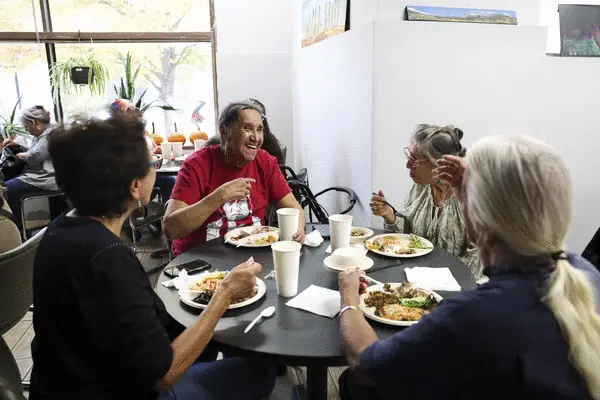
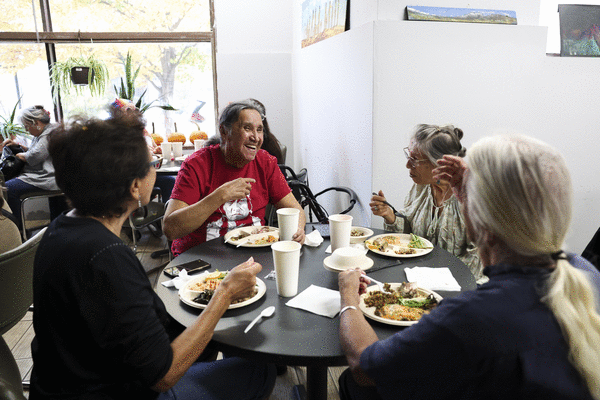
But the weekly Wednesday senior lunch is where you’ll best see the program in practice, and not only for Native American Chicagoans.
“Anybody’s welcome to come,” said Paul Molina, chef and project coordinator for the Food is Medicine program. His family background is Mexican and Texas Kickapoo, and he previously worked at the Indigenous Food Lab. The professional kitchen and training center in Minneapolis was co-founded by the award-winning chef Sean Sherman of Owamni, which the James Beard Foundation named Best New Restaurant in 2022.
The Food is Medicine program is sponsored by a grant from the Department of the Interior, Molina said.
“What we do is try to serve healthy food with that grant money,” he said. “So it allows me to buy Native foods from other states, like Michigan, Wisconsin and Minnesota.”
He buys dried beans from New Mexico to further keep their grant money in the Native American community.
“Really, it’s for Native people,” he added. “But we have enough to share with everybody, so I try to leave the door open for people to come and eat with us once a week in our senior lunch program.”
One recent menu featured herb-marinated wild salmon with rosemary, thyme, lemon balm and sage harvested from their small kitchen garden.
“We’re working on getting bigger plots so that we can be more food sustainable,” said Molina, who also goes foraging for sumac when the time is right.
Once a month he offers a food box, the chef said, free for whoever wants it.
“I try to incorporate a lot of healthy foods, stuff that our seniors probably won’t eat during the week,” he said about the weekly lunch and monthly food box. “I don’t want to say, ‘Forget about the past, but it’s time to move on a little bit, and focus on the things we can change right now.”
The past for him means there’s one dish you won’t find at senior lunch.
“When people ask me if I make fry bread, I tell them, ‘No, sorry, I’m not gonna do it,” Molina said.
The deep-fried dough has a complicated culinary history rooted in the forced displacement of Native Americans, symbolizing the worst of colonization to some, and the best of resilience to others.
“I haven’t made it since I’ve been here,” the chef said. “But there’s other people that’ll come in and make it because it’s a good seller. People just come out of the woodwork that you haven’t seen in years just to get that bread. That’s kind of funny, but amazing. I can’t think of any other way to make it healthier.”
Fry bread Indian tacos will be available at the center’s annual Holiday Native Art Market on Dec. 7.
To be clear, the chef will not be making the fry bread then either. He does, however, use a surprising ingredient when making cornbread.
“I love Jiffy,” he said about the boxed corn muffin mix. “I grew up on that, so I’ll use that.”
At the recent senior lunch with the herb-marinated salmon, he made cornbread for dessert with scratch-made Wojapi, a traditional stewed berry blend, balanced with an untraditional lemon curd.
Molina, who grew up in the Pilsen neighborhood, cooks alone and usually sees about 20 people on Wednesdays, but expects more after the gala.
“Now the word is getting out,” he said. “I met people there that said they would come.”
At the gala, another chef cooked and created her own menu in the spirit of Food is Medicine.
“We had braised bison with a blackberry mole sauce. We had roasted rabbit with a spiced cranberry sauce. We had a woodland mushroom wild rice stuffing,” said Jessica Walks First, owner and executive chef of Ketapanen Kitchen.
Ketapanen Kitchen is a full-service cultural immersion experience.
“We do catering. We do pop-ups. We do education,” said Walks First, who is from the Menominee Indian Reservation in Wisconsin. “The word ketapanen is an expression of love in the Menominee language because I believe anything in the kitchen should be done with love.”
She’s become best known for her Indigenous tamales.
“We do bison blueberry, rabbit carrot mole and wild turkey chipotle,” Walks First said.
At the gala, the foods she used were also mostly Indigenous ingredients. She offered an apple beet harvest salad with maple vinaigrette, and for dessert, a blueberry cake with warm wojapi pudding and cream.
“All those foods have medicinal properties,” she said. “But our food is medicine in a different way. It’s medicine that creates connection, that can heal the spirit and the heart. Sharing a meal is sacred. Preparing a meal for people is sacred. Feeding people is sacred. And all of those things are healing acts. So that’s the other spectrum of medicine when it comes to Indigenous food.”
Her mission with Ketapanen Kitchen is to bring Indigenous cuisine to the forefront of Chicago’s culinary scene.
“But with that mission, it’s also to bring the stories,” she added. “The education component is very important as well. It’s probably the most important piece, because so much of our history has been obliterated or falsely written.”
She counts fewer than 20 professional Native American chefs in this country.
“It is startling. It’s saddening. And it hurts my heart,” she said. “But I know all of those chefs.”
And they are overwhelmed with work.
“There’s a demand for it. There’s a need for it. There’s a want for it,” Walks First said. “We’re trying to fill the void. But us being the pioneers of Indigenous foods in the modern scene, I think what we’re doing is kind of laying the groundwork for others to walk behind us.”
“I would love there to be at least a few more chefs in Chicago who I could split the workload with,” she added. “I’m not complaining that I’m busy, believe me, it keeps my life comfortable and it gives me opportunities to further myself. However, there are so many Native people who are cooks.”
“I don’t know a Native home that you can ever walk into and someone isn’t trying to feed you,” the chef said. “I have never been to a Native event where you go in and there’s no food.”
“With that kind of number of people who cook and who value food as part of their culture, there should be greater representation.”
So what do we need to finally get an Indigenous Native American restaurant in Chicago?
“Funding,” Walks First said. “So many more of us could do the work if there was money for small businesses.”
“If I could afford a restaurant front in Chicago, I’d already be there.”
In addition to her work as a chef, she is the president of the board of directors at the AIC.
“I grew up at the American Indian Center,” Walks First said. “With Chicago being one of the largest urban Indian populations in the country, that was our second home.”
“My children grew up there,” she added. “And our community is not just Native people, but it’s the allyships we formed.”
“Food is Medicine encompasses mind, body and soul,” the chef said. “And when you’re doing the work to heal your community, especially a community that is riddled with generational trauma, a program like this is vital.”
And on top of all of her overwhelming work at Ketapanen Kitchen, the American Indian Center and the gala at the Newberry, she recently lost her son.
“His name was Michael Pamonicutt III,” said Walks First, her voice breaking. “He was also a Menominee tribal police officer.”
“My son was a very healthy young man,” she said. “All I know is my baby was here one minute and then he was gone.”
Pamonicutt was 30 and died in Shawano, Wisconsin, on Sept. 28.
“Being in that gala, surrounded by my community, helps me heal,” Walks First said. “They have been there for me every step of the way since the moment my son died. That’s what healing is. That’s what community is. That’s what AIC is.”
Back at the senior lunch, Molina said they hope to have a small cafe open a few days a week in the future to further serve the community.
What does he dare to dream for the culinary future of their cultural center?
“My dream would be to have an awesome garden, maybe a rooftop garden, to grow our own food,” Molina said. “To have a good menu to showcase the Americas, South America and Canada too.”
“And to have some really good drinks where you can use herbs and teas and just stuff that’s really healthy for you,” he added.
But being in Chicago, would he ever do something like an American Indian Center Italian beef sandwich since “The Bear” has been so big?
“I’ve done those,” Molina said about his secret senior special. “I’ll do a venison dip with giardiniera. I just slow-cook venison and slice that up, then make a juice with everything. And then my little secret is to add chai in there while it’s cooking.”
The chai mellows out the gaminess of the wild venison, he said.
“Because you have cloves and other spices in there,” he added. “Yeah, it’s good.”
Imagine if we could all have an Indigenous Native American chai-infused wild venison Italian beef-inspired sandwich that was once a senior lunch special.
“Hunting season is coming,” Molina said. “We have some people who might hopefully drop off some venison for us.”
____
American Indian Center, 3401 W. Ainslie St., 773-275-5871, aicchicago.org
©2024 Chicago Tribune. Visit at chicagotribune.com. Distributed by Tribune Content Agency, LLC.
[ad_2]
Source link