














[ad_1]
COVID-19 data
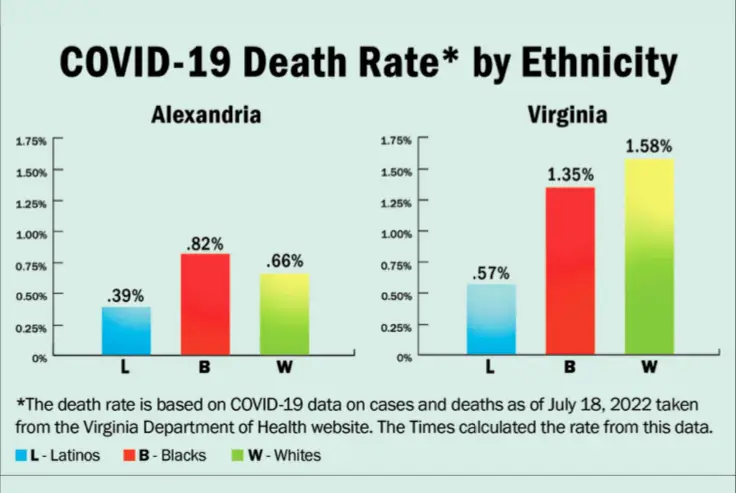
Latinos in Alexandria and statewide have by far the lowest death rate per COVID-19 cases of the three main ethnic groups of whites, Latinos and Blacks, while Blacks have the worst outcome per case in Alexandria. Perhaps the most shocking data point is that whites have the worst outcome per COVID-19 case statewide of Virginia’s three major ethnic groups.
In Alexandria, Blacks have a death rate of .82% per case of COVID-19, with 61 total deaths out of 7,427 cumulative cases of COVID-19 through July 18, 2022, according to the Virginia Department of Health website. The Black death rate per COVID-19 case is more than double that of Latinos in Alexandria, as Latinos have a death rate of .39% per case of COVID-19, with 30 deaths out of 7,712 cumulative cases.
The white death rate per case of COVID-19 in Alexandria is between that of Blacks and Latinos, at .66%, with 85 deaths out of 12,873 cumulative cases, according to data found on the Virginia Department of Health website. The white death rate per case in Alexandria is 69% higher than that of Latinos, while the Black death rate per case is 110% higher than the Latino death rate.
COVID-19 outcomes in Virginia as a whole are more dire for all three ethnic groups than in Alexandria.
Whites have the worst mortality rate per case throughout Virginia of the three groups, according to data on the Virginia Department of Health website. The white death rate per case of COVID-19 statewide is 1.58%, with 14,046 deaths out of 887,894 cumulative cases. This is almost three times the .57% death rate of Latinos, who have suffered 1,041 deaths out of 182,428 cumulative cases.
The Black death rate per case of COVID-19 statewide is slightly better than that of whites, at 1.35%, with 4,770 deaths out of 353,114 cumulative cases. This death rate is more than twice that of Latinos statewide.
According to Talis, it is difficult to discern trends from the raw numbers provided by the Virginia Health Department.
Talis said that the most important factors the Alexandria Health Department looks for when determining causalities between racial and ethnic groups include age, underlying health factors and other factors that might be relevant to the time at which the data was collected.
“From our standpoint, there [are] a lot of things to consider in that equation to really understand ‘is that difference that we are seeing right now statistically significant?’… and that it’s not just chance or numbers, but really shows a statistical difference, and then thinking about how we would consider age and some other factors to really determine what is going on,” Talis said.
Talis said the AHD will be working to better understand these and other COVID-19 outcomes.
“[The Alexandria Health Department] is going to be doing a deeper dive later this year to really look at that cross-section of ‘who’s been most impacted by COVID in our community?’ and ‘what could be some contributing factors to that?’” Talis said. “It’s really important to do because all of the other conditions and diseases in Alexandria haven’t stopped because of COVID, and so really understanding who is impacted and why will also help us address some of those other chronic conditions and concerns that continue to exist here.”

The role of vaccines
A second finding derived from Virginia Department of Health data is that the rate of vaccination – defined here as at least one dose of a vaccine – is strongly correlated with significantly better COVID-19 health outcomes in Alexandria and statewide.
In Alexandria, white residents have the lowest vaccination rate, at 71.1% of the eligible population, with the Black rate only slightly higher at 74.2%. Conversely, Latinos in Alexandria are almost fully vaccinated, with a 95.1% rate of inoculation against COVID-19.
Statewide, whites have a slightly higher vaccination rate than Blacks, at 67.4% to 65.2%, while the Latino vaccination rate statewide is 83.5%.
Across Virginia, Latinos, the ethnic group with a vaccination rate more than 25% higher than that of whites or Blacks, have a COVID-19 death rate per case that’s between one half and two-thirds lower than either group, according to Times calculations based on Virginia Department of Health data.
Sinha emphasized the role of preventative care in improved medical outcomes.
“Primary healthcare … the frontline people, the people you go to first, that is based on a trust relationship.” Sinha said. “ … There are different socioeconomic classes, and we know that people who have an established physician, a primary care doctor who focuses on preventative health, just tend to do better in general with all sorts of conditions.”
According to Sinha, efforts have been made to provide care to those without ongoing access to healthcare.
“COVID really brought to light the differences that we see in access to healthcare. We have some of the best healthcare in the country, it’s just an access problem that we have. It’s not the same across the board,” Sinha said. “There’s been a tremendous amount of outreach and focus on ethnic minorities.”
Sinha referenced the political polarization surrounding outreach programs that emphasized ethnic minorities. These programs appear to have been extraordinarily successful in minimizing severe COVID-19 outbreaks in Virginia.
“I have never seen politics and healthcare so intermingled [as they are now]. … Decisions should be made by medical personnel,” Sinha said.
Further evidence of the efficacy of vaccines in minimizing deaths from COVID-19 can be garnered from data surrounding gender, vaccinations and COVID-19.
In Alexandria, 90.6% of women have received at least one dose of the COVID-19 vaccine, and women have less than a half percent death rate per case, .44%, with 87 deaths out of 19,866 cases. City men are vaccinated at an 84.6% rate, and have a death rate per case of .63, with 108 deaths out of 17,186 cases.
As with ethnic groups, the statewide vaccination rate is lower and the death rate higher for both men and women, though again, women statewide in Virginia are vaccinated at higher rates than men, 85.5% to 78%, and have a lower death rate per case, .97% as opposed to 1.26%.
Khan said one explanation for women’s better outcomes is that they tend to take advantage of healthcare opportunities more than men generally.
“One reason why women might have a higher vaccination rate is because we’ve noticed that they tend to engage in healthcare more than men do. When you engage in healthcare, it’s more likely that you have conversations with healthcare providers. You have the opportunity because you are already seeking out healthcare. It’s more likely that you have a primary care doctor who you trust and have known for some time, who will be able to advise you on vaccinations,” Khan said.
Khan also spoke to the politicization of vaccinations and outlying factors that have not been reported.
“Since we’ve had vaccines available, that has entered into the mix as a variable as well,” Khan said. “ … Whether it is really because of age or underlying condition, or whether there is some biological underpinning aside from the vaccination question, is unclear.”
Beyond COVID-19
In an effort to find another health metric to compare to the COVID-19 trends, we looked at maternal mortality rates for Latino, Black and white women for 2019, the last year when data would not have been impacted by the pandemic. We were unable to find state or local breakdowns with ethnic data, but national data is available on the Centers for Disease Control and Prevention website.
The CDC reported that Black women had an average maternal mortality rate of roughly 44 per 100,000 live births in 2019. This rate is far worse than those of white and Latino women, with white women having a maternal mortality rate of 17.9.
Latino women again had by far the best health outcome, with a maternal mortality rate of 12.6. Latino women had better outcomes than either Blacks or whites in every age category for which there was statistically valid data, according to the CDC.
Khan emphasized the importance of prenatal care in maternal mortality outcomes.
“One thing that I would want to talk about on this is potentially access to early prenatal care. I think that is a very important factor, and it is something that we’ve been trying to do; to expand access to prenatal care so that patients are able to get it early and so that they have a trusting relationship throughout their pregnancy, to help support them through the process and through the underlying delivery,” Khan said.
While prenatal care is not the only factor, Khan emphasized its importance.
“It is a part that we as an organization focus on and try to make sure everyone in our community has access to,” Khan said.
Khan also cited underlying social and economic elements as potential factors.
“They play a big role. There’s been a lot of talk about trust in the healthcare system, and underlying experiences with racism and discrimination. If that is impacting how someone engages with the healthcare system, I think that can be a challenge. There is also the issue of underlying comorbidities,” Khan said.
This trend of better health outcomes for Latinos than either whites or Blacks from COVID-19 was consistent both before and after the availability of COVID-19 vaccines. It also held true when looking at an entirely different health metric, that of maternal mortality. Khan and Sinha emphasized the need for people to avail themselves of medical care in their communities, something that Latinos appear to have done in large numbers both in Alexandria and Virginia as a whole during the COVID-19 pandemic.
The writer is a rising senior at Christopher Newport University majoring in English with a minor in political science. Denise Dunbar also contributed to this story.
[ad_2]
Source link



