














- By FYH News Team
[ad_1]
“It’s really shocking that the FDA couldn’t issue a warning until 2021,” said Uché Blackstock, an emergency medicine physician and CEO of Advancing Health Equity. “And even in that warning last year, they didn’t even mention racial prejudice or race or racism in it.”
The issue raises broader concerns about bias as technology becomes more entrenched in healthcare, and the government’s ability to counteract it through regulation and oversight. Experts warn that disparate outcomes between racial groups could get worse if technology doesn’t work for all patients.
Researchers identified problems with pulse oximeters years ago, with small studies pointing to erroneous readings in people of color in 1990, 2005 and 2007.
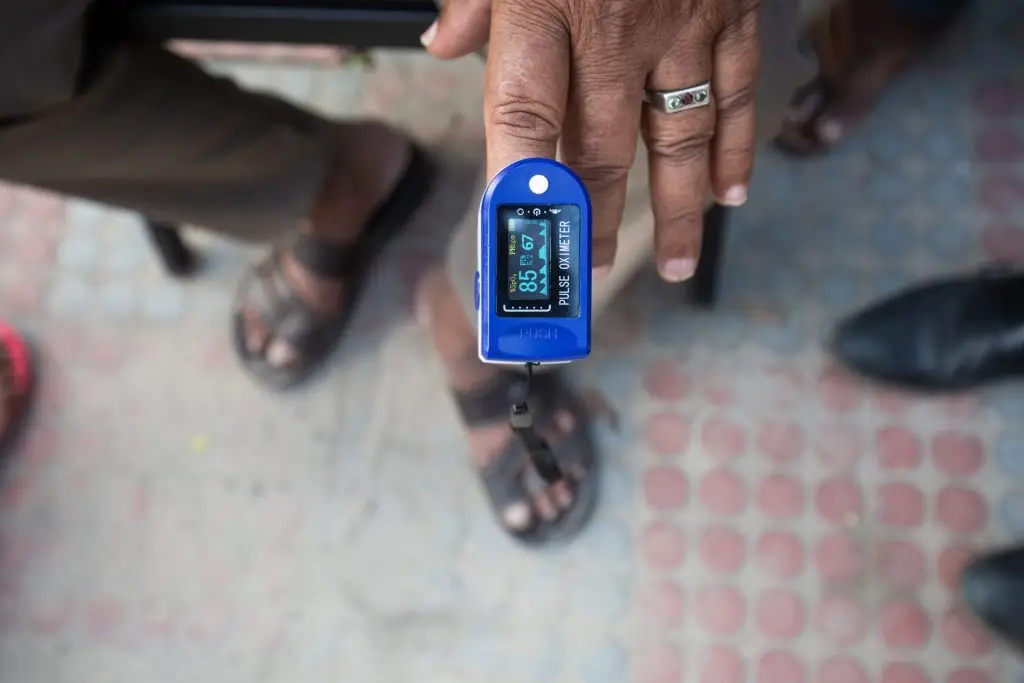
The Covid-19 pandemic has brought renewed attention to the devices, which usually come in the form of a sensor on a patient’s fingertip.
Michael Sjoding, a pulmonologist and critical care physician at the University of Michigan, conducted a study published in December 2020 in the New England Journal of Medicine that found that between January and July 2020, as well as 2014 and 2015, black patients had approximately were three times more likely than whites, because they have low blood oxygen levels, to go undetected. More than one in ten Black patients with an oxygen saturation reading of 92 to 96 percent on a pulse oximeter had a reading of less than 88 percent on blood tests.
Normal levels range from 95 to 100 percent, while levels below 88 percent are considered dangerous.
Experts also say the problem points to the need to update guidelines to compensate for the problem, as well as diversify clinical trials.
The effect on care is real, Sjoding said. “That level of difference, if it had been recognized and detected, would have changed the way we would care for a patient,” he explained. “You would give a patient more oxygen or possibly give a patient different treatments.”
Known and unknown
Experts say the flawed measurements are a result of how light is absorbed by different skin tones. Pulse oximeters work by shooting light at a person’s skin and observing how much it bounces back, said Achuta Kadambi, an engineering professor at the University of California, Los Angeles.
Darker skin reflects a smaller signal than lighter skin, which can damage the pulse oximeter’s reading, he said. Kadambi, who has darker skin, has experienced similar problems with automated soap dispensers, which also rely on light to activate.
“The laws of physics are against dark objects, including skin,” Kadambi said, adding that algorithms are one way to solve the problem.
But the research results so far have limitations because not all have been differentiated by the type of oximeter, said Amira Mohamed, a professor at the Albert Einstein College of Medicine. She also noted that generalizing by race can also be tricky.
“There are different kinds of black people,” Mohamed said. “I’m black myself and it doesn’t mean it will work on me the same as it would for my dark-skinned husband, for example.”
Mohamed also says that existing research has mainly been conducted on fair-skinned people, and future studies should focus on people who are more likely to be affected.
Possible solutions
Current FDA guidelines recommend that manufacturer studies involve a minimum of 10 people and “at least 2 darkly pigmented subjects,” or 15 percent of the total group.
Some experts argue that the FDA should increase that pool.
“Basically you don’t have enough information about the accuracy of the device if you only test it on two people,” says Sjoding.
More specific FDA guidelines on oximeters are warranted, said Ashraf Fawzy, a professor of medicine at Johns Hopkins University and lead author of a study published in May in JAMA Internal Medicine, which found that health care providers were more likely to assess disease severity. underestimate and delay treatment for Black and Hispanic Covid-19 patients.
Faster agency action would have been helpful, Fawzy added. The FDA should consider adding a warning label to the devices, said Kimani Toussaint, a professor of engineering at Brown University who is working on potential solutions.
Some experts, such as Blackstock, argue that the oximeters should be taken off the market. Others, such as Mohamed, say significantly more research needs to be done before conclusions are drawn.
“If we’re concerned about someone’s breathing or someone’s oxygen level, it’s not safe to rely entirely on a pulse oximeter and we should always confirm it,” Mohamed said.
And solving the problem in the devices themselves can be a heavy burden.
The FDA spokesperson said it wants to broaden the available data on the issue by:
funding a prospective clinical trial to communicate any changes to the recommendations. It hopes research can sort out “sometimes conflicting data that contains nonpublic information” that manufacturers have provided.
Meanwhile, researchers at Brown University are working on using a single wavelength of light to bypass the skin. That study on healthy patients is at an early stage and saw similar results to commercial devices. The inaccuracies are more common in sicker patients, said researcher Rutendo Jakachira, who works with Toussaint.
Scientists are also looking at using sound as a possible replacement for light as a new method of measuring oxygen levels in the blood.
Clinical Trial Diversity
Meanwhile, with technology playing an increasing role in healthcare, experts say clinical trials, in which people of color have long been underrepresented, need an overhaul.
Lawmakers are aware of the problem. The House last month passed FDA legislation on user fees for medical products that included language to enhance the diversity of clinical trials.
Adrian Aguilera, head of the Digital Health Equity and Access Lab at the University of California, Berkeley, said that in the absence of several participants, the study results don’t necessarily reflect what will happen in the real world.
Trials are traditionally conducted in person, requiring participants to be on-site, which can create barriers for those on low incomes or those with inflexible jobs. Proponents want to use telehealth to attract a larger group of participants.
Companies should avoid “helicopter research” and instead take the time to build relationships with community organizations and people on the ground, Aguilera said.
“What illustrates this situation with the pulse oximeter is that if you don’t think about bias and racism from the start, and you don’t do it intentionally, it becomes embedded in the technology,” Blackstock said.
[ad_2]
Source link
Trending Topics

Features
- Drive Toolkit
Download and distribute powerful vaccination QI resources for your community.
- Health Champions
Sign up now to support health equity and sustainable health outcomes in your community.
- Cancer Early Detection
MCED tests use a simple blood draw to screen for many kinds of cancer at once.
- PR
FYHN is a bridge connecting health information providers to BIPOC communities in a trusted environment.
- Medicare
Discover an honest look at our Medicare system.
- Alliance for Representative Clinical Trials
ARC was launched to create a network of community clinicians to diversify and bring clinical trials to communities of color and other communities that have been underrepresented.
- Reducing Patient Risk
The single most important purpose of our healthcare system is to reduce patient risk for an acute event.
- Jessica Wilson
- Subash Kafle


