













[ad_1]

Obesity among New Zealand four-year-old children is continuing to decline, but one in three children are still considered overweight, a new University of Otago study shows.
This is the second study analyzing electronic data from the Ministry of Health’s B4 School Check—a free health and development check offered to four-year-olds in New Zealand.
The first analysis of data collected from 2010 to 2016 and published in 2018, revealed a downward trend in the prevalence of obesity in four-year-olds across all socio-economic and ethnic groups.
The latest study, undertaken by researchers from A Better Start National Science, at the University of Otago, and published in the International Journal of Obesity, saw a continuation of that trend from 2017 to 2019.
Some 438,972 consenting records have been included in both studies—about 55,000 children for each year of analysis.
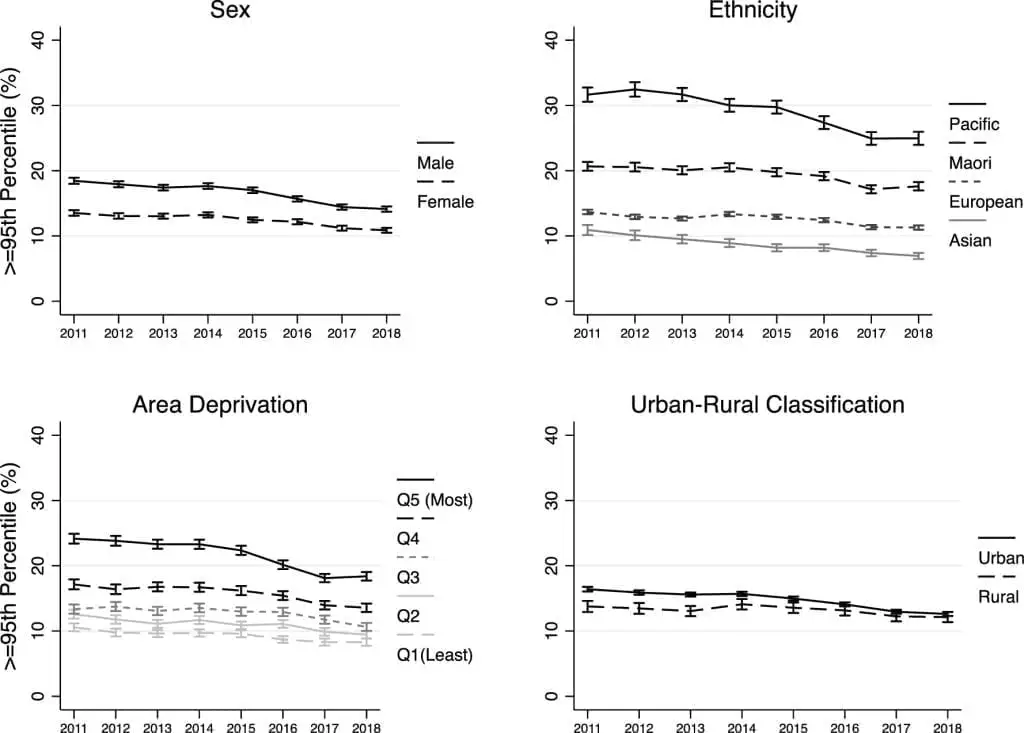
Researcher Dr. Lisa Daniels says in the recent study, the percentage of children at or above the 85th, 95th and 97th percentile reduced by 5%, 3.5%, and 1% respectively between 2011 and 2019.
“What is really reassuring to see from this work is that the declines in high BMI (body mass index) over time are occurring overall and across sociodemographic indicators—sex, ethnicity, deprivation and urban/rural classification—suggesting a narrowing of inequities,” she says.
“Importantly, we observed a narrowing in socioeconomic disparities, showing more pronounced decreases in prevalence above each of the BMI thresholds for children residing in the most deprived areas compared with those living in the least deprived areas.”
While the results are encouraging, the BMI of about 30% of four-year-olds would still be considered overweight or obese.
“There is a lack of national data prior to and beyond the age of 4 years. Future work should focus on what is happening in early preschool years as this time point has been reported to be one of the critical life periods for the development of obesity and a target for early intervention and prevention.”
Reasons for the overall decline is uncertain, Dr. Daniels says.
“Others have suggested that contributions towards declines in overweight and obesity in preschool children could include efforts to focus on public health interventions and initiatives, increased parental education, decreasing unemployment rates, decreased maternal smoking during pregnancy, increased breastfeeding problems and an increasing proportion of mothers born overseas where lower population BMIs are present.”
Another possible factor is New Zealand’s approach to affordable access to early childhood education—all three- and four-year-olds are entitled to 20 free hours—where physical activity and nutrition are important components of the curriculum.
Lisa Daniels et al, Further reductions in the prevalence of obesity in 4-year-old New Zealand children from 2017 to 2019, International Journal of Obesity (2022). DOI: 10.1038/s41366-022-01095-2
Citation:
Further decline in prevalence of obesity in four-year-olds in New Zealand (2022, May 24)
retrieved 24 May 2022
from https://medicalxpress.com/news/2022-05-decline-prevalence-obesity-four-year-olds-zealand.html
This document is subject to copyright. Apart from any fair dealing for the purpose of private study or research, no
part may be reproduced without the written permission. The content is provided for information purposes only.
[ad_2]
Source link