














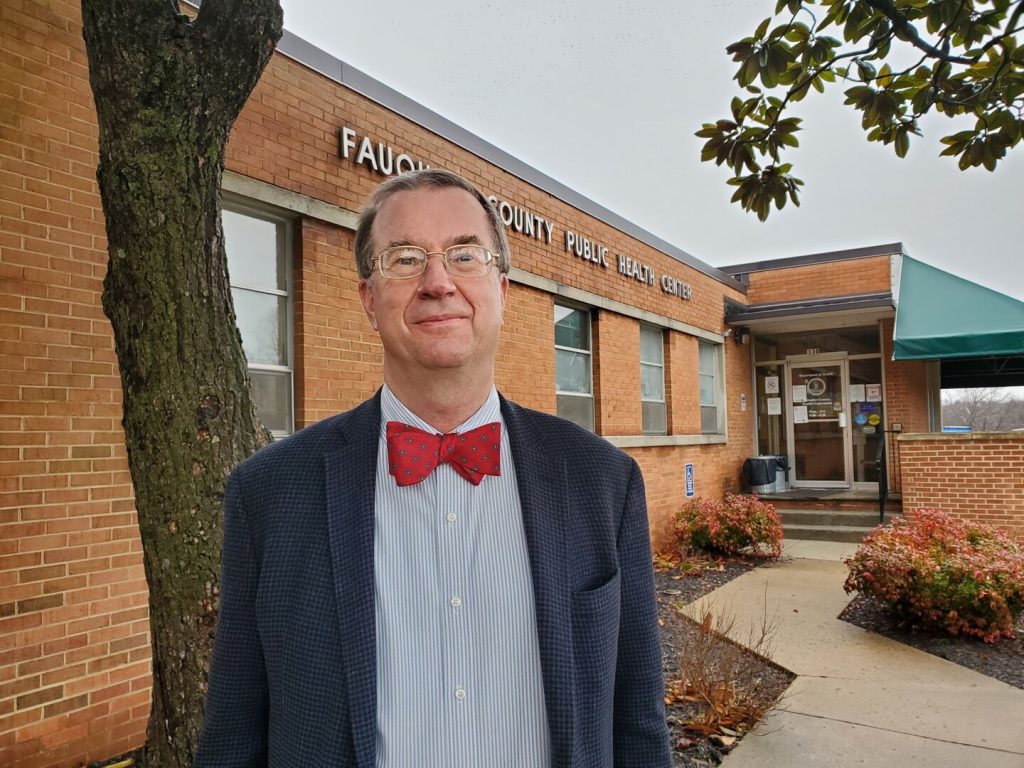
In five months on the job, Virginia’s chief public health official Colin Greene has rejected the state-recognized declaration that racism is a public health crisis and downplayed the role of racism in health disparities, leaving some fearful for their jobs.
Glenn Youngkin's health chief doubts racial disparities in health care
- By FYH News Team
[ad_1]
Greene said he wants staff to be accountable for their work and, doubting the well-established link between structural racism and health disparities, plans to create an investigative unit within the department of health to “start fresh” on, for example, reasons for high rates of Black maternal and infant mortality.
His approach dovetails with efforts by the administration of Gov. Glenn Youngkin (R) to reverse work done under governor Ralph Northam, a Democrat, to acknowledge and address all forms of racism, including rescinding policies intended to further diversity, equity and inclusion in schools.
Greene’s philosophical opposition to considering racism as a scientific variable in public health runs counter to a groundswell of experts embracing the need to confront root causes of health disparities, while the nation grapples with a legacy of racist policies.
Greene maintains that racism is a “politically charged” word that will alienate White people and undermine the state Department of Health’s mission to protect the health and well-being of all Virginians, about 40 percent of whom identify as something other than White.
“If you say racism, you’re blaming White people,” Greene said. “Enough of the world thinks that’s what you’re saying that you’ve lost a big piece of your audience. The fact that there are people teaching about Whiteness in schools in a very negative way doesn’t help.”
In a follow-up interview not long after the mass shooting in Uvalde, Tex., he expanded on his concerns. “It’s not just the word racism,” he said. “For example, when people use the term ‘gun violence,’ I have a problem with that one, too. … Gun violence is, frankly, a Democratic talking point. When you use that term, every Republican in the room is going to walk out,” he said.
Greene’s objections to frank talk of racism stretch back years before Youngkin picked him for the top job, to when he was a local health director in rural northwestern Virginia, documents obtained by The Washington Post through the state’s open records law show.
Greene came to Richmond ready to enforce Youngkin’s order making mask mandates optional in schools and ready to refocus the agency on boosting vaccinations in rural Virginia, where rates lagged among a conservative, mostly White population.
A 63-year-old retired Army physician, Greene said his views on race were shaped in part by 30 years in the most diverse branch of the military, an institution the Associated Press reported last year leaves some servicemembers with no recourse for the discrimination they endure.
“While it was far from perfect, it was an organization where a person’s success was based on their dedication, their abilities and, quite honestly, the quality of their work and the content of their character.” he said.
Greene said as a local health director living on a farm in Loudoun County, that state coronavirus messaging should appeal to rural residents who were hit hard by the pandemic. Youngkin addressed the concern with an ad campaign and visits to Southwest Virginia.
It was not the first time Greene had questioned agency choices. In 2019, emails show, he received a staff-wide message from his predecessor, M. Norman Oliver, after a photo surfaced on then-governor Northam’s medical school yearbook page depicting a person in a Ku Klux Klan costume and a person in Blackface.
Oliver, who studied health inequities and the racial discrimination as a longtime professor at the University of Virginia, said the photo was especially offensive to African Americans and that healing requires “an open, frank, and honest discussion about racism.” His research showed a majority of White people and a number of African Americans “are implicitly, this is, unconsciously pro-white and anti-black,” he said.
In response, Greene emailed Oliver saying that as the leader of a large organization, he should know that his “apparent blanket condemnation of the white race,” was “extremely demoralizing to many on my staff.”
Greene added, “For those of us who try to give our best for you each day, it was a real slap in the face.”
In a recent interview, Greene expanded on his views, saying he associates the word racism with overt displays of violence, such as, “fire hoses, police dogs and Alabama sheriffs.”
Public health experts say acknowledging that systemic or structural racism exists is the first step to addressing systems that perpetuate health inequities.
“To not address it is a dereliction of duty for those of us who are committed to not just public health, but health care specifically,” Oliver said in a recent interview.
Regina Davis Moss, associate executive director of public health policy and practice for the American Public Health Association, noted that since the early 2000s, research by David R. Williams, a professor of public health and African and African American studies at Harvard University, has shown how discrimination harms health.
She also pointed to research that shows Black Americans’ health deteriorates more rapidly than other groups’ because they bear a heavier allostatic load, the cumulative wear and tear on the body in response to stressors, known as “weathering.” The effect impacts pregnancy outcomes as well as diabetes, heart disease, blood pressure and asthma, she said.
Greene said he has read about allostatic load, calling it “entirely subjective.”
Studies have also demonstrated a link between stress, such as the stress of daily discrimination, and degradation of telomeres, sequences of DNA at the end of chromosomes, Davis Moss said. Another study by the same lead researcher found Black women had shorter telomeres than White women, suggesting an environmental cause.
Yet as health commissioner, Greene said the department should not consider racism as a scientific metric. In his view, it can’t be measured the way, for example, poverty or food access can.
Greene in February directed staff to remove an online presentation of department priorities, including a desire to “Explore and eliminate drivers of structural and institutional racism within” the office that runs programs to improve maternal and child health.
He later apologized to Vanessa Walker Harris — director of that office, the Office of Family Health Services, and a Johns Hopkins-educated physician with whom he would later clash — for making the change while she was away, saying he was “practicing urgent damage control with a legislator.” Greene, through a spokeswoman, said he couldn’t recall the name of the lawmaker.
Greene complained to staff in April when the American Public Health Association’s annual awareness week for national public health, the 1915 brainchild of Booker T. Washington that started as National Negro Health Week, featured a day dedicated to understanding racism as a public health crisis.
“America’s been dealing with racism as long as I’ve been alive and it’ll continue dealing with it after I’m gone I suspect, so it’s not a crisis,” he said in an interview.
Greene replaced it with “I am public health,” a website celebrating the public health worker.
He called the new campaign a “positive message, a message everyone can get on board with, a message that’s not going to get anyone angry or offended.”
At least 240 governments and agencies, including the Virginia General Assembly, have declared racism a public health crisis, according to a tracker maintained by the American Public Health Association.
Asked about Greene’s approach to the job, Youngkin said through a spokesperson that while racism exists in the health care system, he is focused on seeking “ways to improve health outcomes for all Virginians.”
Jatia Wrighten, a political scientist at Virginia Commonwealth University who studies race and state legislatures, said the language Greene uses is important.
“You take away racism and we really don’t have to consider what it means and the people who suffered because of it,” she said. “That is dangerous but also effective for someone with his type of power.”
Greene said he learned Black infants die at much higher rates than White infants when he was hired as a local health director in 2017 and received a report that showed 12.2 percent of Black infants per 1,000 live births died in 2013, compared to 5.2 percent of white infants. The Black infant mortality rate has improved somewhat since then, but the grim statistic drives the work of a team that gathered on March 17, in the agency’s Richmond headquarters.
Walker Harris convened the meeting to tell Greene about a federal grant that funds services for women, children and their families, but quickly realized they were at odds.
“The meeting was traumatic. It was tense and challenging,” she said during an hour-long interview in the same conference room where the meeting took place. She wore a pin that she said gives her strength: a mug shot of Rosa Parks taken in 1955, when Parks’s arrest triggered the Montgomery bus boycott.
Greene dismissed her team’s definitions of racism and questioned the well-established link between racism and negative health outcomes for Black mothers and their babies, Walker Harris said. When it was over, one staffer was crying.
“We acknowledge the impact of racism on health outcomes and that it’s important to do so to impact health disparities. It’s a factor along with many other factors,” she said in the interview.
Greene said in the meeting and later in interviews that he had not yet seen compelling evidence that racism was a factor in the poor health outcomes for Black mothers and their babies.
Asked if racism was behind the disparities, he said, “I don’t know that for sure. I will say that intuitively, in my gut, I suspect that it is. If you’re going to be intellectually honest, you don’t start with that assumption, you start with no assumptions and then you go back and look at causes and that’s what I want everyone to do. I want to start fresh on this.”
Before the meeting, Walker Harris shared with Greene six pages of citations on maternal health and maternal mortality, explaining reasons for the stark disparity in health outcomes.
The first in the list, a 2020 article in the Journal of Women’s Health, argues that in addition to conditions in which people are born, grow, live, work and age, social determinants of health should consider structural inequities, such as racism, “as a cause of inequities in maternal health outcomes, as many of the social and political structures and policies in the United States were born out of racism, classism, and gender oppression.”
In the meeting, Greene also raised the issue of sickle cell anemia — a genetic disorder related to one’s ancestry, not skin color — and suggested a genetic link to Black maternal mortality.
“The research is clear it’s not a genetic basis that is the cause of these disparities [for mothers and infants],” Walker Harris said in the interview. “I told him I would not participate in that false equivalence and his bringing up sickle cell in the conversation.”
Walker Harris said she was frustrated with his questioning and that by casting doubt on science that forms the basis of much of her and her team’s work, he was “gaslighting” them.
Greene agreed the March meeting was tense and said he did not know someone had cried.
“The only thing that really struck me was how angry Dr. Walker Harris appeared to be,” he said in one of three times he described her as “angry” during an hour-long interview, invoking a stereotype of Black women. (Greene later said he was not aware of the stereotype.)
Asked about this characterization, Walker Harris reiterated that she was frustrated, but said anger would have been a reasonable response that would not have undermined her work.
Later that day, Walker Harris sent Greene an email saying his “questioning of structural racism’s impact on health outcomes despite robust scientific, public health and social science literature was traumatic for our team.” She added, “ … your comments regarding focusing on measurable outcomes seemed to shame us and disregard the fact that our work is data driven … Altogether, we are fearful for our continued role at VDH and fearful for the work we’ve diligently stewarded even amidst a pandemic.”
Less than an hour later, Greene wrote back and apologized.
“I knew this was going to be a difficult conversation, and I spent much time thinking and praying about how best to express my concerns … perhaps not enough time,” he said in the email.
In the interview, Greene added that agency employees must be prepared to “defend their work” because science is “never done.”
Walker Harris, who has worked in public health for Virginia since 2014 and Maryland before that, said she stayed on during the Youngkin administration because she relishes the opportunity to improve the lives of all Virginians and in particular those who have been marginalized.
“I was recently reminded that we overcome through the word of our testimony,” she said, quoting a Bible verse, “and so I think the telling of the story is important.”
[ad_2]
Source link
Trending Topics

Features
- Drive Toolkit
Download and distribute powerful vaccination QI resources for your community.
- Health Champions
Sign up now to support health equity and sustainable health outcomes in your community.
- Cancer Early Detection
MCED tests use a simple blood draw to screen for many kinds of cancer at once.
- PR
FYHN is a bridge connecting health information providers to BIPOC communities in a trusted environment.
- Medicare
Discover an honest look at our Medicare system.
- Alliance for Representative Clinical Trials
ARC was launched to create a network of community clinicians to diversify and bring clinical trials to communities of color and other communities that have been underrepresented.
- Reducing Patient Risk
The single most important purpose of our healthcare system is to reduce patient risk for an acute event.
Related Posts
National Disability Employment Awareness Month and Health Access
- Jessica Wilson
RSV Season Is Starting. Here’s What Families Should Know
Victor Mejia Lacayo
World Dense Breast Day 2026 Raises Awareness of Breast Density and Cancer Risk
- Subash Kafle


