GnRH analogue plus testosterone does not suppress adult height for transgender boys

[ad_1]

October 21, 2022

3 min read

Disclosures:
The authors report no relevant financial disclosures.


We were unable to process your request. Please try again later. If you continue to have this issue please contact customerservice@slackinc.com.

Most transgender boys reach their predicted adult height after treatment with gonadotropin-releasing hormone analogues and testosterone therapy, according to data published in The Journal of Clinical Endocrinology & Metabolism.

Sabine E. Hannema

“Many transgender boys do not want to compromise their adult height,” Sabine E. Hannema, MD, PhD, a pediatric endocrinologist at Amsterdam UMC in the Netherlands, told Healio. “Worries about how the treatment might affect their height previously caused a dilemma for some. Should they delay the start of treatment until after they had finished their growth spurt? Then they would have to endure progressive breast development and menstrual bleeding. With the results of the study, we can now reassure them that treatment does not affect adult height.”


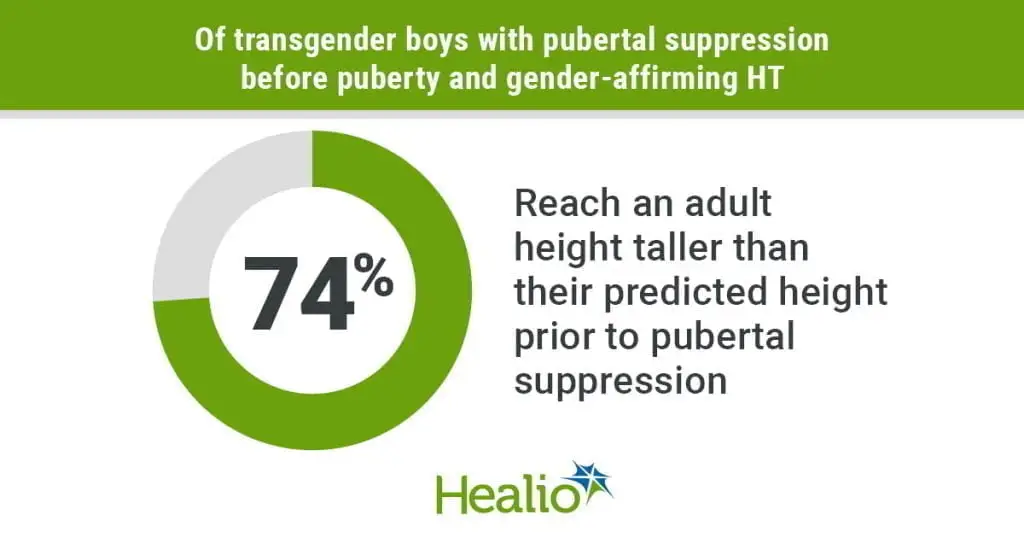
Most transgender boys exceed predicted adult height after pubertal supression and gender-affirming HT

Most transgender boys treated with GnRH analogues and testosterone exceed their predicted adult height. Data were derived from Willemsen LA, et al. J Clin Endocrinol Metab. 2022;doi:10.1210/clinem/dgac571.

Hannema and colleagues conducted a retrospective cohort study of 146 transgender boys attending the gender identity clinic at Amsterdam UMC’s Vrije Universiteit site from 1972 to 2018. Participants started pubertal suppression before age 16 years, received testosterone and had reached age 18 years at the time of data collection. Participants with a bone age of 14 years or younger at the start of pubertal suppression or those who reached menarche 1 year before pubertal suppression were placed in a pubertal group (n = 61; mean age, 12.7 years). Those with a bone age older than 14 years or who reached menarche 1 year or longer before starting pubertal suppression were placed in a postpubertal group (n = 85; mean age, 15.1 years). Bone age was determined by evaluating X-rays of the left hand. Height and weight were measured every 3 to 6 months after the start of pubertal suppression, and height and BMI standard deviation scores were calculated. Midparental height was calculated using a formula that incorporated paternal and maternal height. Female prediction tables were used to determine predicted adult height.

Most exceed predicted adult height

Mean height in the pubertal group was 158.3 cm at baseline and increased to 166.9 cm at the start of gender-affirming hormone therapy. Those with a bone age older than 12 years at the start of pubertal suppression had a greater decrease in height standard deviation score than those with a bone age 12 years or younger (mean difference, –0.6; 95% CI, –0.8 to –0.4), but scores did not differ at the start of HT.

The pubertal group had an increase in height of 5 cm from the start of HT to adulthood with a mean adulthood height of 172 cm. Of the group, 74% had a height taller than the predicted adult height at the start of pubertal suppression. Adult height was 3.9 cm above midparental height and 3 cm above predicted adult height at the start of pubertal suppression. Adult height was similar to predicted adult height at the start of gender-affirming HT.

Younger bone age linked to greater adult height

The time to reach adult testosterone dose did not influence height standard deviation score or adult height. Each year of younger bone age at the start of pubertal suppression was associated with 1.2 cm of adult height above the predicted height. A similar finding was observed with each year of younger bone age at the start of gender-affirming HT.

“Although adult height was unaffected by gonadotropin-releasing hormone (GnRH) analogue and testosterone treatment, 36% of transgender boys had an adult height below –2 standard deviation score compared to the general male population,” Hannema said. “Many ask about treatment options to enhance their growth, so this is a clinical need that requires further research.”

Among the postpubertal group, height increased 2.5 cm to a mean of 169 cm from the start of pubertal suppression to adulthood. Height increased 1 cm or more in 82% of the group. The pubertal group was 3 cm taller than the postpubertal group, but the difference between adult height and midparental height was not different between the groups.

“The findings were not surprising in the sense that my clinical impression was that transgender boys reached a normal adult height,” Hannema said. “On the other hand, findings that in girls with early-normal puberty treatment with GnRH analogues after age 8 years did not have a positive effect and may even have a negative effect on adult height caused some worry. From previous studies in transgender boys, we knew that growth decelerated during GnRH analogue treatment, but whether testosterone treatment resulted in complete catch-up had not been systematically investigated. I am glad we now have these data so that we can use these when counseling transgender boys and their families.”

For more information:

Sabine E. Hannema, MD, PhD, can be reached at s.e.hannema@amsterdamumc.nl.

[ad_2]

Source link
Trending Topics

Features

Download and distribute powerful vaccination QI resources for your community.

Sign up now to support health equity and sustainable health outcomes in your community.

MCED tests use a simple blood draw to screen for many kinds of cancer at once.

FYHN is a bridge connecting health information providers to BIPOC communities in a trusted environment.

Discover an honest look at our Medicare system.

ARC was launched to create a network of community clinicians to diversify and bring clinical trials to communities of color and other communities that have been underrepresented.

The single most important purpose of our healthcare system is to reduce patient risk for an acute event.

Related Posts
Why Your “Ozempic” May Not Be Ozempic: FDA Warnings Highlight Growing Risks of Unregulated GLP-1 Drugs
The Communities Most Burdened by Disease Should Be the First to Benefit from Artificial Intelligence
Black and Asian Cancer Patients Wait Longer for Pain Relief in New Study
Scroll to Top
Featured Articles
Why Your “Ozempic” May Not Be Ozempic: FDA Warnings Highlight Growing Risks of Unregulated GLP-1 Drugs
Why Your “Ozempic” May Not Be Ozempic: FDA Warnings Highlight Growing Risks o...
The Communities Most Burdened by Disease Should Be the First to Benefit from Artificial Intelligence
The Communities Most Burdened by Disease Should Be the First to Benefit from ...
Cancer Pain Care Access Gap Hits Black, Asian Patients
Black and Asian Cancer Patients Wait Longer for Pain Relief in New Study
What Is Cyclosporiasis Symptoms, Food Safety, and Reasons
What Is Cyclosporiasis? The Foodborne Illness Showing Up in the News
Why Minority Mental Health Awareness Month Matters More Than Ever
From Childhood Cancer to Alzheimer’s and ALS Celebrity Health Stories Spark National Conversation on Disease, Caregiving, and Equity
From Childhood Cancer to Alzheimer’s and ALS Celebrity Health Stories Spark N...
Categories
AI
ATTR-CM
BIPOC News
Cancer
Clinical Trials
Covid19
Diseases of the Body
Environment
Health Data
Health Equity Events
Health Policy
Health Tips
Subscribe to our newsletter to receive our latest news​
All Stories
Why Your “Ozempic” May Not Be Ozempic: FDA Warnings Highlight Growing Risks of Unregulated GLP-1 Drugs
Why Your “Ozempic” May Not Be Ozempic: FDA Warnings Highlight Growing Risks o...
The Communities Most Burdened by Disease Should Be the First to Benefit from Artificial Intelligence
The Communities Most Burdened by Disease Should Be the First to Benefit from ...
Cancer Pain Care Access Gap Hits Black, Asian Patients
Black and Asian Cancer Patients Wait Longer for Pain Relief in New Study
BIPOC News
The Communities Most Burdened by Disease Should Be the First to Benefit from Artificial Intelligence
The Communities Most Burdened by Disease Should Be the First to Benefit from ...
Why Minority Mental Health Awareness Month Matters More Than Ever
From Childhood Cancer to Alzheimer’s and ALS Celebrity Health Stories Spark National Conversation on Disease, Caregiving, and Equity
From Childhood Cancer to Alzheimer’s and ALS Celebrity Health Stories Spark N...
Environment
UV Safety Awareness Month Raises Urgency on Skin Cancer Prevention and Sun Protection Equity
UV Safety Awareness Month Raises Urgency on Skin Cancer Prevention and Sun Pr...
Extreme Heat Safety Tips 5 Ways to Protect Your Health This Summer fyh.news
5 Heat Safety Tips That Could Protect Your Health This Summer
Lupus Awareness Event in Baltimore Aims to Support Research and Shine a Light on Health Disparities
Lupus Awareness Event in Baltimore Aims to Support Research and Shine a Light...
Work Force
A multigenerational Black and Hispanic family sitting together in a park, showing how Social Security helps support older adults, people with disabilities, and families across generations.
Millions of Older Americans Could Face Smaller Social Security Checks by 2032...
dreamstime_s_243253251
The Caregiver Journey: The Hidden Backbone of American Healthcare
Families gather at a Bronx community festival with live music, kids’ activities, and health booths sharing SOMOS social care resources and free screenings.
Celebrating Hispanic heritage while learning about health care

[xyz-ips snippet=”Output-Source-Name”]

Clinical Trials
Why Your “Ozempic” May Not Be Ozempic: FDA Warnings Highlight Growing Risks of Unregulated GLP-1 Drugs
Why Your “Ozempic” May Not Be Ozempic: FDA Warnings Highlight Growing Risks o...
Clinical Trial Diversity Remains a Critical Challenge in Alzheimer’s Research
Healthcare professional collecting a blood sample from a diverse patient as part of multicancer early detection screening.
Bridging the Gap: How Multicancer Early Detection Can Advance Health Equity i...
Vaccines and Outbreaks
A parent checking a child's temperature during summer, illustrating the changing RSV patterns and year-round respiratory virus risks.
Can You Get RSV During the Summer?
Michelle Lam, MBA, of NYC Health + Hospitals/Elmhurst & Amy Harris of NYC Health + Hospitals/Elmhurst
Healthcare Leaders Spotlight Vaccine Equity and Adult Immunization Strategies...
Measles Outbreaks Surge: Essential Facts and Prevention Strategies
Other Categories
AI
Read the latest AI News stories trending around the world
ATTR-CM
Cancer
Read the latest Cancer stories trending around the world
Covid19
Diseases of the Body
Read about the latest Diseases of the Body trending around the world
Friday Webinars
Every Friday, we bring you insightful webinars covering critical topics in healthcare, data equity, and policy reform.
Health Data
Read the latest Health Data stories trending around the world
Health Equity Events
Read the best Health Equity Events around the country.
Health Policy
Read the latest Health Policy stories trending around the world
Health Tips
Heart Health
Read the latest on Heart Health News, Stories and Tips.
kidney Health
Read more trending News about Kidney Health, Stories and Tips.