- By FYH News Team
[ad_1]
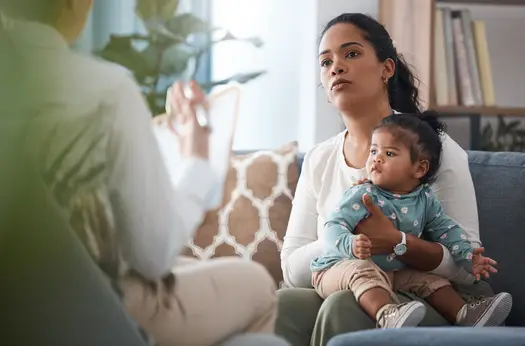
More than 1 million Latinos call Georgia home but the growing community faces an alarming gap in finding and using mental health services.
The National Alliance on Mental Illness reported fewer Hispanic and Latino individuals seek help. It may be because of language barriers, poverty or just not feeling comfortable with cultural differences.
Belisa Urbina, executive director of the nonprofit Ser Familia, which offers social services to Spanish-speakers in the Metro Atlanta area, said fewer than 100 licensed mental health professionals in Georgia speak Spanish, which affects the quality of care even when interpreters are available.
“Most times, this interpreter changes from one appointment to the other,” Urbina explained. “And also, if you’re using an interpreter, then you’re not providing an hour of counseling. You’re providing maybe 30 minutes, at best.”
Urbina emphasized although some Latinos prefer English for daily communication, they may struggle to discuss specific incidents or emotions. She noted the pandemic only heightened the need for mental health support, with suicidal thoughts tripling among Latino children as young as eight.
Urbina pointed out one challenge is the cost of professional certification for mental health providers. She observed many people who receive the necessary education cannot get the credentials to practice due to a lengthy and expensive process. Ser Familia hopes to help make access easier by increasing the number of practitioners through other measures.
“We are establishing a project in which we hopefully are going to bring to Georgia students from universities in Puerto Rico that are ready to do hours,” Urbina outlined. “They can do their practicum here, and the hours are going to be counted in Puerto Rico.”
Urbina hopes in the future, it will be easier for people to get the credentials they need in the mental health field. But she added there is a lot of work to be done to improve health equity for minority populations, especially if they don’t speak English as their first language.
get more stories like this via email
Michigan women have mental-health concerns at rates higher than the national average, according to a new report.
The United Health Foundation reported that the number of women between ages 18 and 44 in Michigan who cite “frequent mental distress” jumped to more than 25% in 2021 from 18% just five years earlier.
Marnie Leavitt, executive director of the Women’s Center of Southeast Michigan, said social media and ease of access to information have led to an overall uptick in anxiety and depression – and a world in turmoil isn’t helping.
“People feel helpless and more aware of the ongoing war in Ukraine and the new war in the Middle East,” she said, “in which we have a great awareness that the primary victims of those conflicts are women and children.”
Leavitt added that concerns about climate change and their children’s education are other top contributors to mental distress for Michigan women. The report also ranked Michigan 44th among states for a high number of women with multiple chronic health conditions and 45th for illicit drug use.
Leavitt said women coming out of the pandemic have faced an unusual set of circumstances that can’t help but affect their mental health.
“Educated with high student loans, unable to get jobs,” she said. “Now, the job market has opened up. Despite the upticks in what people are making for salaries, in the Ann Arbor area, people are still almost unable to pay their rent.”
Dr. Lisa Saul, national medical director for maternal and child health at UnitedHealthcare, said mortality rates for women have increased about 40% between 2019 and 2021. Maternal mortality rates increased 29% in that time period. She said it’s important to acknowledge the racial disparities in these figures and address them to keep people healthy before, during and after pregnancy.
“For both maternal mortality as well as for severe maternal morbidity,” she said, “we’re seeing increases in the American Indian and Alaska Native populations that seems to be a new trend.”
The United Health Foundation report also contains some positive findings. Michigan ranks in the top 10 among states for women having health insurance, getting cervical-cancer screenings and exercising.
Spanish-speaking Idahoans face a lack of mental health resources and advocates in the state want to change it.
Kurtis Pugh, mental health manager for the Community Council of Idaho, which serves migrant agricultural laborers and their families, said there is some stigma surrounding mental health issues in Spanish-speaking communities but often, people lack access to care.
“That’s where our biggest obstacles are,” Pugh explained. “There are very few Spanish speaking mental health professionals; competent Spanish speaking mental health professionals.”
Pugh pointed out access is especially difficult in rural communities, where there might be only one mental health professional, and they are not likely to speak Spanish. The Community Council of Idaho has partnered with the National Alliance of Mental Illness-Idaho to help provide resources and family support groups to migrant families in Spanish.
In November, the group will start a peer support group in Spanish.
Jorge Lopez, licensed professional counselor and board member of the National Alliance of Mental Illness-Idaho, uses a variety of methods for connecting with Spanish-speaking community members, such as talking about the shared experience of COVID.
Lopez also noted many families are immigrants from other countries, which produces its own form of trauma. Because he is from a similar community, he understands what they are going through.
“That feeling of being stuck, being lost, being alone; that is associated with mental health,” Lopez emphasized. “I kind of used the lived experiences as the bridge to kind of shed light on the fact that, ‘Hey, we all struggle with something maybe related to our mental health, our emotions.'”
Lopez added the most important aspect of expanding services to Spanish speakers is connecting with local groups already working in their communities.
“The whole point is to always learn the needs from the people themselves,” Lopez stressed. “And not assume what their needs are or assume what the solutions for what they need is.”
Scams and fraud have long-lasting effects on a person’s mental well-being, but the latest research found the emotional toll is particularly high on older adults.
Half the victims in fraud cases reported to the Federal Trade Commission were under age 30 but the financial losses are greater in older adults, at an average of $1,500. AARP said people who get scammed often experience shame and a desire for isolation.
Keith Gattozzi, a victim of a romance and cryptocurrency scam, said he felt awful after discovering he had fallen for someone who did not even exist.
“Since I was in cybersecurity all my life, and I’m not stupid and I don’t know — I’m, like, looking for love in all the wrong places — but I felt like an idiot,” Gattozzi acknowledged. “I was embarrassed. I didn’t tell anybody. I told one of my friends; I didn’t tell anybody else.”
AARP, in conjunction with Volunteers of America’s ReST program, offers free online facilitated emotional support sessions for fraud victims. ReST stands for “Resilience, Strength and Time,” and people can attend as many sessions as they would like.
Seth Boffeli, senior adviser for fraud prevention at AARP, said the pandemic and dependence on technology have contributed to much of the increase in scams. Michigan reported $38 million in fraud losses in 2019 – which jumped to $134 million last year.
Boffeli suggested it is just a matter of time before any American of any age will be tempted by a convincing scam.
“What we need more understanding on is just what we’re facing,” Boffeli urged. “These are professional criminal enterprises that are master manipulators using technology — the latest technology — to take advantage of us. Any of us could fall victim.”
He added it is key in these cases to stop, think and verify, to prevent falling for a scam.
AARP’s Fraud Watch Network tracks and posts information about current and common scams online. In some areas, they also teach community education classes, host free document-shredding events, and work with lawmakers on consumer protections.
[ad_2]
Source link
Trending Topics

Features
- Drive Toolkit
Download and distribute powerful vaccination QI resources for your community.
- Health Champions
Sign up now to support health equity and sustainable health outcomes in your community.
- Cancer Early Detection
MCED tests use a simple blood draw to screen for many kinds of cancer at once.
- PR
FYHN is a bridge connecting health information providers to BIPOC communities in a trusted environment.
- Medicare
Discover an honest look at our Medicare system.
- Alliance for Representative Clinical Trials
ARC was launched to create a network of community clinicians to diversify and bring clinical trials to communities of color and other communities that have been underrepresented.
- Reducing Patient Risk
The single most important purpose of our healthcare system is to reduce patient risk for an acute event.
- Jessica Wilson
- Subash Kafle