December 04, 2023
2 min read
[ad_1]
December 04, 2023
2 min read
We were unable to process your request. Please try again later. If you continue to have this issue please contact customerservice@slackinc.com.
Children born to women with infertility who utilized assisted reproduction methods had slightly higher risk for autism spectrum disorder, independent of fertility treatment used, according to study results published in JAMA Network Open.
“Although individuals with subfertility and those receiving fertility therapy are at a higher risk of adverse pregnancy outcomes, including preeclampsia, cesarean birth, multiple pregnancy, preterm birth and severe neonatal morbidity, there is limited data about the mediating effect of those factors on the association between mode of conception and autism spectrum disorder,” Maria P. Velez, MD, PhD, associate professor in the department of obstetrics and gynecology at Queen’s University and Institute for Clinical Evaluative Sciences (ICES), Toronto, and colleagues wrote.

Velez and colleagues conducted a population-based cohort study with data from 1,370,152 children (51.3% boys) in Ontario, Canada. All participants were singleton or multifetal live births at 24 or more weeks gestation from 2006 to 2018. Researchers evaluated modes of conception including unassisted conception; subfertility ; ovulation induction or intrauterine insemination (IUI); or IVF or intracytoplasmic sperm injection; and their associations between infertility and the risk for autism spectrum disorder.
The primary outcome was autism spectrum disorder diagnosis at age 18 months or older.
Overall, 86.5% of women had unassisted conception (mean age, 30.1 years), 10.3% had parental subfertility (mean age, 33.3 years), 1.5% had ovulation induction or IUI (mean age, 33.1 years) and 1.7% had IVF or intracytoplasmic sperm injection (mean age, 35.8 years). Children were followed for a median of 8.1 years starting at age 18 months.
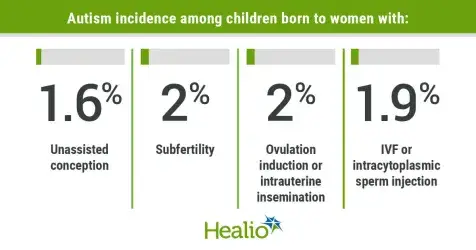
Overall, 1.6% of children had an autism diagnosis. Of these, 1.6% were from the unassisted conception group, 2% from the subfertility group, 2% from the ovulation induction or IUI group and 1.9% from the IVF or intracytoplasmic sperm injection group.
The autism spectrum disorder incidence rate was 1.93 per 1,000 person-years for children born to women in the unassisted conception group, 2.49 per 1,000 person-years for the subfertility group, 2.72 per 1,000 person-years for the ovulation induction or IUI group and 2.71 per 1,000 person-years for the IVF or intracytoplasmic sperm injection group. The adjusted HR for autism was 1.2 (95% CI, 1.15-1.25) for children born to women in the subfertility group, 1.21 (95% CI, 1.09-1.34) for the ovulation induction or IUI group and 1.16 (95% CI, 1.04-1.28) for the IVF or intracytoplasmic sperm injection group.
Researchers noted that some obstetrical and neonatal factors may mediate a sizeable proportion of the association between conception mode and autism risk. For example, the researchers wrote, after IVF or intracytoplasmic sperm injection, the proportion mediated by cesarean birth was 29%, multifetal pregnancy was 78%, preterm birth was 50% and severe neonatal morbidity was 25%.
“Efforts to decrease multifetal pregnancy following ovulation induction or IUI and IVF should continue to be reinforced, alongside the development of focused care pregnancy plans both for individuals with subfertility and those receiving fertility treatment,” the researchers wrote. “Certainly, major efforts are needed to decrease adverse pregnancy outcomes and optimize neurodevelopment in early childhood.”
Collapse
Disclosures:
Velez reports no relevant financial disclosures. Please see the study for all other authors’ relevant financial disclosures.
[ad_2]