










[ad_1]

OKLAHOMA CITY (KFOR) — In recent years, celebrities have brought mental health to the forefront of the conversation on health.
Artists and athletes are laying the groundwork for families to take charge of their mental health.
In honor of Black History Month, we are focusing on mental health challenges in the African American community.
According to the Health and Human Services Office of Minority Health, Black Americans are more likely than white Americans to report emotional distress and hopelessness.
Wichita author empowers kids to read through history
African Americans living in poverty are twice as likely to report serious psychological distress.
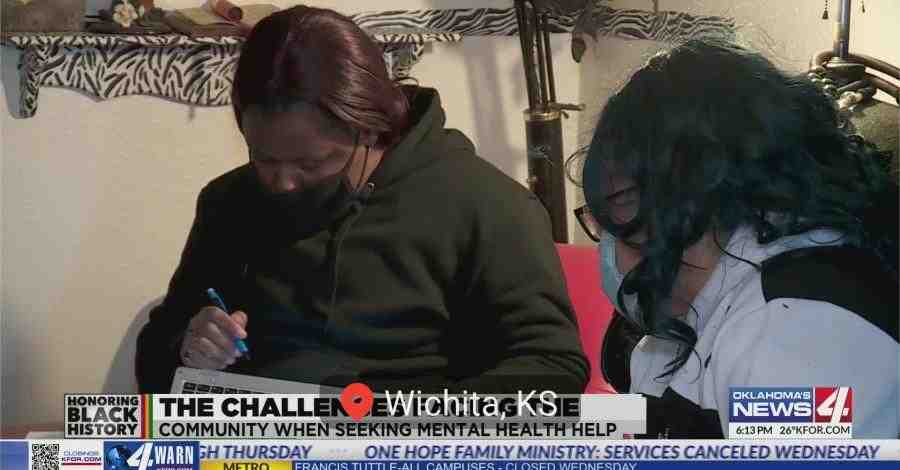
“I’m going to be honest. At first, I didn’t really think I needed help,” said Aphenie Sinegal, 22, who is studying cybersecurity in college.
Aphenie and her mother, Meloney Sinegal, believe mental health services saved their life.
“It’s OK to ask for help,” said Aphenie.
Years ago, Meloney was in a horrible car crash. Long after her body healed, her mind had not.
The experience triggered anxiety, bipolar disorder and post-traumatic stress.
Wichita barbershop offers cut above the rest
She did not seek help at first.
“I felt alone. Shallow. And just like, ‘I don’t know where to go,’” Meloney remembers. “I thought that it was for like … crazy people.
A mental breakdown and crisis hospitalization forced Meloney to get the psychological help she desperately needed.
“I grew up in an all-Black community just north of Cincinnati, Ohio,” said psychiatrist Dr. Willis Holloway. “It was a low socio-economic community. So, a lot of these kids that I see, I can identify with them. These are the kids I grew up with.”
Dr. Holloway believes access to mental health services is one of the biggest challenges in the African American community.
“There’s still a fairly large number of African Americans who don’t feel they get treated the same way, particularly in the mental health arena,” said Dr. Holloway.
Historically skeptical of health care, many African Americans are acutely aware of discrimination in the medical field.
It’s a turnoff and often one of the reasons they don’t seek help.
Wichita burger restaurant serves a special ‘home run’
“You want someone you can relate to, someone who understands, someone that knows what you’re going through,” Aphenie said.
If a patient is seeking a doctor who looks like them in Oklahoma, that is a significant challenge.
“I think they see themselves as lost in the system. They don’t see where to plug in. They see themselves as a square peg in a round hole,” Dr. Holloway said. “In the State of Oklahoma, there are very few of us, and there have been for a very long time. In this town, I could count the number of African American psychiatrists on one hand. I might still be able to count them on one hand. There is just not that many.”
Progress in that area may have stalled.
But when it comes to acceptance of mental health treatment and early intervention for children, there is momentum.
“Those kids are still in the development stages. Their brains are still being shaped and molded,” Dr. Holloway said. “You have an opportunity to put some hard wiring in place that will carry that kid forward, hopefully in a positive way.”
If you are in Wichita, Kansas, or the surrounding areas and are in need of help regarding your mental health, you can reach out to the following organizations:
Comcare Crisis Center has a 24-hour crisis line, 316-660-7500 . They offer suicide prevention services, have a stress/trauma assistance team (STAT), mobile crisis unit (MCU), offer state hospital pre-admission screening and pre-petition screening. Comcare also has a crisis stabilization unit that provides a safe, structured environment for out-of-home stabilization and serves as a community-based alternative to psychiatric hospitalization. Comcare also has its integrated care team, or ICT-1, which is a multidisciplinary, co-responder program aimed at providing resources to those in the community experiencing a mental health crisis.
You can call the Mental Health Association of South Central Kansas at 316-685-1821 . They offer services for every stage of life, including children and adults . They also offer services for prevention , family stabilization, seniors , housing . They have a counseling center and OneCare Kansas , which provides extra support to help manage care needs.
Call 211 for the United Way of the Plains free and confidential service that can connect you to a wide range of resources and services across Kansas.
You can also call the Substance Abuse and Mental Health Services Administration (SAMHSA) national helpline at 1-800-662-4357 . It is a free, confidential, 24/7, 365-day-a-year treatment referral and information service (in English and Spanish) for individuals and families facing mental and/or substance use disorders.
Copyright 2022 Nexstar Media Inc. All rights reserved. This material may not be published, broadcast, rewritten, or redistributed.
For the latest news, weather, sports, and streaming video, head to KSN-TV.
[ad_2]
Source link