










[ad_1]
Four weeks before the Oregon Health Authority was set to roll out a highly touted new climate benefit for low-income Oregon Health Plan members, it is having to change course to offer a much narrower benefit that won’t help as many people or help them in as timely a way.
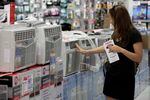
FILE: A woman looks at air conditioners for sale in a P.C. Richard & Son store, in New York, Sunday, July 1, 2012.
Richard Drew / AP
For months state officials have been telling organizations that oversee care in the Oregon Health Plan that starting Jan. 1, eligible members would have the right to obtain air conditioners, heaters and other climate-related devices to help them survive weather extremes attributed to climate change.
But behind the scenes, the benefit as described lacked a key component: federal approval. And in November, federal health officials formally shared with state officials that, for a second time, it would be rejecting their vision of providing a broader benefit, and would continue to require a formal state or federal declaration of emergency before devices could be distributed.
As a result of federal officials confirming their earlier stance, the new climate benefit “is unlikely to achieve the meaningful distribution of devices as we intended,” said Steph Jarem, who is overseeing the state’s implementation of changes to the Oregon Health Plan.
Simply put, the change means the new benefit is now far less likely to fill gaps in the present system. Program terms negotiated years ago depended on regional insurers’ willingness to fund devices such as air conditioners, heaters, air filtration devices, humidifiers, portable power supplies and refrigeration devices for medicines. That meant some people could get them but not others — and the new benefit was supposed to change that.
Now, instead of rolling out the new benefit on Jan. 1, 2024 as planned, the agency aims to revise and launch a far more limited version by sometime in March. The health authority had already sent out contracts to organizations overseeing care under the Oregon Health Plan, which now must be amended. Other work will also have to be redone.
The state had initially proposed the federal government allow such devices to be distributed to people at risk whether or not a formal emergency had been declared, according to Jarem. But federal officials rebuffed that idea more than a year ago — and issued legal language for the program saying devices could only be distributed in the wake of a formal declaration of emergency over heat or cold.
But the kind of formal emergency declaration the feds wanted, Jarem said, “doesn’t actually happen with heat and cold events.”
When the terms were issued in 2022, state officials “noticed that this wasn’t really how we intended and tried to talk about it then,” she added.
So the state tried again in August of this year, hoping that federal officials would change their mind. State officials proposed protocols that diverged from the September 2022 federal requirements in an attempt to expand the benefit.
“I think we have been able to work with them in so many ways to gain flexibility and to come to a satisfactory middle ground that it was surprising to get this hard ‘No,’” Jarem said. She said a delay in the most recent federal response made things that much harder. The agency “wished that we could have gotten some of that feedback earlier, that this was going to be a hard ‘No.’”
‘A very fraught set of negotiations that we all committed to live to’
Trying to understand the federal decision-making is like “reading tea leaves,” Jarem said.
While Jarem said she was surprised by that federal denial, records obtained by The Lund Report suggested the feds were surprised by the state’s attempt to revisit the terms it had issued earlier.
Emails obtained under Oregon Public Records Law show Interim Oregon Health Authority Director David Baden in October made the climate request a priority, and personally went to bat for the changes by email and in a call with federal officials.
Top federal officials, however, responded that the original terms were narrowly framed and had to stay that way, according to notes from the call.
With its attempt to redesign the climate benefit, Oregon was seeking a “broader reach than we expected on services. It was meant to be very narrowly negotiated, that was the way we could be moving forward,” a federal official said in the call.
In response Baden stressed the limitations of tying the benefit to a formal emergency declaration.
Earlier talks around the climate benefit were “a very fraught set of negotiations that we all committed to live to,” a federal official said, according to the notes. “But I hear you.”
Jarem, in an email sharing the notes on Nov. 1, 2023, wrote “Not the best news but also not clear enough info to move to panic.”
She told The Lund Report she felt federal Medicaid officials were constrained by feedback from their counterparts in other agencies that were part of the waiver approval, such as the Federal Emergency Management Administration, or FEMA.
Climate and air conditioners
Members of the Oregon Health Plan, the state’s version of Medicaid, meet certain income guidelines to receive free health care funded by the state and federal governments.
In September 2022, the state announced that the federal government had approved its latest renewal of the Oregon Health Plan. Known as a waiver, the new program would include the first climate-related benefit of its kind.
It was intended to deliver on the long-time goal of using the Oregon Health Plan to fund not just direct health care, but other needs that could dramatically curb health care costs; for example, an air conditioner to a vulnerable person for times of extreme heat — an idea made famous by former Gov. John Kitzhaber, a physician, and embraced nationally.
But achieving the goal has proven more difficult than hoped, thanks in part to federal actuarial rules. And the number of air conditioners distributed hasn’t met expectations.
The topic gained new currency after the 2021 heat wave that killed at least 72 people in Multnomah County alone.
State officials had hoped to craft the new benefit to eliminate barriers and ensure every person who was considered eligible could receive needed devices.
“We were looking to provide this to a broader number of people who are at risk In these climate events,” Jarem said, adding that the goal was to make “that more equitable in terms of how it gets distributed across the state.”
Now, she said that in addition to revising the program to match the federal requirements, the agency is now looking for workarounds that can help distribute the devices more widely.
According to the state, members of the coordinated care organizations that serve the Oregon Health Plan can contact their CCO to see if devices to address heat and cold are available through programs called “flexible services” or “health related services.” To figure out what CCO they are in, OHP members can call 1-800-273-0557 or email Ask.OHP@odhsoha.oregon.gov.
‘We just try to grit our teeth’
Two years ago, Jarem spearheaded a different federal partnership that foundered, in which she also blamed onerous federal restrictions. After two years of program development, OHA cancelled a pilot program that it had applied for to improve care for children with behavioral and physical health-related needs in Jefferson, Deschutes, Crook, Polk and Marion counties. More than $3 million was spent, most of it on salaries, and no services to children were delivered.
Jarem told The Lund Report there are similarities between the two outcomes, in that the state was trying to use federal funds to advance programs it had hoped to do anyway.
“I think the reality is we have to work under the federal government. We like to be innovative in our state. There are a lot of benefits … And so that comes with some challenges in terms of their restrictions and their flexibility.
“I think it’s a double edged sword, really,” she added. “I would never turn my back on the opportunities presented … we just try to grit our teeth and know that it comes with challenges. And sometimes we muddle through, and sometimes we say, ‘that’s enough.’”
Asked about the frustrating situation, Jarem said “I’m getting used to it, which, I don’t know what that says about being a glutton for punishment.”
She added, “I’m trying to see the positive in a lot of this and say that it gives us more time to work with our partners … and our community based organizations to continue to develop what this benefit looks like … We’re working together in new ways.”
She noted that Oregon’s Medicaid program changes go well beyond climate-related health needs, also including increased benefits for housing and nutrition that have not yet been rolled out.
“I actually believe that this will also build towards a better foundation for the other benefits. Housing and nutrition are going to be right behind climate, and will have much more complexity,” she said.
The Oregon Health Authority has issued a press release about the change. It follows in its entirety:
OHA updates plan for climate benefits while awaiting federal approval
After federal rules posed added restrictions to the state’s plan, OHA and state partners pursued new avenues to get devices to OHP members
Portland, Ore. – Today Oregon Health Authority (OHA) announced the state will update its plan for how climate-related devices are distributed to eligible Oregon Health Plan (OHP) members prior to a forecasted weather-related emergency. The benefits are projected to begin in March 2024, pending federal government approval.
OHA initially proposed introducing climate benefits for OHP members in January 2024 as part of Oregon’s 1115 Medicaid waiver, which uses federal dollars to provide climate devices like air conditioners, air filtration devices, and portable power supplies to eligible Medicaid members; however, the Centers for Medicare and Medicaid Services (CMS) informed the state that distributing climate devices prior to an emergency declaration would not be possible.
“The limitation would have severely restricted distribution of climate devices, so we sought feedback from state partners and a more flexible approach,” said Dave Baden, interim director of OHA. “We look forward to continuing to work with CMS and moving toward final approval.”
“Our first priority always is our community,” said Sean Jessup, Chief Executive Officer, Eastern Oregon Coordinated Care Organization (EOCCO). “We’re laser-focused on getting the right resources to our OHP members, particularly in times of greater need. We’re encouraged that this plan will even better serve people.”
Before the new benefits launch, CCO-enrolled OHP members can contact their CCO to see if climate supports are available through “flexible services” (also called health related services). If a member has OHP but is not sure which CCO they are in, they can call the Client Services Unit at 1-800-273-0557 or email: Ask.OHP@odhsoha.oregon.gov.
Additional details will be provided in the coming weeks. Information about Oregon’s 1115 Medicaid waiver is currently available on OHA’s web site, via the waiver newsletter, and through webinars in English and Spanish.
—
This story was originally published by The Lund Report, an independent nonprofit health news organization based in Oregon. You can reach Nick Budnick at nick@thelundreport.org or at @NickBudnick on X.
[ad_2]
Source link