










[ad_1]
Study Population
 Demographic Characteristics of the Participants at Baseline and Vaccination Status as of September 21, 2021.
A total of 44,546 participants were enrolled between June 18, 2020, and April 23, 2021, from 135 sites across the United Kingdom; 35,768 met the inclusion criteria for this analysis (Fig. S1). The characteristics of the participants are shown in Table 1; most participants were women (84%), and the median age was 46 years (interquartile range, 36 to 54). Table S2 shows a comparison of these characteristics with those of the national population.
At the beginning of the analysis, we assigned 26,280 participants to the previously uninfected cohort and 9488 to the previously infected cohort. The participants in the previously infected cohort were more likely than those in the previously uninfected cohort to be male, younger, from Black, Asian, or ethnic minority backgrounds, to work in clinical roles (eg, to be doctors, nurses, or allied health professionals), and to report more frequent exposure to patients with Covid-19 (Table 1).
By the end of the analysis, 94.9% of the participants had received two doses of vaccine: 78.5% had received the BNT162b2 vaccine with a long interval between doses, 8.6% had received the BNT162b2 vaccine with a short interval between doses, and 7.8% had received the ChAdOx1 nCoV-19 vaccine (Table 1 and Fig. S2). We did not identify any major demographic differences among the participants according to vaccination schedule (Table S3).
Follow-up time varied according to participant, with a total of 7,482,388 participant person-days, of which 998,270 involved unvaccinated participants and 6,430,118 involved vaccinated participants (from the date of the first dose). A total of 62,291 PCR tests were performed during the “unvaccinated follow-up period,” which included follow-up time before vaccination in participants who were vaccinated during the analysis period and the total follow-up time in those who remained unvaccinated at the end of the analysis. A total of 427,951 PCR tests were performed during the period of the analysis in which participants were vaccinated (ie, the “vaccinated follow-up period”). The average test interval was 16 days in the unvaccinated period and 15 days in the vaccinated period. In the previously uninfected cohort, 358,346 tests (average test interval, 14.8 days) were performed, and 131,896 tests were performed in the previously infected cohort (average test interval, 14.3 days).
Primary Outcome
The primary outcome was PCR-confirmed SARS-CoV-2 infection. Primary infections were noted in 2747 participants during follow-up, and reinfections were seen in 210, with cases peaking at the end of December 2020, declining by March and April 2021, and increasing in May 2021, a pattern that reflected national trends (Fig. .S3). At 14 days before or after the date of the positive PCR test, among the participants with primary infections, 1673 (61%) reported Covid-19 – related symptoms, 368 (13%) reported other symptoms, 118 (4%) reported no symptoms, and 588 (21%) did not provide data on symptoms. In contrast, among the participants with reinfections, 71 (34%) reported Covid-19 – related symptoms, 42 (20%) reported other symptoms, 45 (21%) reported no symptoms, and 52 (25%) did not provide data on symptoms. A total of 357 participants (13%) with primary infection reported a hospital visit for Covid-19 – related symptoms, as compared with 18 (9%) of those with reinfection.
Vaccine Effectiveness against Primary Infection
 Incidence of SARS-CoV-2 Infection and Effectiveness of Covid-19 Vaccines against Symptomatic and Asymptomatic Infection in Participants without Previous SARS-CoV-2 Infection, December 7, 2020, through September 21, 2021.
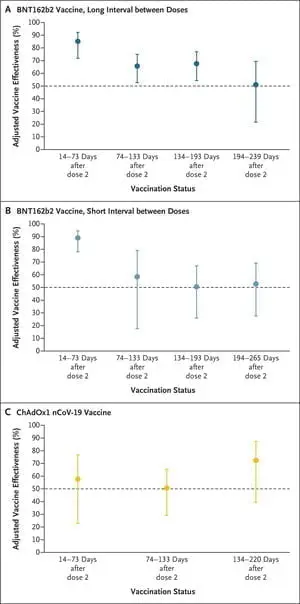
  Adjusted Vaccine Effectiveness over Time in Previously Uninfected Participants, According to Vaccine Type and Dosing Interval.
Shown is the adjusted vaccine effectiveness of two doses of coronavirus disease 2019 (Covid-19) BNT162b2 vaccine with a long interval between doses (Panel A), BNT162b2 vaccine with a short interval between doses (Panel B), and ChAdOx1 nCoV-19 vaccine with short dose intervals and long dose intervals combined (Panel C) in participants without previous severe acute respiratory syndrome coronavirus 2 (SARS-CoV-2) infection. Data are for the period from December 7, 2020, through September 21, 2021. 𝙸 bars indicate 95% confidence intervals.
Among the participants without previous SARS-CoV-2 infection, two doses of BNT162b2 vaccine administered with a long interval between doses was associated with a decrease in the risk of infection of 85% (95% confidence interval [CI]72 to 92) (ie, the adjusted vaccine effectiveness in the first 2 months after the development of the full immune response, 14 to 73 days after the second dose) (Table 2 and S4 and Figure 1). Over time, the adjusted vaccine effectiveness declined but remained high, at 68% (95% CI, 54 to 77), 134 to 193 days after the second dose. At a median of 201 days (interquartile range, 197 to 205) after the second dose, we observed evidence of waning of protection, with an adjusted vaccine effectiveness of 51% (95% CI, 22 to 69).
A similar trend was observed in the participants who received a second dose of BNT162b2 vaccine with a short interval between doses, with high protection at 14 to 73 days (adjusted vaccine effectiveness, 89%; 95% CI, 78 to 94) that decreased to 53% (95% CI, 28 to 69) at a median of 238 days (interquartile range, 220 to 249) after the second dose. We found no significant difference between the BNT162b2 vaccine participants who had a long interval and those who had a short interval between doses with respect to protection after the second dose, with a hazard ratio for infection of 1.34 (95% CI, 0.58 to 3.10) at 14 to 73 days with the use of the short interval as the reference group.
The adjusted effectiveness of two doses of the ChAdOx1 nCoV-19 vaccine was 58% (95% CI, 23 to 77) 14 to 73 days after the second dose. The effectiveness did not differ considerably with longer periods of time after the second dose, with overlapping confidence intervals of vaccine effectiveness reflecting the small number of participants with data used to calculate this estimate (Table 2 spirit Figure 1). At 14 to 73 days after the second dose, the BNT162b2 vaccine with a short interval between doses was 74% more effective (95% CI, 36 to 89) and the BNT162b2 vaccine with a long interval between doses was 65% more effective (95 % CI, 21 to 85) than the ChAdOx1 nCoV-19 vaccine. The Wald chi-square test of the model was 371.46 (31 degrees of freedom), with an Akaike information criterion of 15,367.
Durability of Protection after Primary Infection
 Incidence of SARS-CoV-2 Reinfection and Effectiveness of the BNT162b2 Vaccine against Symptomatic and Asymptomatic Reinfection among Participants with Previous SARS-CoV-2 Infection, December 7, 2020, through September 21, 2021.
  Protection against Reinfection with SARS-CoV-2 up to 18 Months after the Primary Infection.
Data are for the period from December 7, 2020, through September 21, 2021, for both the BNT162b2 and ChAdOx1 nCoV-19 vaccines and with all dosing intervals. 𝙸 bars indicate 95% confidence intervals.
A total of 6169 participants in the previously infected cohort were followed in the unvaccinated follow-up period and up to 1 year after a primary infection. These participants were predominantly infected in the spring of 2020 and were followed in the period before emergence of the delta (B.1.617.2) variant. The risk of reinfection among these participants was 86% (95% CI, 81 to 89) lower than the risk of primary infection among the unvaccinated participants in the previously uninfected cohort (Table 3 spirit Figure 2). There was evidence of considerable waning of protection more than 1 year after infection, with a reduction to 69% (95% CI, 38 to 84); protection during the first year after infection was 54% (95% CI, 3 to 78) higher than that after more than 1 year.
Durability of Protection Conferred by Infection and Vaccination
In the previously infected cohort, with unvaccinated participants in the previously uninfected cohort as the reference group (Table 3 spirit Figure 2), a beneficial boosting of infection-acquired immunity was apparent, with combined protection of more than 90% after vaccination (after both the first and second doses). Waning of protection was not observed more than 1 year after infection or more than 6 months after vaccination. The Wald chi-square of the model was 789.68 (30 degrees of freedom), with an Akaike information criterion of 14,841.
[ad_2]
Source link