














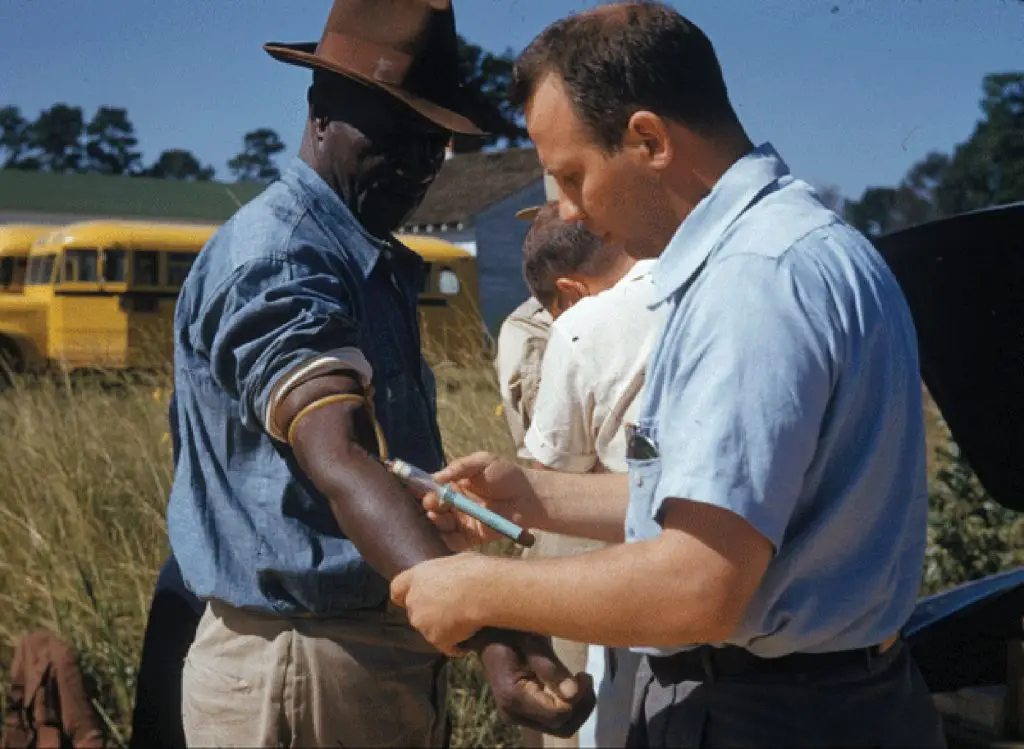
Racist Doctors and Organ Thieves: Why So Many Black People Distrust the Health Care System

[ad_1]

Discrimination, lack of access, mistrust and mistreatment aren’t unique to Black Americans; Latinos and other minority groups experience it, too. Poor people often wait longer for worse care in underfunded, understaffed — and often de facto racially segregated — public hospitals and clinics than richer, better-insured people. And they know it.

Growing up in Detroit, Michael Winans, now in his early 40s, was “too busy getting by” to pay attention to a syphilis experiment that ended before he was born. But distrust of the medical establishment flowed in his family. His grandmother survived a stroke but died during routine follow-ups; the family suspected sub-par care. Later, his mother hesitated when she needed fibroid surgery. When she finally went in, she ended up with an unexpected hysterectomy. Winans knows that sometimes happens, that the less invasive operation isn’t always enough. But was it necessary for his mother? He wonders.

“When you grow up in a predominantly Black town like Detroit, you can go much of your life without really interacting with someone of another race,” he says. “If the first time is when you have a health issue … you ask yourself, ‘Does this person care for me? Or see me as a number?’ It’s another level of potential trepidation or concern.”

The Black American experience is getting particular scrutiny right now, along with hopes for change. Some of the people interviewed for this story were more optimistic than others about progress. But none saw the health system as color-blind.

“People see that I’m Black before they notice — if they ever get to the point that they notice — that I have a PhD.,” says Cara James, who ran the Office of Minority Health at the Centers for Medicare and Medicaid Services during the Obama administration. James, who also previously led work on racial disparities at the Kaiser Family Foundation, is now the president and CEO of Grantmakers in Health, which works with foundations and philanthropies to improve health care.

Things may have gotten better since the days when James would carefully select which suit to wear as she accompanied her grandmother, an agricultural worker in the South with little formal education, to medical appointments. But they haven’t improved enough.

“We are human,” she says, “We have perceptions and biases about others.”

Those biases can be subtle — or not.

When Matthew Thompson, a financial officer at a reproductive health organization in Texas, fell ill soon after relocating to Austin a few years back, he didn’t yet have a regular doctor but managed to get an appointment with someone. That doctor, who was white, took one look at Thompson, a 40-something Black male, and on the basis of a brief examination and blood pressure reading, diagnosed him with hypertension and handed him a prescription.

“He was a white doctor … he gave the whole speech about genetics and race,” Thompson recalls.

But most health differences between Black people and white people are not genetic; many are socioeconomic or the result of inequality or the lingering distrust that might deter a Black patient from seeking care earlier.

That doctor was right that hypertension is common in Black men. The problem is that Thompson didn’t have it. The doctor treated a stereotype, not a person.

Ironically, trust — tragically misplaced trust — was part of what allowed the Tuskegee study to go on for 40 long years. That’s according to Lillie Tyson Head, who leads the Voices for Our Fathers Legacy Foundation, an organization created by the descendants of those who suffered. The men, like her father, Freddie Lee Tyson, who was born with syphilis, were told they had “bad blood,” not syphilis. And they trusted those men in white coats who kept studying them, untreated, endangering them, their wives and their children.

“Those men were trusting,” says Tyson Head, 78, a retired schoolteacher. “They went forth thinking they would be treated. And they were still trusting for over 40 years.”

[ad_2]

Source link

Trending Topics

Features

Download and distribute powerful vaccination QI resources for your community.

Sign up now to support health equity and sustainable health outcomes in your community.

MCED tests use a simple blood draw to screen for many kinds of cancer at once.

FYHN is a bridge connecting health information providers to BIPOC communities in a trusted environment.

Discover an honest look at our Medicare system.

ARC was launched to create a network of community clinicians to diversify and bring clinical trials to communities of color and other communities that have been underrepresented.

The single most important purpose of our healthcare system is to reduce patient risk for an acute event.

Related Posts
Florida Reports First 2026 Death Linked to Vibrio vulnificus as Cases Rise to 12
Nationwide Levothyroxine Recall: Patients Urged to Check Thyroid Medication Lots
R&B Singer Nivea Reveals Leukemia Diagnosis at 44, Says Treatment Is Going Well
Scroll to Top
Featured Articles
Vibrio vulnificus Florida First 2026 Death Reported Fyh.news
Florida Reports First 2026 Death Linked to Vibrio vulnificus as Cases Rise to 12
Levothyroxine Recall Check Affected Thyroid Medication Lots Fyh.news
Nationwide Levothyroxine Recall: Patients Urged to Check Thyroid Medication Lots
Nivea Leukemia Diagnosis Singer Shares Treatment Update
R&B Singer Nivea Reveals Leukemia Diagnosis at 44, Says Treatment Is Goin...
Sen. Alex Padilla speaks during the announcement of the Health Equity and Accountability Act of 2026, legislation aimed at reducing health disparities and expanding access to healthcare for underserved communities.
Health Equity Act Reintroduced to Expand Access
Senate HELP Committee advances bipartisan health care bills on insulin, biosimilars, rural care and price transparency.
Senate Committee Advances 11 Health Care Access Bills
Bottle and tablets representing the recall of some cetirizine 5 mg allergy medicine
Cetirizine Recall: Check Your Allergy Medicine
Categories
AI
ATTR-CM
BIPOC News
Cancer
Clinical Trials
Covid19
Diseases of the Body
Environment
Health Data
Health Equity Events
Health Policy
Health Tips
Subscribe to our newsletter to receive our latest news​
All Stories
Vibrio vulnificus Florida First 2026 Death Reported Fyh.news
Florida Reports First 2026 Death Linked to Vibrio vulnificus as Cases Rise to 12
Levothyroxine Recall Check Affected Thyroid Medication Lots Fyh.news
Nationwide Levothyroxine Recall: Patients Urged to Check Thyroid Medication Lots
Nivea Leukemia Diagnosis Singer Shares Treatment Update
R&B Singer Nivea Reveals Leukemia Diagnosis at 44, Says Treatment Is Goin...
BIPOC News
Senate HELP Committee advances bipartisan health care bills on insulin, biosimilars, rural care and price transparency.
Senate Committee Advances 11 Health Care Access Bills
Bottle and tablets representing the recall of some cetirizine 5 mg allergy medicine
Cetirizine Recall: Check Your Allergy Medicine
How NMQF Advances Minority Health Through Data, Research and Health Access
Environment
UV Safety Awareness Month Raises Urgency on Skin Cancer Prevention and Sun Protection Equity
UV Safety Awareness Month Raises Urgency on Skin Cancer Prevention and Sun Pr...
Extreme Heat Safety Tips 5 Ways to Protect Your Health This Summer fyh.news
5 Heat Safety Tips That Could Protect Your Health This Summer
Lupus Awareness Event in Baltimore Aims to Support Research and Shine a Light on Health Disparities
Lupus Awareness Event in Baltimore Aims to Support Research and Shine a Light...
Work Force
A multigenerational Black and Hispanic family sitting together in a park, showing how Social Security helps support older adults, people with disabilities, and families across generations.
Millions of Older Americans Could Face Smaller Social Security Checks by 2032...
dreamstime_s_243253251
The Caregiver Journey: The Hidden Backbone of American Healthcare
Families gather at a Bronx community festival with live music, kids’ activities, and health booths sharing SOMOS social care resources and free screenings.
Celebrating Hispanic heritage while learning about health care

[xyz-ips snippet=”Output-Source-Name”]

Clinical Trials
House Advances Bipartisan EARLY Act Reauthorization, Renewing Focus on Early Breast Cancer Detection for Young Women
House Advances Bipartisan EARLY Act Reauthorization, Renewing Focus on Early ...
Early Cancer Detection Is Entering a New Era. Flint Is Helping Lead the Way.
Why Your “Ozempic” May Not Be Ozempic: FDA Warnings Highlight Growing Risks of Unregulated GLP-1 Drugs
Why Your “Ozempic” May Not Be Ozempic: FDA Warnings Highlight Growing Risks o...
Vaccines and Outbreaks
Cyclospora Outbreak Linked to Lettuce Sickens 1,600+ fyh.news
Cyclospora Outbreak Linked to Recalled Lettuce Sickens More Than 1,600 Across...
A parent checking a child's temperature during summer, illustrating the changing RSV patterns and year-round respiratory virus risks.
Can You Get RSV During the Summer?
Michelle Lam, MBA, of NYC Health + Hospitals/Elmhurst & Amy Harris of NYC Health + Hospitals/Elmhurst
Healthcare Leaders Spotlight Vaccine Equity and Adult Immunization Strategies...
Other Categories
AI
Read the latest AI News stories trending around the world
ATTR-CM
Cancer
Read the latest Cancer stories trending around the world
Covid19
Diseases of the Body
Read about the latest Diseases of the Body trending around the world
Friday Webinars
Every Friday, we bring you insightful webinars covering critical topics in healthcare, data equity, and policy reform.
Health Data
Read the latest Health Data stories trending around the world
Health Equity Events
Read the best Health Equity Events around the country.
Health Policy
Read the latest Health Policy stories trending around the world
Health Tips
Heart Health
Read the latest on Heart Health News, Stories and Tips.
kidney Health
Read more trending News about Kidney Health, Stories and Tips.


