









Structural Racism Drives Higher COVID-19 Death Rates In Louisiana, Study Finds

[ad_1]

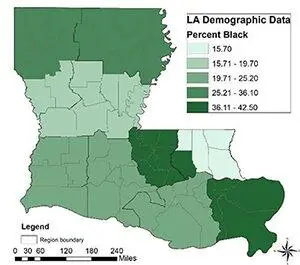
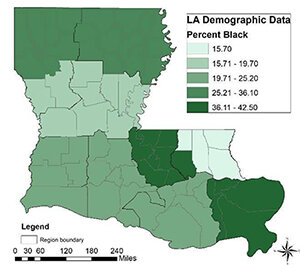
The spatial distribution of percent Black residents in Louisiana. Credit: Guangxiao Hu, Nora Hamovit, Kristen Croft, Jennifer D. Roberts, and Deb Niemeier, University of Maryland.

Disproportionately high COVID-19 mortality rates among Black populations in Louisiana parishes are the result of longstanding health vulnerabilities associated with institutional and societal discrimination, according to research conducted by an interdisciplinary team under the mentorship of University of Maryland (UMD) Clark Distinguished Chair Deb Niemeier and UMD Associate Professor of Kinesiology Jennifer Roberts in the School of Public Health.

The team included doctoral students from three different programs at UMD, working together as part of an interdisciplinary fellowship program known as UMD Global STEWARDS, directed by Professor Amy R. Sapkota of the School of Public Health.

“Our results suggest that structural racism and inequities led to severe disparities in initial COVID-19 effects among highly populated Black Louisiana communities, and that as the virus moved into less densely populated Black communities, similar trends emerged,” the researchers concluded in a study published in the Proceedings of the National Academy of Sciences on Monday, June 27.

Over the course of generations, discrimination in employment, education, housing, and access to medical care has led to higher risks of chronic illnesss (including asthma, diabetes, and obesity) among Black communities, as well as a higher likelihood of suffering a stroke, the authors noted. The Centers for Disease Control and Prevention (CDC) have linked these factors to the likelihood of becoming severely ill from COVID-19.

Both nationally and in Louisiana, Black communities encounter inadequate housing and lower rates of home ownership, reduced access to health care, and lower rates of employment. As exemplified by Cancer Alley, Black families are more likely to live in so-called “fence-line” neighborhoods, located near industrial facilities that expose them to pollutants, and typically encounter reduced air and water quality compared to white Americans. Black families are also more likely to be uninsured and face higher rates of unemployment. These and multiple other factors, all reflecting decades of institutional and societal bias, add up to a combination of stressors that undermine health and, in the case of COVID-19, have made Black communities particularly vulnerable.

To obtain their findings, the team members identified the spatial distribution of social and environmental stressors across Louisiana parishes, and used hotspot analyses to develop aggregate stressors. They then tracked the correlations among stressors, cumulative health risks, COVID-19 mortality rates, and the size of Black populations across Louisiana. The results suggest that COVID-19 mortality rates initially spiked in Black communities with high population densities and moderate levels of aggregate stress. Over time, the rates also increased in less densely populated Black communities with higher levels of aggregate stress.

“We find that Black communities in Louisiana parishes with both higher and lower population densities experience higher levels of stressors leading to greater COVID-19 mortality rates,” the researchers wrote. “Our work using the COVID-19 pandemic, particularly as observed in Louisiana, makes clear that communities with high levels of social, economic, and environmental racism are significantly more vulnerable to a public health crisis.”

The study lead authors include UMD graduate students Kristen Croft (Department of Civil and Environmental Engineering). Nora Hamovit (Department of Biology), and Guangxiao Hu (Department of Geographical Sciences).

Allen P. Davis, Professor of Civil and Environmental Engineering, is a co-PI for the UMD STEWARDS program, which aims to bring together graduate students from a wide variety of backgrounds to work on collaborative projects. “Each student brings their own area of expertise to the table, resulting in synergy,” Davis said. “That kind of synergy is something you might not get in other disciplinary studies.”

The value of such an approach was evident in the collaboration among the three students. “As a human geographer, my main focus was on the spatial disparities of structural racism and inequities and their effects on COVID-19 mortalities,” Hu said. “Using hotspot analysis, we identified two groups of parishes with high or low population densities located at different regions of Louisiana. Our research provides policy makers with very useful insights about the disproportionate burden of Black communities and the nonstationary distribution of this disproportion across Louisiana.”

Hamovit performed the initial data analysis that yielded stressor index calculations, which Hu then utilized for hotspot analysis. “Because my Ph.D. research involves large and complex data sets I brought a strength of data organization and analysis to our team,” Hamovit said. Croft played a key role in defining the research topic and utilized her background in stormwater research to pinpoint specific variables that could have a bearing on health.

Faculty mentors included Niemeier and Roberts. Niemeier, who joined the UMD civil and environmental engineering faculty in 2020 as the inaugural Clark Distinguished Chair, is an internationally-recognized expert on the equity impacts of infrastructure and engineering decisions. She is a member of the National Academy of Engineering and, in 2021, was elected to the American Philosophical Society. Her work, which details how marginalized communities are affected by vehicle emissions, development patterns, climate change, and approaches to disaster preparation and recovery, has helped spur policy and regulatory reforms.


Neighborhoods most affected by racism and COVID-19 pandemic stressors at a greater risk for preterm births, study finds


More information:
Assessing inequities underlying racial disparities of COVID-19 mortality in Louisiana parishes, Proceedings of the National Academy of Sciences (2022). doi.org/10.1073/pnas.2123533119

Citation:
Structural racism drives higher COVID-19 death rates in Louisiana, study finds (2022, June 27)
retrieved 28 June 2022
from https://medicalxpress.com/news/2022-06-racism-higher-covid-death-louisiana.html

This document is subject to copyright. Apart from any fair dealing for the purpose of private study or research, no
part may be reproduced without the written permission. The content is provided for information purposes only.

[ad_2]

Source link
Trending Topics

Features

Download and distribute powerful vaccination QI resources for your community.

Sign up now to support health equity and sustainable health outcomes in your community.

MCED tests use a simple blood draw to screen for many kinds of cancer at once.

FYHN is a bridge connecting health information providers to BIPOC communities in a trusted environment.

Discover an honest look at our Medicare system.

ARC was launched to create a network of community clinicians to diversify and bring clinical trials to communities of color and other communities that have been underrepresented.

The single most important purpose of our healthcare system is to reduce patient risk for an acute event.

Related Posts
How NMQF Advances Minority Health Through Data, Research and Health Access
Early Cancer Detection Is Entering a New Era. Flint Is Helping Lead the Way.
Why Your “Ozempic” May Not Be Ozempic: FDA Warnings Highlight Growing Risks of Unregulated GLP-1 Drugs
Scroll to Top
Featured Articles
How NMQF Advances Minority Health Through Data, Research and Health Access
Early Cancer Detection Is Entering a New Era. Flint Is Helping Lead the Way.
Why Your “Ozempic” May Not Be Ozempic: FDA Warnings Highlight Growing Risks of Unregulated GLP-1 Drugs
Why Your “Ozempic” May Not Be Ozempic: FDA Warnings Highlight Growing Risks o...
The Communities Most Burdened by Disease Should Be the First to Benefit from Artificial Intelligence
The Communities Most Burdened by Disease Should Be the First to Benefit from ...
Cancer Pain Care Access Gap Hits Black, Asian Patients
Black and Asian Cancer Patients Wait Longer for Pain Relief in New Study
What Is Cyclosporiasis Symptoms, Food Safety, and Reasons
What Is Cyclosporiasis? The Foodborne Illness Showing Up in the News
Categories
AI
ATTR-CM
BIPOC News
Cancer
Clinical Trials
Covid19
Diseases of the Body
Environment
Health Data
Health Equity Events
Health Policy
Health Tips
Subscribe to our newsletter to receive our latest news​
All Stories
How NMQF Advances Minority Health Through Data, Research and Health Access
Early Cancer Detection Is Entering a New Era. Flint Is Helping Lead the Way.
Why Your “Ozempic” May Not Be Ozempic: FDA Warnings Highlight Growing Risks of Unregulated GLP-1 Drugs
Why Your “Ozempic” May Not Be Ozempic: FDA Warnings Highlight Growing Risks o...
BIPOC News
How NMQF Advances Minority Health Through Data, Research and Health Access
Early Cancer Detection Is Entering a New Era. Flint Is Helping Lead the Way.
The Communities Most Burdened by Disease Should Be the First to Benefit from Artificial Intelligence
The Communities Most Burdened by Disease Should Be the First to Benefit from ...
Environment
UV Safety Awareness Month Raises Urgency on Skin Cancer Prevention and Sun Protection Equity
UV Safety Awareness Month Raises Urgency on Skin Cancer Prevention and Sun Pr...
Extreme Heat Safety Tips 5 Ways to Protect Your Health This Summer fyh.news
5 Heat Safety Tips That Could Protect Your Health This Summer
Lupus Awareness Event in Baltimore Aims to Support Research and Shine a Light on Health Disparities
Lupus Awareness Event in Baltimore Aims to Support Research and Shine a Light...
Work Force
A multigenerational Black and Hispanic family sitting together in a park, showing how Social Security helps support older adults, people with disabilities, and families across generations.
Millions of Older Americans Could Face Smaller Social Security Checks by 2032...
dreamstime_s_243253251
The Caregiver Journey: The Hidden Backbone of American Healthcare
Families gather at a Bronx community festival with live music, kids’ activities, and health booths sharing SOMOS social care resources and free screenings.
Celebrating Hispanic heritage while learning about health care

[xyz-ips snippet=”Output-Source-Name”]

Clinical Trials
Early Cancer Detection Is Entering a New Era. Flint Is Helping Lead the Way.
Why Your “Ozempic” May Not Be Ozempic: FDA Warnings Highlight Growing Risks of Unregulated GLP-1 Drugs
Why Your “Ozempic” May Not Be Ozempic: FDA Warnings Highlight Growing Risks o...
Clinical Trial Diversity Remains a Critical Challenge in Alzheimer’s Research
Vaccines and Outbreaks
A parent checking a child's temperature during summer, illustrating the changing RSV patterns and year-round respiratory virus risks.
Can You Get RSV During the Summer?
Michelle Lam, MBA, of NYC Health + Hospitals/Elmhurst & Amy Harris of NYC Health + Hospitals/Elmhurst
Healthcare Leaders Spotlight Vaccine Equity and Adult Immunization Strategies...
Measles Outbreaks Surge: Essential Facts and Prevention Strategies
Other Categories
AI
Read the latest AI News stories trending around the world
ATTR-CM
Cancer
Read the latest Cancer stories trending around the world
Covid19
Diseases of the Body
Read about the latest Diseases of the Body trending around the world
Friday Webinars
Every Friday, we bring you insightful webinars covering critical topics in healthcare, data equity, and policy reform.
Health Data
Read the latest Health Data stories trending around the world
Health Equity Events
Read the best Health Equity Events around the country.
Health Policy
Read the latest Health Policy stories trending around the world
Health Tips
Heart Health
Read the latest on Heart Health News, Stories and Tips.
kidney Health
Read more trending News about Kidney Health, Stories and Tips.