










Tools for more accurate obesity risk assessment based on sex, ethnicity

[ad_1]

UConn CAHNR: Jacob Earp

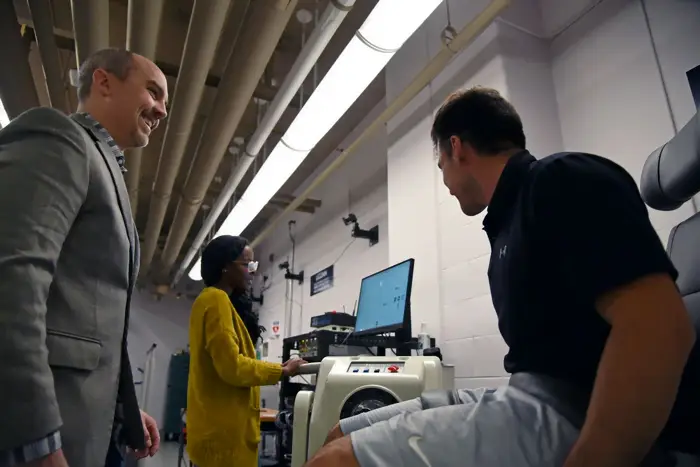
image: Jacob Earp (left) and graduate students Davina Robinson (center) and Carlos Rehbein (right).
view more 

Credit: Jason Sheldon/UConn Photo)

For decades, health care practitioners have used body mass index (BMI) as an indicator of a person’s health. But this equation only considers height and weight, and may not capture an accurate picture of a person’s risk for obesity-related diseases, like heart disease, diabetes, and certain cancers.

Jacob Earp, assistant professor of kinesiology in the College of Agriculture, Health and Natural Resources, recently published papers in the International Journal of Environmental Research and Public Health and Nutrition, Metabolism and Cardiovascular Diseases that include a series of equations that add simple circumference measurements to better predict how a person’s fat is distributed within their body and accounts for known differences in ethnicity and sex.

Scientists have known for years that having more adipose tissue, or fat, around the middle of your body, in the abdominal cavity is a greater health risk than having fat in other parts of the body.

“There is clear evidence that fat located in certain places, mainly in the visceral cavity, is really the fat that increases most of your metabolic risk,” Earp says.

Additionally, fat distribution looks different between different ethnic populations and between women and men. This fact influences which interventions work best for different groups.

To generate their equations, Earp’s team looked at data from 12,000 full-body DXA scans logged in the National Health Nutrition Examination Survey.

One significant finding was that Hispanic individuals are at a higher risk of poor fat distribution and its associated diseases.

Additionally, they found that men who are commonly classified as being either underweight or obese using BMI had unhealthier adipose tissue distribution than normally believed, and the opposite was true for women.

“On the high end, women still had higher abdominal fat in general because as that body mass index or waist circumference increases, abdominal adiposity increased, but we actually found that the distribution gets worse in men,” Earp says. “For women, as they got to those higher levels of obesity, they were better able to distribute that fat in a healthier fashion.”

Earp says he hopes these equations can serve as a tool for physicians and researchers who can input simple measurements of a patient’s height, weight, and waist and hip circumference to get a sense of how that patient’s fat is distributed based on their sex and ethnicity.

This will help physicians assess a patient’s risk of obesity-related conditions more accurately than using BMI which may mislabel people and recommend inappropriate lifestyle interventions.

“It’s our hope that these equations can be used to identify people who are misclassified based on BMI alone,” Earp says.

For example, someone may have a high weight and be flagged as obese, but their weight is due to muscle and bone mass and their fat distribution is actually very healthy. By contrast, someone with a lower weight would not be labeled as at-risk but they may have high abdominal fat.

Earp’s group is also working with recently obtained data from the UConn Center on Aging and the Pepper Center to study fat distribution within muscles. In this study they only looked at fat beneath the skin and stored in around the hips. But as people age, fat within muscle becomes a significant concern.

The next steps for this research are looking at how to adapt the equations to populations with chronic illnesses like diabetes and COPD which create atypical fat distribution.

“We know the obesity crisis is something we’ll be facing for years to come. These tools help us better address a major health issue across a broad range of Americans,” says Earp.


Disclaimer: AAAS and EurekAlert! are not responsible for the accuracy of news releases posted to EurekAlert! by contributing institutions or for the use of any information through the EurekAlert system.

[ad_2]

Source link

Trending Topics

Features

Download and distribute powerful vaccination QI resources for your community.

Sign up now to support health equity and sustainable health outcomes in your community.

MCED tests use a simple blood draw to screen for many kinds of cancer at once.

FYHN is a bridge connecting health information providers to BIPOC communities in a trusted environment.

Discover an honest look at our Medicare system.

ARC was launched to create a network of community clinicians to diversify and bring clinical trials to communities of color and other communities that have been underrepresented.

The single most important purpose of our healthcare system is to reduce patient risk for an acute event.

Related Posts
There’s Levels to High Cholesterol
World Alzheimer’s Month: Why Starting the Conversation About Memory Matters
Peptides Are Everywhere. But Are They Safe?
Scroll to Top
Featured Articles
There’s Levels to High Cholesterol
Alzheimer’s Awareness During World Alzheimer’s Month
World Alzheimer’s Month: Why Starting the Conversation About Memory Matters
Peptide safety and injectable wellness treatments
Peptides Are Everywhere. But Are They Safe?
Brain-Eating Amoeba Infection Leaves North Carolina Teen Critical
North Carolina Teen Hospitalized With Rare Brain-Eating Amoeba Infection
Breaking the Silence and Finding Support in the Black Man's Mind
Gary, Indiana Tap Water Raises Health and Environmental Justice Concerns
Categories
AI
ATTR-CM
BIPOC News
Cancer
Clinical Trials
Covid19
Diseases of the Body
Environment
Health Data
Health Equity Events
Health Policy
Health Tips
Subscribe to our newsletter to receive our latest news​
All Stories
There’s Levels to High Cholesterol
Alzheimer’s Awareness During World Alzheimer’s Month
World Alzheimer’s Month: Why Starting the Conversation About Memory Matters
Peptide safety and injectable wellness treatments
Peptides Are Everywhere. But Are They Safe?
BIPOC News
There’s Levels to High Cholesterol
Alzheimer’s Awareness During World Alzheimer’s Month
World Alzheimer’s Month: Why Starting the Conversation About Memory Matters
Breaking the Silence and Finding Support in the Black Man's Mind
Environment
Gary, Indiana Tap Water Raises Health and Environmental Justice Concerns
UV Safety Awareness Month Raises Urgency on Skin Cancer Prevention and Sun Protection Equity
UV Safety Awareness Month Raises Urgency on Skin Cancer Prevention and Sun Pr...
Extreme Heat Safety Tips 5 Ways to Protect Your Health This Summer fyh.news
5 Heat Safety Tips That Could Protect Your Health This Summer
Work Force
A multigenerational Black and Hispanic family sitting together in a park, showing how Social Security helps support older adults, people with disabilities, and families across generations.
Millions of Older Americans Could Face Smaller Social Security Checks by 2032...
dreamstime_s_243253251
The Caregiver Journey: The Hidden Backbone of American Healthcare
Families gather at a Bronx community festival with live music, kids’ activities, and health booths sharing SOMOS social care resources and free screenings.
Celebrating Hispanic heritage while learning about health care

[xyz-ips snippet=”Output-Source-Name”]

Clinical Trials
Historic Cancer Leadership Milestone Highlights the Importance of Early Detection and Community Outreach
Historic Cancer Leadership Milestone Highlights the Importance of Early Detec...
House Advances Bipartisan EARLY Act Reauthorization, Renewing Focus on Early Breast Cancer Detection for Young Women
House Advances Bipartisan EARLY Act Reauthorization, Renewing Focus on Early ...
Early Cancer Detection Is Entering a New Era. Flint Is Helping Lead the Way.
Vaccines and Outbreaks
Summer COVID Surge Builds Across U.S. Fyh.news
Summer COVID Surge Builds Across U.S. as Cases Rise Again
Class I Salmonella Egg Recall What to Know Fyh.news
FDA Gives Egg Recall Highest-Risk Class I Designation Over Salmonella Outbreak
Taylor Farms Recalls Jalapeño-Containing Foods as Salmonella Outbreak Sickens 345 Across 27 States
Taylor Farms Recalls Jalapeño-Containing Foods as Salmonella Outbreak Sickens...
Other Categories
AI
Read the latest AI News stories trending around the world
ATTR-CM
Cancer
Read the latest Cancer stories trending around the world
Covid19
Diseases of the Body
Read about the latest Diseases of the Body trending around the world
Friday Webinars
Every Friday, we bring you insightful webinars covering critical topics in healthcare, data equity, and policy reform.
Health Data
Read the latest Health Data stories trending around the world
Health Equity Events
Read the best Health Equity Events around the country.
Health Policy
Read the latest Health Policy stories trending around the world
Health Tips
Heart Health
Read the latest on Heart Health News, Stories and Tips.
kidney Health
Read more trending News about Kidney Health, Stories and Tips.