









[ad_1]

LOS ANGELES (KABC) — Purple lights, marigolds, and altars are the centerpiece of most Day of the Dead celebrations across the country.
Not only do these gatherings honor those who have died, they also help the Equity for Latinx/Hispanic Healthy Aging (ELHA) Lab at UCLA start conversations about brain health.
“We don’t want to recreate what our community is doing, like it’s been done for a long time, and we’re just here to add the brain health part and improve what they’re doing,” said the neuropsychologist and the founder of lab Mirella Díaz-Santos.
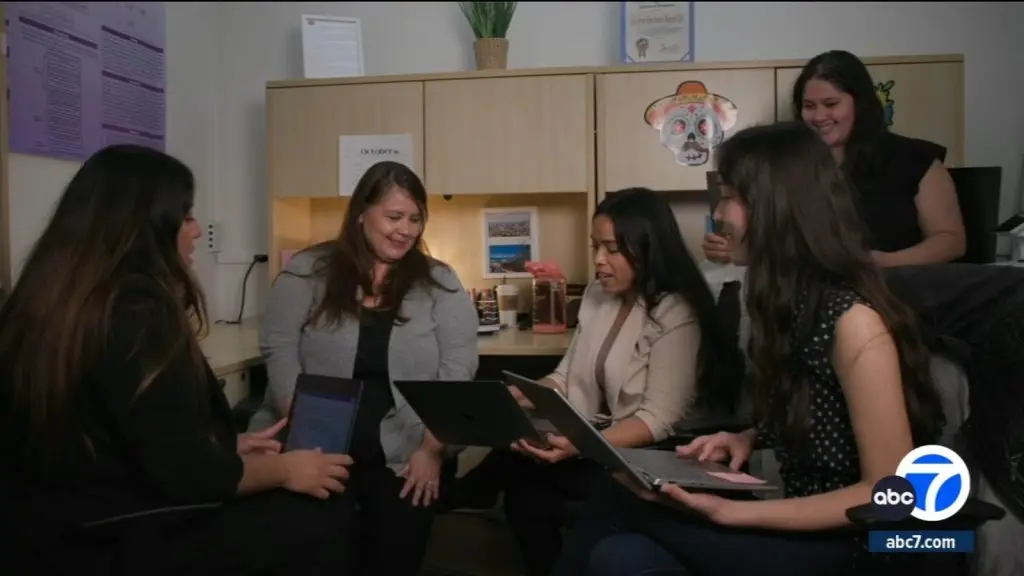
The women-led, multicultural, and multilingual group uses a community-based approach, but before they go out into the community, the work and preparation behind the scenes takes place at UCLA.
“We hope to empower the community to be like, ‘Okay, I know exactly what mechanisms contribute to me, like living a healthy life, and now I want to take that information and be an advocate. for myself,’” said the clinical research coordinator. Aisha Mohammed.
Their goal is the prevention, early detection, and management of Alzheimer’s disease and other forms of dementia. Díaz-Santos was born and raised in Puerto Rico where his grandmother, Estrella Ortiz Romero, died in 2007 after being diagnosed with dementia.
“We didn’t find a lot of information about dementia or Alzheimer’s or any other resources,” he said.
The ELHA lab pays tribute to her grandmother and creates educational tools that work with language and culture. For example, explaining how a celebration of Día de los Muertos can produce cognitive stimulation.
“Setting up their own altars … your prefrontal cortex is working, so their brain is awake,” explained senior research associate Stephanie Ovalle-Eliseo.
Latinos are 1.5 times more likely to develop Alzheimer’s disease than their white counterparts, but make up a small portion of research participants.
A common barrier is language.
“Some of these assessments that were used were developed in the early ’80s, early ’90s, and they were tested mostly in white middle-class populations. Applying that standard may not be appropriate for our population, “said research neuropsychologist Dr. Lorena Monserratt.
The lab aims to change that while building lasting relationships.
“What they tell us is the academics come when they need something, and they take it, and then they leave,” Díaz-Santos said.
Instead of taking, Díaz-Santos led an effort to collaborate and create partnerships with community-based organizations.
“We need to test what prevention strategies are best for our communities, and to do that, we need our partners to dictate the science,” he said.
Looking ahead, Díaz-Santos’ team strives for greater inclusion.
“We also need to talk about how our communities are linguistically diverse, like all of our native languages that we have here in Southern California. We need to talk about race, like Black Latinos and our Asian Latinos ,” he said.
The lab was established last year and hit the ground running with a deep sense of urgency
“In terms like, the rates and forecasts and with an aging community, we are in a time crunch to get this information as quickly as possible,” said Ovalle-Eliseo.
Díaz-Santos believes they can do more together.
“We are here, and we belong here, and we are here to stay,” he said.
[ad_2]
Source link