














[ad_1]

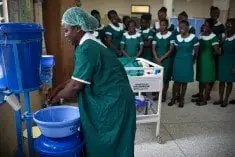
Midwife Rebecca Aryee washes her hands during a lesson at Cape Coast Midwifery School, Cape Coast, Ghana, on Monday 4 June 2018. Jhpiego has set up a ‘skills lab’ at the Cape Coast midwifery school, and sponsored the development of learning apps to help facilitate the training of new midwives.
Evidence shows that in low- and middle-income countries, the expansion of health coverage or access to care has not always reduced overall mortality, said Dr. Patricia Jodrey, Child Health Team Lead in the Office of Maternal and Child Health and Nutrition at the U.S. Agency for International Development (USAID). “However, the analysis also showed that when countries have progressed in improving the quality of their health systems, the survival rate tends to improve,” she said.
In fact, 58 percent of neonatal deaths are due not to lack of access to care, but poor quality of care, said Dr. Blerta Maliqi, Team Lead in the Department of Maternal, Newborn, Child, and Adolescent Health and Ageing at the World Health Organization (WHO). “And half of maternal deaths are due to poor quality care,” she said. The doctors spoke at a recent event hosted by the Wilson Center’s Maternal Health Initiative, in collaboration with USAID’s MOMENTUM Country and Global Leadership, on the importance of quality care and country-led strategies to improve maternal, newborn, child, and adolescent health and family planning outcomes during the COVID-19 pandemic.
Strengthening quality care includes expanding access to essential services
In India, health agencies are taking a multi-pronged approach to improve the quality of adolescent health care. Across schools, facilities, and communities, health workers provide a constellation of youth-driven outreach activities. These include adolescent-friendly health clinics, which provide services for any visiting adolescent at no cost, and school health and wellness programs, which train teachers on themes ranging from emotional well-being, internet safety, injury and violence prevention, healthy lifestyle, nutrition, and sanitation. Although this school-based program started less than two years ago, in just the last seven to eight months, more than 150,000 teachers across the country have been trained, said Dr. Zoya Ali Rizvi, Deputy Commissioner in the Adolescent Health Division of the Ministry of Health and Family Welfare in India.
An equally successful initiative in schools, community centers, and villages in India is Adolescent Health and Wellness Days (AHWDs). During these quarterly health events, adolescents engage in a wide variety of infotainment activities that help increase their awareness of health issues, address health myths and misconceptions, and familiarize youth with available health services. Besides talks by medical officers and doctors, the events feature plays, skits, speeches, and small movies. Thousands of AHWDs were held during the COVID-19 pandemic, even when schools were closed, she said.
Efforts have also been made to improve the quality of water, sanitation, and hygiene (WASH) services during the COVID-19 pandemic. In 2020, Bangladesh, India, Sierra Leone, Ghana, and Uganda were part of a year-long, five-country initiative to rapidly improve the quality of WASH services in health care facilities. These efforts improved quality outcomes including infection prevention readiness, the availability of basic WASH services, and provider adherence with handwashing and personal protective equipment (PPE) standards, said Maureen Fatsani Tshbalala, Senior Project Director of the Institute for Healthcare Improvement for USAID’s MOMENTUM Country and Global Leadership.
Capacity building and community engagement enhances service delivery
In Sierra Leone, strong interagency partnership and political will have been critical to ensuring quality maternal, child, and newborn services are provided and maintained. With the assistance of partner and donor organizations including USAID, WHO, and the Ministry of Health and Sanitation, Sierra Leone has expanded quality of care into health care facilities across Sierra Leone and appointed 36 of its first quality and patient safety officials, said Matron Margaret Titty Mannah, Program Manager of the Quality Management Programme at the Ministry of Health and Sanitation in Sierra Leone. By investing in quality of care, Sierra Leone has greatly improved screening for child wasting and screening for anemia among pregnant women, she said.
A defining feature undergirding the success of these country-level initiatives is community involvement. Across 25 health care facilities in Ghana, health workers engage community members to improve WASH readiness and services. We educate the community on handwashing practices and provide PPE, said Mavis Donkor, Deputy Health Information Officer of the Christian Health Association of Ghana. We have not left the community behind, said Donkor. “We have brought them on board, and we are thinking about the staff and also the community as a whole,” she said.
When it comes to maternal mortality, mothers are a key part of the solution. “If we engage them, if we involve them, they are the best solution-makers because they know what they need,” said Tshabalala. “In some contexts or some settings, they are culturally-driven, and if we can understand their culture and be able to align our solutions with what they need, then we win, and we want to have that.”
Strategies and challenges to sustaining quality improvement
While providing quality services, countries identified several strategic approaches to sustaining these service improvements. These solutions include engaging leadership at all levels; strengthening existing infrastructure and resources; supporting Quality Improvement (QI) teams through training, mentoring, and coaching; identifying clear objectives and measures; and documenting and disseminating best practices, said Tshabalala. During the COVID-19 pandemic, many countries also relied on virtual platforms to strengthen service quality. To improve the quality of WASH services, health care facilities used digital tools such as Zoom, WhatsApp, and Google Slides to support virtual QI coaching and peer learning, she said.
However, services cannot improve if these essential services do not exist in the first place. “We need to be taking services to the community because we don’t have enough clinics. We need enough facilities, and we need to have mobile services that are workable, that are applicable, and also that are needed to the different communities,” said Tshabalala.
Other challenges to sustaining quality improvement efforts were also revealed in Ghana. Barriers to continuous quality improvements of WASH services included lack of funding, staff resistance to change, poor attitude of staff and clients, unreliable water supply systems, and inadequate logistics, said Donkor.
Ultimately, quality care is key to improving maternal, child, and newborn health services and outcomes. “We are convinced that women and children need quality health care to survive and thrive,” said Koki Agarwal, Director of USAID’s MOMENTUM Country and Global Leadership and Vice President of D.C. Operations of Jhpiego. “At the end of the day, we recognize that we cannot accelerate reductions in maternal, newborn, and child mortality and morbidity in USAID partner countries without quality. In other words, there is no progress without quality,” she said.
Read More
Sources: The International Encyclopedia of Political Communication, The Lancet, Ministry of Health & Family Welfare.
Photo Credit: Midwife Rebecca Aryee delivers a lesson about the proper way to wash hands. Photo used with permission courtesy of Kate Holt/MCSP.
[ad_2]
Source link



