








Covid vaccine rates are SIX TIMES higher among Chinese pupils than Black Caribbeans, data shows – The Florida Post

[ad_1]

Covid vaccine uptake is six times higher among Chinese teenagers in England than Black Caribbeans, official data shows.

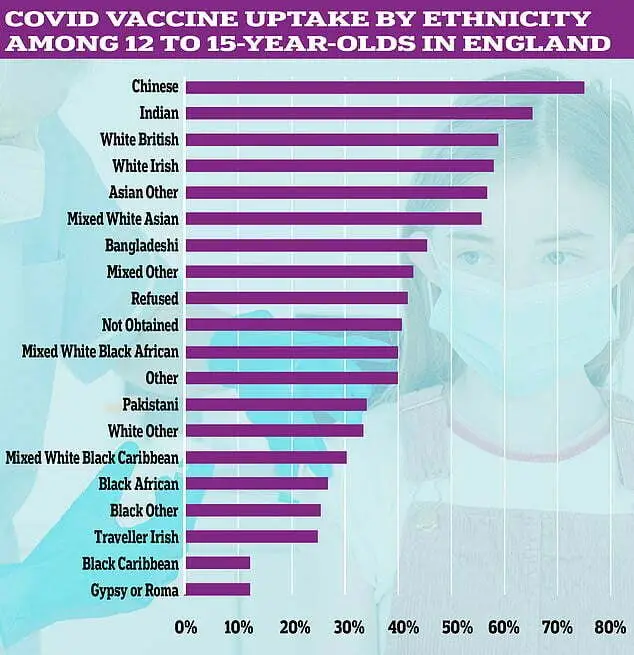
Three-quarters of Chinese pupils aged 12 to 15-year-olds have had a coronavirus jab, compared to just an eighth of Black Caribbean students, according to the Office for National Statistics. 

Rates are just as low among students of Gypsy or Roma background.

Jabs have been available to the cohort since September and more than half had at least one jab by January 9, according to the statisticians. 

Dr Patrick Nguipdop-Djomo, a clinical epidemiologist at the London School of Hygiene & Tropical Medicine, said the disparity in uptake among some groups could be due to ‘less access to information around vaccines’ or to jab sites themselves. 

The data should ‘help inform and support the provision of vaccination services and tailor communication to areas and groups with lower uptake’, he added.

The findings mirror uptake among adults, with data consistently showing willingness to come forward for a jab is lower among some ethnic groups. 

Researchers have pointed to a lack of trust among those promoting the vaccines, a lack of accessible information and inconvenient location and jab appointment times.

The Office for National Statistics found 52.5 per cent of pupils in England aged 12 to 15 had received at least one Covid jab. But the proportion of this cohort vaccinated varied hugely by age. Chinese (75.5 per cent), Indian (65.7 per cent) and White British (59.1 per cent) were the most likely to be vaccinated. But uptake among Black Caribbean (12.4 per cent) and Gypsy or Roma groups (12.4 per cent) was up to six times lower

The Office for National Statistics found 52.5 per cent of pupils in England aged 12 to 15 had received at least one Covid jab. But the proportion of this cohort vaccinated varied hugely by age. Chinese (75.5 per cent), Indian (65.7 per cent) and White British (59.1 per cent) were the most likely to be vaccinated. But uptake among Black Caribbean (12.4 per cent) and Gypsy or Roma groups (12.4 per cent) was up to six times lower 

The ONS data shows vaccine uptake increased with age, with 77.2 per cent of 17-year-olds having come forward for at least one jab. Children aged 12 had the lowest uptake, with 48.7 per cent having at least one injection. Just over half of 13-year-olds had received their first dose, while the figures for children aged 14 (54.1 per cent), 15 (56.4 per cent) and 16 (66.7 per cent) were slightly higher

The ONS data shows vaccine uptake increased with age, with 77.2 per cent of 17-year-olds having come forward for at least one jab. Children aged 12 had the lowest uptake, with 48.7 per cent having at least one injection. Just over half of 13-year-olds had received their first dose, while the figures for children aged 14 (54.1 per cent), 15 (56.4 per cent) and 16 (66.7 per cent) were slightly higher 

The ONS statisticians also found vaccination rates varied by region in England. By January 9, children aged 12 to 15 in the South East were most likely to be jabbed (60.7 per cent). London has the lowest jab rates, at just 40.8 per cent. Vaccine uptake was also lower than the national average among pupils in Yorkshire and the Humber (51.8 per cent), the West Midlands (49.8 per cent) and the North West (48.8 per cent)

The ONS statisticians also found vaccination rates varied by region in England. By January 9, children aged 12 to 15 in the South East were most likely to be jabbed (60.7 per cent). London has the lowest jab rates, at just 40.8 per cent. Vaccine uptake was also lower than the national average among pupils in Yorkshire and the Humber (51.8 per cent), the West Midlands (49.8 per cent) and the North West (48.8 per cent)

Deprivation levels also influenced how vaccinated youngsters are, according to the ONS data. In the wealthiest areas of the country (which score 10 on the deprivation scale), 70.3 per cent of 12 to 15-year-olds are vaccinated, while the uptake is nearly half this figure (36.1 per cent) among those living in the poorest parts of the country (which score one on the scale)

Deprivation levels also influenced how vaccinated youngsters are, according to the ONS data. In the wealthiest areas of the country (which score 10 on the deprivation scale), 70.3 per cent of 12 to 15-year-olds are vaccinated, while the uptake is nearly half this figure (36.1 per cent) among those living in the poorest parts of the country (which score one on the scale)

The ONS figures cover vaccination rates up to January 9, based on a database covering uptake among pupils in state-funded schools.  

The researchers said there is huge variation between jab rates among youngsters aged 12 to 15 based on their ethnicity.

Three in four Chinese students are vaccinated, compared to just 12.4 per cent of Black Caribbean and Gypsy or Roma groups, the data shows.

For comparison, 65.7 per cent of Indian students and six in 10 white British and Irish students have had a jab, the next-most vaccinated groups.

However, the ONS noted that despite white British students having the third-highest jab uptake, the majority of England’s unvaccinated pupils are in this group.

Of the country’s more than 1million unvaccinated 12 to 15-year-olds, 650,000 (59.1 per cent) are white British, the ONS said.

Quarter of parents of kids aged 5-11 wouldn’t agree to them getting jabbed 

One in four parents with children aged between five and 11 wouldn’t agree to them getting a Covid vaccine, official data shows.

A quarter (24 per cent) of parents said they were unlikely to agree with their child getting a Covid jab, according to questionnaire completed by more than 3,000 parents.

Ministers announced on Sunday that Covid jabs would be offered to vulnerable five to 11-year-olds in England.

The move followed the UK’s medicines watchdog approving a low dosage of the vaccine for the age group, after finding it was safe and effective. 

Children in the age group eligible for the jab include those with learning disabilities and diabetes. 

Main reasons for preventing their child from getting a jab included concerns about the side effects and waiting to see how it works, according to the Office for National Statistics.

Nearly two-thirds of parents said they were likely to agree with their child getting the vaccine.

Dr Patrick Nguipdop Djomo, co-chief investigator of the study at the London School of Hygiene & Tropical Medicine, said taking on board the concerns among parents can help tailor the messaging around vaccines to support uptake and ‘address concerns around side effects and effectiveness in the groups currently being offered the vaccine’.

Dr Shamez Ladhani, a consultant paediatrician at the UK Health Security Agency and the study’s chief investigator, said the data ‘provides a real insight into attitudes towards vaccination – which has been proven to protect against hospitalisation and severe disease’.

He added: ‘With Covid case rates currently high across school-age groups, it’s vital that we monitor and evaluate measures that help reduce transmission.

‘We need families and students to continue to take part in the programme.’    

The ONS team also found that Covid vaccine uptake increased with age, with 77.2 per cent of 17-year-olds having come forward for at least one jab.

Children aged 12 had the lowest uptake, with 48.7 per cent having at least one injection.

Just over half of 13-year-olds had received their first dose, while the figures for children aged 14 (54.1 per cent), 15 (56.4 per cent) and 16 (66.7 per cent) were slightly higher. 

Jabs were offered to 16 and 17-year-olds on August 15, while 12 to 15-year-olds could get their first dose five weeks later, which could explain some of this disparity. 

And the ONS noted that not all children in these age groups will be currently eligible for vaccination, such as if they have tested positive in the previous 12 weeks.

The statisticians also found vaccination rates varied by region. Children in the South East were most likely to be jabbed, with 60.7 per cent of 12 to 15-year-olds having at least one dose. 

London has the lowest jab rates, at just 40.8 per cent.

Vaccine uptake was also lower than the national average among pupils in Yorkshire and the Humber (51.8 per cent), the West Midlands (49.8 per cent) and the North West (48.8 per cent).  

Deprivation levels also influenced how vaccinated youngsters are, according to the ONS data.

In the wealthiest areas of the country, 70.3 per cent of 12 to 15-year-olds are vaccinated, while the uptake is nearly half this figure among those living in the poorest parts of the country (36.1 per cent). 

Students eligible for free school meals were also less likely to be vaccinated, as are children whose first language is not English.  

Fiona Dawe, deputy director of wider surveillance studies at the ONS, said there are ‘many different factors’ contributing to vaccine rates including geography, deprivation and ethnicity.

She said some of the disparity across the country may be down to different deprivation levels in different regions.

It comes after ministers announced on Sunday that Covid jabs would be offered to vulnerable five to 11-year-olds in England, such as those with learning disabilities and diabetes. 

The UK’s medicines watchdog approved a low dosage of the vaccine for the age group in December, after finding it was safe and effective. 

However, a questionnaire sent to more than 3,000 parents in England by the ONS found 24 per cent were unlikely to agree with their child getting the jab.

Concerns about the side effects and wanting to see how effective it is in the age group were cited as the main reasons for parent hesitancy, the researchers said. 

[ad_2]

Source link

Trending Topics

Features

Download and distribute powerful vaccination QI resources for your community.

Sign up now to support health equity and sustainable health outcomes in your community.

MCED tests use a simple blood draw to screen for many kinds of cancer at once.

FYHN is a bridge connecting health information providers to BIPOC communities in a trusted environment.

Discover an honest look at our Medicare system.

ARC was launched to create a network of community clinicians to diversify and bring clinical trials to communities of color and other communities that have been underrepresented.

The single most important purpose of our healthcare system is to reduce patient risk for an acute event.

Related Posts
How NMQF Advances Minority Health Through Data, Research and Health Access
Early Cancer Detection Is Entering a New Era. Flint Is Helping Lead the Way.
Why Your “Ozempic” May Not Be Ozempic: FDA Warnings Highlight Growing Risks of Unregulated GLP-1 Drugs
Scroll to Top
Featured Articles
How NMQF Advances Minority Health Through Data, Research and Health Access
Early Cancer Detection Is Entering a New Era. Flint Is Helping Lead the Way.
Why Your “Ozempic” May Not Be Ozempic: FDA Warnings Highlight Growing Risks of Unregulated GLP-1 Drugs
Why Your “Ozempic” May Not Be Ozempic: FDA Warnings Highlight Growing Risks o...
The Communities Most Burdened by Disease Should Be the First to Benefit from Artificial Intelligence
The Communities Most Burdened by Disease Should Be the First to Benefit from ...
Cancer Pain Care Access Gap Hits Black, Asian Patients
Black and Asian Cancer Patients Wait Longer for Pain Relief in New Study
What Is Cyclosporiasis Symptoms, Food Safety, and Reasons
What Is Cyclosporiasis? The Foodborne Illness Showing Up in the News
Categories
AI
ATTR-CM
BIPOC News
Cancer
Clinical Trials
Covid19
Diseases of the Body
Environment
Health Data
Health Equity Events
Health Policy
Health Tips
Subscribe to our newsletter to receive our latest news​
All Stories
How NMQF Advances Minority Health Through Data, Research and Health Access
Early Cancer Detection Is Entering a New Era. Flint Is Helping Lead the Way.
Why Your “Ozempic” May Not Be Ozempic: FDA Warnings Highlight Growing Risks of Unregulated GLP-1 Drugs
Why Your “Ozempic” May Not Be Ozempic: FDA Warnings Highlight Growing Risks o...
BIPOC News
How NMQF Advances Minority Health Through Data, Research and Health Access
Early Cancer Detection Is Entering a New Era. Flint Is Helping Lead the Way.
The Communities Most Burdened by Disease Should Be the First to Benefit from Artificial Intelligence
The Communities Most Burdened by Disease Should Be the First to Benefit from ...
Environment
UV Safety Awareness Month Raises Urgency on Skin Cancer Prevention and Sun Protection Equity
UV Safety Awareness Month Raises Urgency on Skin Cancer Prevention and Sun Pr...
Extreme Heat Safety Tips 5 Ways to Protect Your Health This Summer fyh.news
5 Heat Safety Tips That Could Protect Your Health This Summer
Lupus Awareness Event in Baltimore Aims to Support Research and Shine a Light on Health Disparities
Lupus Awareness Event in Baltimore Aims to Support Research and Shine a Light...
Work Force
A multigenerational Black and Hispanic family sitting together in a park, showing how Social Security helps support older adults, people with disabilities, and families across generations.
Millions of Older Americans Could Face Smaller Social Security Checks by 2032...
dreamstime_s_243253251
The Caregiver Journey: The Hidden Backbone of American Healthcare
Families gather at a Bronx community festival with live music, kids’ activities, and health booths sharing SOMOS social care resources and free screenings.
Celebrating Hispanic heritage while learning about health care

[xyz-ips snippet=”Output-Source-Name”]

Clinical Trials
Early Cancer Detection Is Entering a New Era. Flint Is Helping Lead the Way.
Why Your “Ozempic” May Not Be Ozempic: FDA Warnings Highlight Growing Risks of Unregulated GLP-1 Drugs
Why Your “Ozempic” May Not Be Ozempic: FDA Warnings Highlight Growing Risks o...
Clinical Trial Diversity Remains a Critical Challenge in Alzheimer’s Research
Vaccines and Outbreaks
A parent checking a child's temperature during summer, illustrating the changing RSV patterns and year-round respiratory virus risks.
Can You Get RSV During the Summer?
Michelle Lam, MBA, of NYC Health + Hospitals/Elmhurst & Amy Harris of NYC Health + Hospitals/Elmhurst
Healthcare Leaders Spotlight Vaccine Equity and Adult Immunization Strategies...
Measles Outbreaks Surge: Essential Facts and Prevention Strategies
Other Categories
AI
Read the latest AI News stories trending around the world
ATTR-CM
Cancer
Read the latest Cancer stories trending around the world
Covid19
Diseases of the Body
Read about the latest Diseases of the Body trending around the world
Friday Webinars
Every Friday, we bring you insightful webinars covering critical topics in healthcare, data equity, and policy reform.
Health Data
Read the latest Health Data stories trending around the world
Health Equity Events
Read the best Health Equity Events around the country.
Health Policy
Read the latest Health Policy stories trending around the world
Health Tips
Heart Health
Read the latest on Heart Health News, Stories and Tips.
kidney Health
Read more trending News about Kidney Health, Stories and Tips.