







Institutional Racism Linked To Worse Asthma Outcomes For Black Pittsburghers

[ad_1]

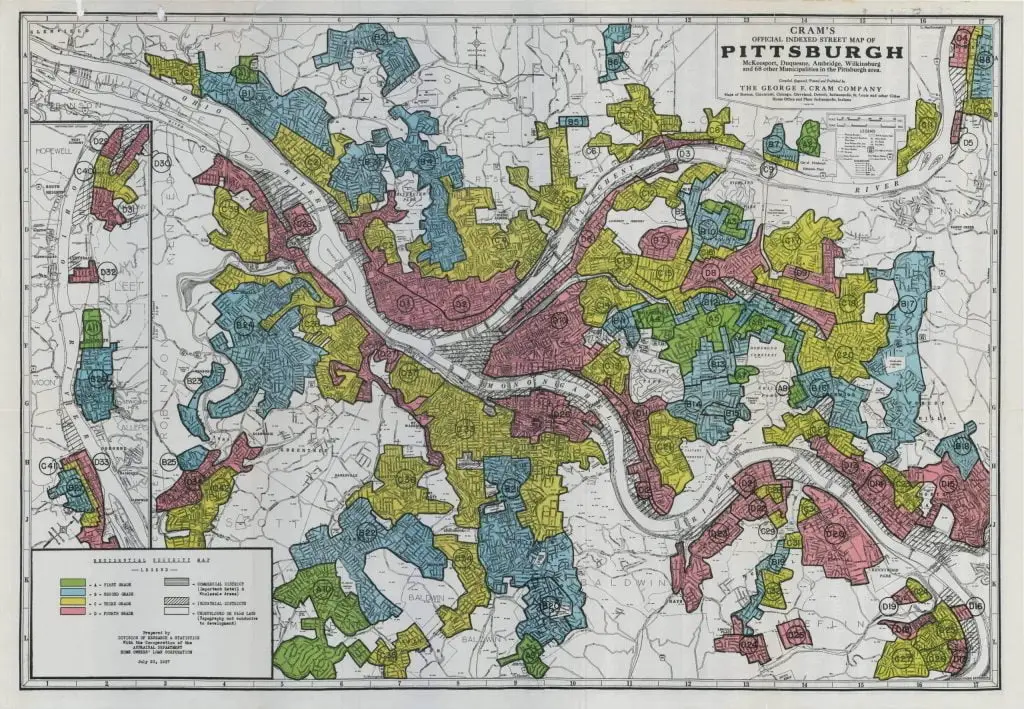
Home Owners’ Loan Corporation Residential Security Map 1937. Credit: Robert K. Nelson, LaDale Winling, Richard Marciano, Nathan Connolly, et al., “Mapping Inequality,” American Panorama, ed.

Redlining, a discriminatory mortgage lending practice instituted in the 1930s, resulted in health impacts that reverberate today, contributing to long-term environmental and asthma-related inequities that disproportionately affect Black Pittsburgh residents, according to a new analysis by University of Pittsburgh School of Public Health scientists.

The study, online now and scheduled for a coming print edition of the American Journal of Respiratory and Critical Care Medicine, is among the first to demonstrate that racism—rather than race—is an overarching socioenvironmental risk factor that appears to worsen asthma severity in Black people.

“We directly link racist loaning practices more than 80 years ago to the maintenance of poor environmental quality in the most redlined neighborhoods today,” said lead author Alexander Schuyler, an M.D.-Ph.D. student in Pitt’s Medical Scientist Training Program. “Our data, in turn, connects the higher pollution exposures to worsened asthma outcomes. In short, institutional racism—not race-based biology—is why many Black Pittsburghers experience severe asthma.”

During the 1930s, the Home Owners’ Loan Corporation (HOLC) generated a four-tiered grading system for mortgage applications in more than 200 U.S. metropolitan areas, including Pittsburgh and Allegheny County. The corporation assigned an “A” score to neighborhoods it deemed “best” and a “D” score to neighborhoods it called “hazardous” for mortgage lending. “D” neighborhoods had the highest proportion of Black residents, resulting in Black loan applicants experiencing financial blacklisting—or redlining—for decades.

Schuyler partnered with Sally Wenzel, M.D., chair of Pitt Public Health’s Department of Environmental and Occupational Health and director of Pitt’s Asthma and Environmental Lung Health Institute at UPMC, to cross Allegheny County’s historically redlined neighborhoods with data from 1,034 participants in the Asthma Institute’s Asthma Registry. The registry, established in 2007, collects clinical and demographic information on patients with asthma.

By overlaying neighborhood-level data about different types of air pollution from multiple sources—industrial, vehicular, railroad and waterway—Schuyler and Wenzel determined that emissions of carbon monoxide, fine particulates, sulfur dioxide and volatile organic compounds all increased across HOLC grades, with “D” neighborhoods experiencing the highest pollution levels.

The worst asthma-related outcomes—including uncontrolled or severe asthma—followed the same trajectory and disproportionately affected Black asthma registry participants.

“Air pollution induces structural changes in the lungs, causes inflammation and damages cells lining the airway, all of which can exacerbate asthma,” said Wenzel. “So, seeing worse asthma in people living in neighborhoods with more pollution isn’t surprising. What struck me was the enduring legacy of redlining. We are still seeing the long-term effects of the loss of generational capital and neighborhoods labeled as ‘toxic.’ Institutional racism is something we, as clinicians, have to recognize as a real, continued threat to the health of our patients and one we must fight against.”

The researchers also found that registry participants living in “D” neighborhoods, especially Black participants, received lower-quality asthma-related health care. They were less likely to be prescribed stronger medications with worsening asthma or be referred for advanced care than their white “A” neighborhood counterparts.

Schuyler said this could reflect bias by health care providers, but could also arise from equations that factor in race when calculating pulmonary function, colloquially known as “race-norming.” This can result in a Black patient’s lung function being designated as normal, when had the patient been white, it would be considered poor enough to need additional medical attention.

“This is another example of ascribing an unsubstantiated biological value to race to explain Black people having worse health outcomes, rather than recognizing it as institutional racism, which is something that can be addressed,” Schuyler said. “I hope our work empowers patients and further directs clinicians to account for racism, not race, when caring for their patients and encourages all of us to support local and national policies that repair the multigenerational damage brought by institutional racism.”


Living in redlined areas associated with lower lung function in those with asthma


More information:
Alexander J. Schuyler et al, Historical Redlining Impacts Contemporary Environmental and Asthma-Related Outcomes in Black Adults, American Journal of Respiratory and Critical Care Medicine (2022). DOI: 10.1164/rccm.202112-2707OC

Citation:
Institutional racism linked to worse asthma outcomes for Black Pittsburghers (2022, June 15)
retrieved 15 June 2022
from https://medicalxpress.com/news/2022-06-racism-linked-worse-asthma-outcomes.html

This document is subject to copyright. Apart from any fair dealing for the purpose of private study or research, no
part may be reproduced without the written permission. The content is provided for information purposes only.

[ad_2]

Source link
Trending Topics

Features

Download and distribute powerful vaccination QI resources for your community.

Sign up now to support health equity and sustainable health outcomes in your community.

MCED tests use a simple blood draw to screen for many kinds of cancer at once.

FYHN is a bridge connecting health information providers to BIPOC communities in a trusted environment.

Discover an honest look at our Medicare system.

ARC was launched to create a network of community clinicians to diversify and bring clinical trials to communities of color and other communities that have been underrepresented.

The single most important purpose of our healthcare system is to reduce patient risk for an acute event.

Related Posts
Cyclospora Outbreak Linked to Recalled Lettuce Sickens More Than 1,600 Across Five States
How NMQF Advances Minority Health Through Data, Research and Health Access
Early Cancer Detection Is Entering a New Era. Flint Is Helping Lead the Way.
Scroll to Top
Featured Articles
Cyclospora Outbreak Linked to Lettuce Sickens 1,600+ fyh.news
Cyclospora Outbreak Linked to Recalled Lettuce Sickens More Than 1,600 Across...
How NMQF Advances Minority Health Through Data, Research and Health Access
Early Cancer Detection Is Entering a New Era. Flint Is Helping Lead the Way.
Why Your “Ozempic” May Not Be Ozempic: FDA Warnings Highlight Growing Risks of Unregulated GLP-1 Drugs
Why Your “Ozempic” May Not Be Ozempic: FDA Warnings Highlight Growing Risks o...
The Communities Most Burdened by Disease Should Be the First to Benefit from Artificial Intelligence
The Communities Most Burdened by Disease Should Be the First to Benefit from ...
Cancer Pain Care Access Gap Hits Black, Asian Patients
Black and Asian Cancer Patients Wait Longer for Pain Relief in New Study
Categories
AI
ATTR-CM
BIPOC News
Cancer
Clinical Trials
Covid19
Diseases of the Body
Environment
Health Data
Health Equity Events
Health Policy
Health Tips
Subscribe to our newsletter to receive our latest news​
All Stories
Cyclospora Outbreak Linked to Lettuce Sickens 1,600+ fyh.news
Cyclospora Outbreak Linked to Recalled Lettuce Sickens More Than 1,600 Across...
How NMQF Advances Minority Health Through Data, Research and Health Access
Early Cancer Detection Is Entering a New Era. Flint Is Helping Lead the Way.
BIPOC News
How NMQF Advances Minority Health Through Data, Research and Health Access
Early Cancer Detection Is Entering a New Era. Flint Is Helping Lead the Way.
The Communities Most Burdened by Disease Should Be the First to Benefit from Artificial Intelligence
The Communities Most Burdened by Disease Should Be the First to Benefit from ...
Environment
UV Safety Awareness Month Raises Urgency on Skin Cancer Prevention and Sun Protection Equity
UV Safety Awareness Month Raises Urgency on Skin Cancer Prevention and Sun Pr...
Extreme Heat Safety Tips 5 Ways to Protect Your Health This Summer fyh.news
5 Heat Safety Tips That Could Protect Your Health This Summer
Lupus Awareness Event in Baltimore Aims to Support Research and Shine a Light on Health Disparities
Lupus Awareness Event in Baltimore Aims to Support Research and Shine a Light...
Work Force
A multigenerational Black and Hispanic family sitting together in a park, showing how Social Security helps support older adults, people with disabilities, and families across generations.
Millions of Older Americans Could Face Smaller Social Security Checks by 2032...
dreamstime_s_243253251
The Caregiver Journey: The Hidden Backbone of American Healthcare
Families gather at a Bronx community festival with live music, kids’ activities, and health booths sharing SOMOS social care resources and free screenings.
Celebrating Hispanic heritage while learning about health care

[xyz-ips snippet=”Output-Source-Name”]

Clinical Trials
Early Cancer Detection Is Entering a New Era. Flint Is Helping Lead the Way.
Why Your “Ozempic” May Not Be Ozempic: FDA Warnings Highlight Growing Risks of Unregulated GLP-1 Drugs
Why Your “Ozempic” May Not Be Ozempic: FDA Warnings Highlight Growing Risks o...
Clinical Trial Diversity Remains a Critical Challenge in Alzheimer’s Research
Vaccines and Outbreaks
Cyclospora Outbreak Linked to Lettuce Sickens 1,600+ fyh.news
Cyclospora Outbreak Linked to Recalled Lettuce Sickens More Than 1,600 Across...
A parent checking a child's temperature during summer, illustrating the changing RSV patterns and year-round respiratory virus risks.
Can You Get RSV During the Summer?
Michelle Lam, MBA, of NYC Health + Hospitals/Elmhurst & Amy Harris of NYC Health + Hospitals/Elmhurst
Healthcare Leaders Spotlight Vaccine Equity and Adult Immunization Strategies...
Other Categories
AI
Read the latest AI News stories trending around the world
ATTR-CM
Cancer
Read the latest Cancer stories trending around the world
Covid19
Diseases of the Body
Read about the latest Diseases of the Body trending around the world
Friday Webinars
Every Friday, we bring you insightful webinars covering critical topics in healthcare, data equity, and policy reform.
Health Data
Read the latest Health Data stories trending around the world
Health Equity Events
Read the best Health Equity Events around the country.
Health Policy
Read the latest Health Policy stories trending around the world
Health Tips
Heart Health
Read the latest on Heart Health News, Stories and Tips.
kidney Health
Read more trending News about Kidney Health, Stories and Tips.