









[ad_1]

Abstract
Food insecurity is prevalent among low-income immigrant and minority patients with cancer. To our knowledge, this randomized controlled trial is the first to prospectively examine the impact on cancer outcomes of food insecurity interventions, with the goal of informing evidence-based interventions to address food insecurity in patients with cancer.
A three-arm randomized controlled trial was conducted among food-insecure (18-item US Department of Agriculture Household Food Security Survey Module score ≥ 3) patients with cancer (N = 117) at four New York City safety net cancer clinics. Arms included a hospital cancer clinic–based food pantry (arm 1), food voucher plus pantry (arm 2), and home grocery delivery plus pantry (arm 3). Treatment completion (primary outcome) and full appointment attendance were assessed at 6 months. Food security status, depression symptoms (Patient Health Questionnaire-9), and quality-of-life scores (Functional Assessment of Cancer Therapy-General) were assessed at baseline and at 6 months.
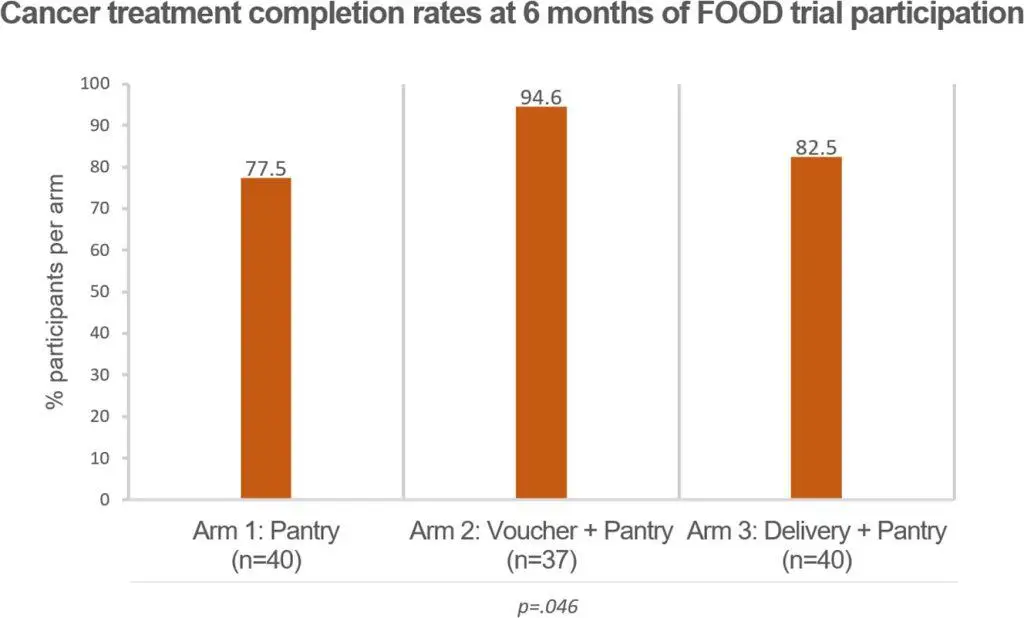
Voucher plus pantry had the highest treatment completion rate (94.6%), followed by grocery delivery plus pantry (82.5%) and pantry (77.5%; P = .046). Food security scores improved significantly in all arms, and Patient Health Questionnaire-9 and Functional Assessment of Cancer Therapy-General scores improved significantly in the pantry and delivery plus pantry arms.
Our findings in this preliminary study suggest that voucher plus pantry was the most effective intervention at improving treatment completion, and it met our a priori criterion for a promising intervention (≥ 90%). All interventions demonstrated the potential to improve food security among medically underserved, food-insecure patients with cancer at risk of impaired nutrition status, reduced quality of life, and poorer survival. All patients with cancer should be screened for food insecurity, with evidence-based food insecurity interventions made available.
© 2022 by American Society of Clinical Oncology
CONTEXT
-
Key Objective
-
To our knowledge, this randomized controlled trial is the first to prospectively compare cancer treatment completion and quality-of-life outcomes of hospital cancer clinic–based food insecurity interventions among medically underserved patients with cancer: food pantry (arm 1), food voucher plus pantry (arm 2), and home grocery delivery plus pantry (arm 3).
-
Knowledge Generated
-
Voucher plus pantry was the most effective at improving treatment completion (primary outcome; 94.6% completion rate) in this preliminary study. Food security scores improved significantly in all arms, and depression and quality-of-life scores improved significantly in the pantry and delivery plus pantry arms.
-
Relevance
-
Data on the interventions’ effectiveness may give providers and health care systems the option to implement interventions that best fit their resources and/or patient needs. All patients with cancer should be screened for food insecurity, with evidence-based food insecurity interventions made available to patients with need.
Supported by The New York State Health Foundation; National Cancer Institute: Core Cancer Center Support Grant (P30 CA008748), R01 CA230446 01; the CCNY/MSKCC Partnership for Cancer Research Training & Community Outreach (U54 CA137788); Laurie Tisch Illumination Fund; New York Community Trust; and AVON Foundation.
Conception and design: Francesca Gany, Yuelin Li, Victoria Blinder, Jennifer Leng
Provision of study materials or patients: Irina Melnic, Margaret Kemeny, Elizabeth Guevara, Caroline Hwang
Collection and assembly of data: Irina Melnic, Julia Ramirez, Margaret Kemeny, Elizabeth Guevara, Caroline Hwang
Data analysis and interpretation: Francesca Gany, Irina Melnic, Minlun Wu, Yuelin Li, Jackie Finik
Manuscript writing: All authors
Final approval of manuscript: All authors
Accountable for all aspects of the work: All authors
AUTHORS’ DISCLOSURES OF POTENTIAL CONFLICTS OF INTEREST
Food to Overcome Outcomes Disparities: A Randomized Controlled Trial of Food Insecurity Interventions to Improve Cancer Outcomes
The following represents disclosure information provided by authors of this manuscript. All relationships are considered compensated unless otherwise noted. Relationships are self-held unless noted. I = Immediate Family Member, Inst = My Institution. Relationships may not relate to the subject matter of this manuscript. For more information about ASCO’s conflict of interest policy, please refer to www.asco.org/rwc or ascopubs.org/jco/authors/author-center.
Open Payments is a public database containing information reported by companies about payments made to US-licensed physicians (Open Payments).
No potential conflicts of interest were reported.
[ad_2]
Source link