








To help give Asian American communities a sense of belonging and safety amid anti-Asian hate crimes, Minnesota State University is hosting its first Asian American Pacific Islander Summer Camp.
Incoming ninth and 12th graders who identify as an AAPI from all over the state were invited to attend the three-day camp this week revolving around the Asian American college experience and solidarity building.
“We wanted to ensure that students from marginalized backgrounds have an opportunity to visit, stay overnight and experience college so that they know that college can be accessible to them,” Interim Director of Asian American Affairs Pakou Lee said. “The pandemic shaped the experiences of Asian Americans with xenophobia and violence, but we want Asian American students to feel safe here.”
Camper Madelyn Thor instantly felt that sense of safety just by being around others in the AAPI community.
“I feel more comfortable when I see people who are racially the same as me,” the incoming ninth grader from Coon Rapids said. “I do want to meet other people of different races, but it’s easier for me to relate when they’re the same.”
Her feelings are often echoed by others in the Black, Indigenous and people of color communities due to their shared experiences regarding racial injustice. Asian Americans have faced plenty in the past few years.
From 2019 to 2020, the FBI documented a 77 percent increase in hate crimes targeting Asian people in the U.S.
From 2020 to 2021, more than 9,000 anti-Asian hate incidents were self-reported to Stop AAPI Hate — an advocacy group formed in 2020 as a response to the increased violence against Asian people due to the pandemic. COVID-19 was dubbed the “China virus” and “kung flu” by then-U.S. President Donald Trump.
The Center for the Study of Hate and Extremism more recently compiled data regarding hate crimes against Asian people in the U.S., revealing anti-Asian hate crimes increased by 169 percent in the first quarter of 2021 alone and 339 percent in total last year.
The creation of the camp offers AAPI students a safe space to share and heal from all they’ve experienced in recent years while getting to see what college would be like for them as well.
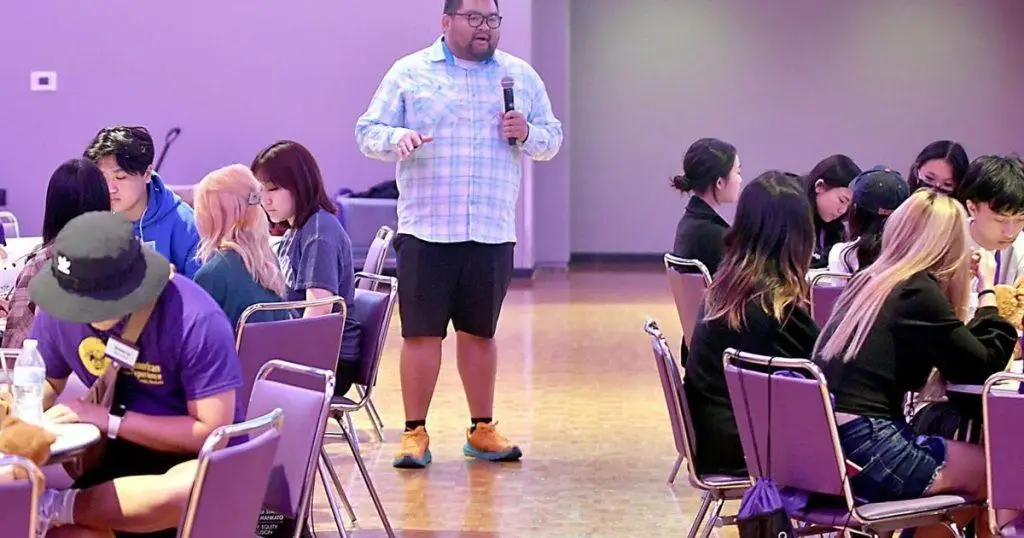
Throughout the camp, 40 students got to experience living in the residence halls, attended presentations and workshops, and were mentored by current AAPI students at MSU, who took on the role as camp counselors.

Camp counselor Peter Lee talks about his experiences with hate during the camp.
One was incoming MSU senior Keng Thao who said he applied to be a camp counselor to give prospective AAPI students the wisdom and experience he wished he got for himself.
“When I was in high school, I never really had the opportunity to experience a university, especially one specifically for the Asian American college experience,” he said. “It means a lot that I can give them (the campers) the experience I wanted as a high schooler.”
The AAPI Summer Camp isn’t the first camp MSU has held to give prospective students from marginalized communities a college experience with others that share their ethnic background.
The American Indian Summer Camp returned this week for the eighth time since it started in 2013, with a break in 2020 and 2021 due to the pandemic.
American Indian Affairs at MSU and the Four Dakota communities joined forces to create the camp in hopes of giving Native high school students the opportunity to experience college so they could see that it’s possible for them to achieve.
“Our high school graduation rate for Native students in the state of Minnesota is 53 percent,” Director of American Indian Affairs Megan Heutmaker said. “We’re just trying to help showcase that college is possible, exciting and safe, and that Native students belong on college campuses.”
The long-standing camp has offered teachings of the Dakota and Ojibwe languages and other culturally connected activities, along with college prep classes and informational sessions.
Heutmaker said that she was in full support of the creation of the AAPI camp. The two camps even shared breakfast together Thursday.
“I think it’s amazing,” she said. “It’s important that we have a community here that shows that we have support and dedication for our diverse and underrepresented students.”