













[ad_1]

By Kiyana Patel
Jackson, MS. —A weather-related calamity has shut off the water taps for many Jackson, Missouri households for the second time in a year, creating an environmental justice issue that serves as a reminder of the endurance of racism.
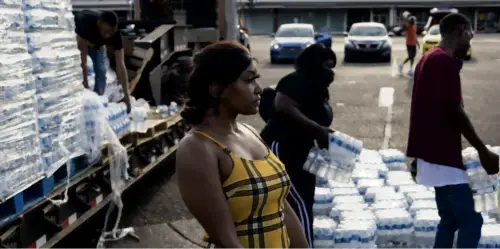
Local health officials first warned that the city’s water supply was hazy at the end of July and asked Jackson residents to begin boiling their water. The already-dangerous situation worsened when a nearby river flooded, causing problems at the OB Curtis Water Plant. The flood resulted in the Aug. 29 failure of Jackson’s main water treatment facility, leaving residents without clean water for drinking, bathing, or cooking.
On Aug. 30, Governor Tate Reeves declared a state of emergency. However, neither a state plan nor a timetable for when Jackson’s roughly 150,000-person population may expect the clean water scarcity to end were specified in the announcement. Instead, residents were informed
that they would be without clean water “indefinitely.”
While Jacksonians wait for a comprehensive state plan, they must endure the lack of water pressure required to flush toilets and put out fires.
According to CNN reports, the situation has become so dire that the city briefly ran out of bottled water to distribute to residents, leaving them without safe drinking water, a basic human right.
Social media users have pointed to the city’s dearth of essential infrastructure repairs as a root cause of the water crisis. Jackson had “a decaying water system” prior to this specific problem, in part because the city lacked the necessary financing for maintenance.
Jackson councilman Aaron Banks agreed, explaining that when severe temperatures forced Jackson’s water treatment facility to close in 2020, his district remained without water for over six weeks—significantly longer than the neighboring areas. The city has not been able to recover since.
“We have not gone a month without having a ‘boil water’ notice or low to no water pressure in the last two years,” Banks says. “Unfortunately, that is something we have gotten used to as American citizens—nobody should be adapting to that type of quality of life.”
What is happening in Jackson, as well as in Michigan cities like Flint in 2014 where the water supply was tainted with lead is, according to experts and advocates, a direct result of years of prejudice and segregation.
Though President Joe Biden passed a historic infrastructure plan which includes funding for underprivileged and underdeveloped towns such as Jackson, the funds are given by state legislators, who, according to Banks, frequently succumb to politics and prioritize projects for their constituents above addressing structural issues.
The councilman claims he has seen state funds go into the infrastructure of towns and areas near Jackson for years, but it hasn’t reached institutions like the city’s water treatment facility that are in dire need of it.
People of color have typically been the people hit hardest by underfunded infrastructure issues.
More than 80% of Jackson’s population is Black, making the water crisis there a painfully obvious example of environmental racism.
According to Greenaction, a nonprofit organization devoted to environmental justice projects, the term “environmental racism” is used to highlight “the disproportionate impact of environmental dangers on people of color.”
Part of the difficulty of addressing environmental justice is that people in positions of authority don’t understand the intersection between climate change and racism.
In a poll of 150 C-suite executives in the United States, the overwhelming majority agreed that businesses should address environmental justice, but they couldn’t define it. More than half of the respondents assumed the movement was about deforestation, suing businesses that have affected the environment, or achieving justice for the world.
It makes sense that they didn’t believe addressing environmental justice would actually make a difference in those communities if they believe this is only about justice for plants and trees and don’t realize that climate change and pollution have disproportionately negative effects on communities of color.
Nearly half of the respondents didn’t believe the environmental justice movement would improve the lives of marginalized or low-income communities.
Flint and Jackson are not alone in suffering from water infrastructure and environmental racism problems. Jackson is symptomatic of a growing water infrastructure catastrophe that the Associated Press predicts many U.S. cities, suburbs, and rural communities must prepare for.
[ad_2]
Source link