









YouTube CPAC
UPDATE 9:55 am
Prime Minister Justin Trudeau says the powers granted to police under the Emergencies Act are still needed, even now that the streets of Ottawa have been cleared.
The government used measures under the law for the first time in the face of protests in the national capital and border blockades.
Trudeau says there are still concerns about trucks returning to Ottawa streets and border crossings.
He says the government will continue to evaluate the situation every day to see when the powers under the Emergencies Act can be lifted.
He also made an appeal to mend national rifts in the wake of the protests.
He made the comments on the day Parliament is expected to vote on emergency measures used to quell an anti-vaccine mandate protest that gridlocked the streets of Ottawa for three weeks.
He says Canadians must choose if they want to continue to see those scenes play out.
He suggests Canadians reach out to friends after a heated political argument, or family members they haven’t seen in a while because they are unvaccinated.
Trudeau has faced criticism for polarizing the national conversation about COVID-19 restrictions and vaccine mandates.
UPDATE 8:55 am
Prime Minister Justin Trudeau says the government needs to reflect on the role of misinformation and foreign funding in destabilizing Canadian life once the crisis related to anti-mandate protests has passed.
Trudeau was asked whether any of the extraordinary powers invoked as part of the Federal Emergencies Act could become permanent.
He says the government will need to think about how to keep borders open and protect critical infrastructure in the future.
The government has already signaled its intent to register fundraising websites like GoFundMe with Canada’s financial intelligence agency going forward.
ORIGINAL 8:00 am
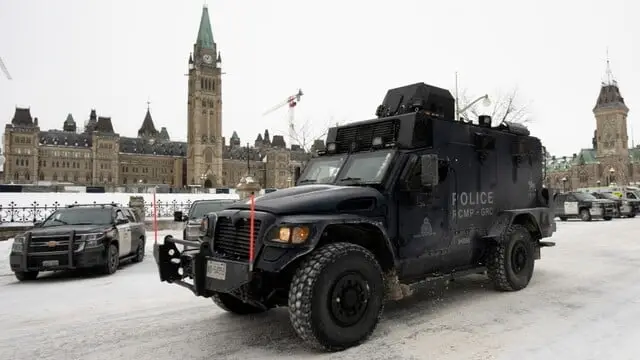
Silence and calm reigned on the streets of Ottawa for the first time in more than three weeks on Sunday as police continued their efforts to put a final end to anti-government demonstrations that immobilized the national capital.
Roadways once choked with trucks and protesters opposed to COVID-19 public health measures and Prime Minister Justin Trudeau’s government were largely clear, though debris and other signs of the blockade dubbed an illegal occupation by its critics were still in evidence.
Ottawa Police, working in tandem with forces from across the country, said they’d arrested 191 people and laid 391 charges related to the demonstrations, though Ottawa Interim Police Chief Steve Bell said the mammoth law enforcement operation was far from over.
“There is another phase that will identify how we maintain the streets, how we will eventually demobilize, once we’ve identified that there is no threat of further protests coming to our city,” Bell said at a news conference. “We are not there yet.”
Bell said charges laid to date include obstructing police, disobeying a court order, assault, mischief, possessing a weapon and assaulting a police officer.
Law enforcement is “with every hour” getting closer to delivering on its promise to clear streets and giving them back to residents, he added.
Chris Harkins, deputy commissioner with the Ontario Provincial Police, said commercial and private vehicle driver’s licenses have been suspended, while 76 vehicles have been seized and towed in Ottawa.
But the massive enforcement blitz also drew attention from Ontario’s police watchdog on Sunday. The Special Investigations Unit announced it was probing two police-involved incidents related to the weekend effort to clear protesters, including one where a woman was injured when mounted police from Toronto charged at the crowd.
The quiet that filled the streets around Parliament Hill on Sunday morning held throughout the day, though a heavy police presence remained and small groups of protesters were still gathered at fences erected to block off the long-standing heart of the demonstrations.
Police watched them closely from a distance, but did not move to force them to leave. About 100 police checkpoints remain to monitor and limit who can access the downtown core, and the parliamentary district is now largely fenced off with almost no access to whatsoever.
On Bank Street a few blocks south of Parliament Hill, Centretown resident Mary Werre and a friend were loading trash into black garbage bags. Werre said some locals had made plans to help clean up and take down any remaining hateful signs.
As Werre was speaking with The Canadian Press, a man and a woman passed by and then returned to complain about a man sitting in a wheelchair on the opposite street corner. The man went on to refer to those experiencing homelessness as “bums” and suggested the presence of trucks in recent weeks had curbed local crime.
“So this is the type of people that residents have been having to deal with on a regular basis,” Werre said as the man walked off.
Werre said it was nice to wake up to relative silence on Sunday and realize there were no livestreams showing action unfolding in her neighborhood.
“It was like, wait, is it over? Is it finally (over)?”
Alexis Shotwell, a Centretown resident and Carleton University professor, said she was glad things appeared to be ending but was not comfortable with the huge numbers of police still on the streets.
“I’m not loving having these many checkpoints and this many police in the neighborhood. It does not actually make our neighborhood feel safer,” she said. “It’s obviously been a horrific time for anyone who actually lives here.”
Jaya Dutta, who lives just off Parliament Hill, was so thankful for the more peaceful atmosphere that she went up to an officer at one checkpoint to thank him.
“Just to be able to walk around without being yelled at,” she said.
Dutta said she works just a few blocks from her home but had a friend drive her to work instead of walking for the last couple of weeks.
Tow trucks were removing vehicles left behind throughout the downtown core, and residents on three streets were warned to move their cars or they too would be towed.
On Wellington Street in front of Parliament Hill, the epicenter of the convoy’s party was entirely dismantled. The street, once packed three lanes deep with big rigs and RVs and cars, was deserted on Sunday save for a row of OPP SUVs and a lone plow clearing a recent snowfall from city sidewalks.
The profanity-laced signs and anti-vaccine posters that previously plastered the fences along the street are gone. Only a few Canada flag pennants still flapped in the wind.
Piles of garbage were collected on street corners – broken tents, empty gas cans, propane tanks and in at least one spot, a metal bucket full of empty beer cans and liquor bottles.
Metropolitain Brasserie Restaurant owner Sarah Chown said she was relieved to see police clear the intersection where her business is located.
She said she understands the need for barricades and fences to prevent demonstrators from reentering the area, but has reservations too.
“We’re now sort of stuck in this holding pattern,” she said. “Where do we go from here, and when are we going to be able to operate again?”
Robin Seguin, owner of Victoria Barber Shop located steps away from West Block, shared Chown’s views.
While Seguin said she is relieved to see demonstrators removed from downtown streets, she has questions about the next steps before she can make a full return to work and clients can feel comfortable coming to sit in her chair.
“How long are the barricades going to be up? How long is it going to be before things get back to normal?” she said.
Four convoy organizers have been charged and named publicly by police, including the original Go Fund Me fundraising organizer Tamara Lich, trucking company operator Chris Barber, and Patrick King, whose Facebook Live videos before the convoy began said violence and bullets were the only way to end the COVID-19 restrictions.
Tyson George Billings, known as “Freedom George” among convoy members, was arrested Saturday night. The High Prairie, Alta., Resident was shooting a Facebook Live video bragging about sneaking “past the roadblocks in his truck” and still being out of jail.
“I do not know if they’re actually looking for me,” he said while others in the car yelled “freedom” repeatedly.
Seconds later, red and blue lights lit up behind his truck.
“Looks like they might have got me,” he said, pulling over.
He was arrested when he got out of the car, and police seized a six-inch blade he told them was his “legal knife.”
Onlookers can be heard shouting “shame.”
Billings faces five charges including mischief, counseling others to commit mischief, and obstructing police.
Meanwhile, Ontario’s Special Investigations Unit said in a release Sunday it is probing an interaction between the Toronto Police Service mounted unit and a 49-year-old woman.
Police on horses were brought in to help with crowd control on Friday evening. At one point officers charged at the crowd and a woman with a walker fell.
The SIU said the woman reported a serious injury, and family on social media have varyingly said she broke her clavicle or dislocated her shoulder.
The Ottawa Police said in a tweet Friday evening that nobody was killed or seriously injured after a slew of social media reports that someone had died.
The SIU is also investigating the use of Anti-Riot Weapon Enfields by officers from the Vancouver Police Department on Saturday evening. The weapon is described as firing “less lethal” munitions including direct impact batons, chemical irritant delivery munitions and smoke delivery munitions.
The SIU said no injuries had been reported so far but is asking anyone who was struck to contact them.
In the House of Commons, meanwhile, debate on the government’s decision to invoke the Emergencies Act stretched into another day. A final vote on the measure is expected to proceed on Monday evening.

Photo: CTV News