










[ad_1]
Transcript:
Ifeyinwa Osunkwo, MD:Dr Desai, before we go into acute care and the disease treatment options, can you lay a landscape of how much sickle cell disease there is? How many people are affected globally in the United States? What are we talking about in terms of demographics—how many of them are young, maybe old? What should people anticipate in their practice in terms of the chance of seeing a sickle cell patient as a primary care doctor or as a hematologist?
Payal Desai, MD:In the United States, 1 of 6 African Americans carries the sickle cell trait mutation. You can see that birth rates are different across different parts of the world and across the United States. For example, there are about 8 to 10 states with the majority of sickle cell disease cases in the United States. A lot of them are in the South, in warmer climates. Patients also gravitate to those areas because of their disease. A lot of patients do better in warmer temperatures. It’s also the areas where we’ve had the largest African American population.
In the United States, most patients who have sickle cell disease are African American, and that’s where the largest communities exist. If you look outside the United States, track the equator and you’ll see, whether that’s in South America, the Caribbean, Africa, India, the Mediterranean. We think about sickle cell as a Black disease, but it’s not; it affects all sorts of nationalities. Anywhere the mutation might have protected people from malaria, you can see that. The incidence is much higher outside the United States. In countries such as India and Nigeria, the rates are quite high, and you see birth rates that affect. I’ve seen some statistics that say 1 of 10 people, 1 of 5 people. It’s hard to know without newborn screening, but I’ve seen lots of rates. The annual populations are in the hundreds of thousands, instead of the total population in the United States, which is around 100,000. I would love if other people have input or other statistics that they could speak to.
Ifeyinwa Osunkwo, MD:Wally, what are your thoughts?
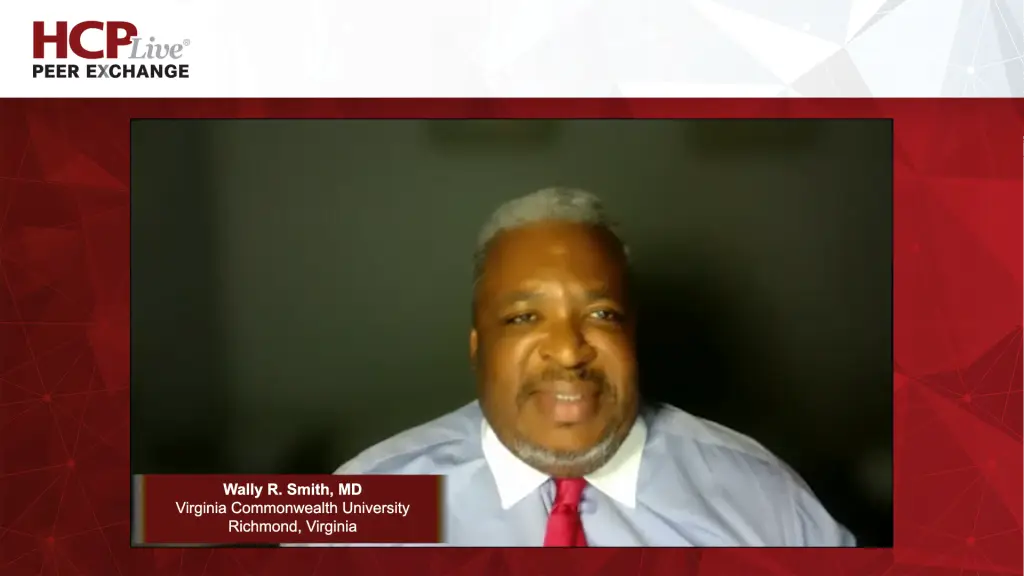
Wally R. Smith, MD:I’m interested in India, which until 10 years ago—when the world sickle cell map was epidemiologically validated by [Frédéric] Piel and others—we were unaware of the huge population. Outside the African continent, India has the largest concentration of patients with sickle cell disease. I didn’t learn that growing up. That wasn’t in the textbooks, and their expression is phenotypically different.
Ifeyinwa Osunkwo, MD: Yes.
Wally R. Smith, MD:I’m interested in in trying to understand that what can we learn from Indian patients with sickle cell that might lead to better disease management. What about their hemoglobin is different that would be a target for some drug? I have no idea.
Ifeyinwa Osunkwo, MD: Nimish?
Nirmish Ramesh Shah, MD:I’ll carry that to the next step. The fascinating part is some of the epigenetic things that might be leading to some protection. We see this in the Middle East, we’re learning more about India, but even the simple things that we look at epigenetically, like the upregulation of fetal hemoglobin, seems to be 1 area that in the Middle East and India are higher than what we see in the United States in the Black African American population. They do present very differently. They present later, but inevitably it’s sickle cell disease and; in many times, it’s not asymptomatic. They’re patients whom we must follow and learn from, but I emphasize what Dr Smith’s saying: that we can learn a lot. If the fetal hemoglobin is a specific target, then we need to do more research in trying to figure out how to do a better job of increasing fetal hemoglobin beyond what we’ve been doing with hydroxyurea.
Ifeyinwa Osunkwo, MD: Excellent. Basically, sickle cell is a global disease; it doesn’t affect only Americans. It affects people around the world. For the pop quiz at the end of this session, the top countries for sickle cell disease in order of magnitude are Nigeria, India, Democratic Republic of Congo, and Tanzania. There are about 100,000 people in the United States. Worldwide there are about 300,000 babies born [with sickle cell disease] every year, and the majority in low-income countries will pass away before their fifth birthday. It’s a huge burden. I anticipate that in the next couple of years, every provider—no matter where you are—will have the privilege of seeing sickle cell patients who most likely are adults. As Dr Smith said, 95% of kids in the United States and high-income countries are going to live to age 18. About 60% to 65% are over age 18, so they’re living longer, but we still have a way to go to shorten the mortality gap.
Transcript edited for clarity.
[ad_2]
Source link
Trending Topics
Features
- Drive Toolkit
Download and distribute powerful vaccination QI resources for your community.
- Health Champions
Sign up now to support health equity and sustainable health outcomes in your community.
- Cancer Early Detection
MCED tests use a simple blood draw to screen for many kinds of cancer at once.
- PR
FYHN is a bridge connecting health information providers to BIPOC communities in a trusted environment.
- Medicare
Discover an honest look at our Medicare system.
- Alliance for Representative Clinical Trials
ARC was launched to create a network of community clinicians to diversify and bring clinical trials to communities of color and other communities that have been underrepresented.
- Reducing Patient Risk
The single most important purpose of our healthcare system is to reduce patient risk for an acute event.
- Jessica Wilson
- Victor Mejia
- Jessica Wilson