










[ad_1]
For the past two years, the battle against COVID-19 has been mostly fought in hospitals
and vaccination clinics. Just as that paradigm was shifting, ACP and Annals of Internal Medicine‘s eighth virtual forum on the disease took place on Feb. 9.
“It is truly momentous that here we are two years into the pandemic for outpatient
physicians and we now can do the proverbial something for our patients,” said
moderator Rebecca Andrews, MD, FACP, associate program director of categorical internal
medicine at the University of Connecticut in Farmington and Chair of ACP’s Board of
Governors.
She was joined by four other panelists to discuss “Outpatient Evaluation and
Management of Patients with COVID-19.” The experts used clinical vignettes
to address testing, quarantine and isolation, treatment, and escalation of care for
COVID-19. A video recording of the forum was published by Annals on Feb. 15, along with commentary by Christine Laine, MD, MPH, FACP, ACP Senior Vice President
and Annals Editor-in-Chief, and is available online.
“We have felt and seen this shift in complexity of recommendations and treatment
options during just the last several months,” said Dr. Andrews. “With
the options have come some complex questions.”

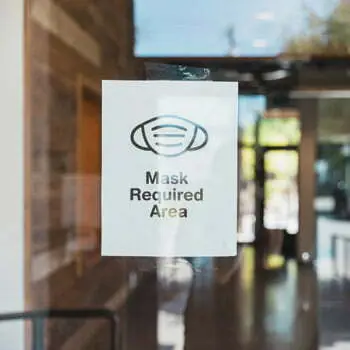
wear a mask indoors and then test for COVID-19 from five to seven days after exposure.
Image by SDI Productions
A common question is what to do after exposure to SARS-CoV-2. That depends on whether
the person has been vaccinated, noted panelist Megan L. Ranney, MD, MPH, Warren Alpert
Endowed Professor of Emergency Medicine and academic dean at Brown University School
of Public Health in Providence, R.I.
For unvaccinated people, the immediate answer is to quarantine. “Stay away
from other people for at least the next five days, then test at approximately five
days. And then for the next five days after that, if you choose to be out in public,
do so only with a mask on,” she said.
Vaccinated people don’t have to quarantine, according to the CDC, but should follow
the same guidance to mask up and then test, which Dr. Ranney usually advises them
to do between five to seven days after exposure.
Recent events have led panelist Paul E. Sax, MD, to vary a little from that guidance.
“The incubation period for omicron appears to be shorter than with previous
variants. If one has the luxury of having multiple rapid tests available …
then you can actually have people test closer to the time of the exposure,”
he said. “My standard recommendation more recently has been to test on days
2, 4, 6, and then stop.”
This is a point where best practice may remain in flux, said Dr. Ranney. “There
will doubtless be another variant at some point, and our time periods for testing
and quarantine may shift a little bit.”
There’s also some uncertainty about how to test. “Either a PCR or an antigen
test is acceptable, according to the CDC recommendations,” said Dr. Ranney,
who highlighted some tradeoffs between the two options. Polymerase chain reaction
(PCR) tests may remain positive after a patient is no longer infectious, but rapid
antigen tests give more false negatives.
An inaccurately negative test is the bigger concern, noted Dr. Sax, who is a professor
of medicine at Harvard Medical School and clinical director of the division of infectious
diseases at Brigham and Women’s Hospital in Boston.
“False-positive test results are extremely uncommon with both [quantitative]
PCR and with antigen tests,” he said. “The likelihood of a false positive
is directly related to the incidence of COVID-19 in your community at the time. So
a false positive during late December, early January in the northeastern United States
was basically impossible.”
If a person undergoes both kinds of tests and the results disagree, “You have
to believe it is positive,” cautioned Dr. Sax.
Testing at the end of infection is even more fraught. The CDC has not said that health
care workers who have had COVID-19 need to test negative before returning to work,
Dr. Sax noted. “But there weren’t sufficient tests available” at the
time that recommendation was issued, he added.
That’s not the only reason for the recommendation, said panelist Roy M. Gulick, MD,
MPH, Rochelle Belfer Professor in Medicine and chief of the division of infectious
diseases at Weill Medical College of Cornell University in New York City. “Part
of the controversy over retesting at day five has to do with the fact that none of
these tests were actually validated to follow the illness. They’re all diagnostic
tests.”
Dr. Sax favored testing to “err on the side of safety” before returning
to work, although one of his fellow panelists noted that error is particularly likely
if one uses PCR testing to assess recovery.
“It is just such a sensitive assay. It’ll be positive for a long period of
time when the patients are not necessarily infectious,” said Jason Gallagher,
PharmD, clinical professor at Temple University School of Pharmacy in Philadelphia.
The experts also delved into how to treat COVID-19 in outpatients. Dr. Gulick reviewed
the top options for patients at high risk of severe disease: nirmatrelvir with ritonavir
(Paxlovid), sotrovimab (Xevudy), and remdesivir (Veklury).
“Those are the three best choices. They’re ranked in that order because the
protease inhibitor is oral and available. The monoclonal antibody is a single infusion.
Remdesivir requires three daily infusions,” he said. “The fourth choice,
which is only an option if the first three are not available, is the antiviral molnupiravir.”
With that top choice, it’s important to remember the numerous potential drug interactions, which are listed in the NIH guidelines. Some, including some antiseizure medications, are absolute contraindications, while
others can be worked around.
“If they’re on statins, they can stop them for the period of time that they’re
on Paxlovid and then restart a few days later,” said Dr. Ranney. Nirmatrelvir/ritonavir
can also make oral contraceptives less effective, so patients should use a backup
method, she advised.
Access to the recommended therapies has been a challenge, all agreed. One solution
is an online locator tool from HHS. “Distribution of these short-supply treatments is different in every state.
I’m in Massachusetts, and our mainstream pharmacies did not get any of these treatments
initially,” said Dr. Sax. “When case numbers were extremely high, in
January, we had underutilization of nirmatrelvir … because the distribution
was so confusing, and we’re still working through this problem.”
The proliferation of proposed therapies for COVID-19 has also caused confusion. Dr.
Gallagher did a quick rundown of a few, noting that hydroxychloroquine has been definitively
disproven and ivermectin has very poor evidence support. “Fluvoxamine I think
is pretty interesting, to be quite honest,” he said. Dr. Sax noted that trials
have also shown potential benefit with inhaled steroids in outpatients.
Although studies have failed to show benefit from vitamin D, “I don’t think
it’s harmful,” said Dr. Sax. “I do feel like people should stay away
from zinc. Zinc can be toxic to the olfactory system.”
Dr. Ranney offered a few recommendations that physicians can safely give to patients
searching for a COVID-19 remedy. “I tell people chicken soup, Gatorade, ibuprofen,
making sure that you eat a varied diet, taking a multivitamin. … all the stuff
that my grandmother used to tell me to do when I got sick,” she said. “I
do think that giving folks a sense of agency, and just something to do in this very
scary and anxiety-provoking illness, is helpful.”
Outpatients also value guidance about when to seek additional treatment. “I’m
recommending to all of them … to get themselves a pulse oximeter, because
that’s the first and biggest thing,” said Dr. Ranney. “If their pulse
ox is persistently at or below 90%, they need to come in to the ED.”
Other reasons to escalate to the ED include severe lethargy, inability to keep food
down or produce urine, chest pain, severe difficulty breathing, or stroke symptoms,
but those occur in a minority of COVID-19 patients, she added.
“An awful lot of them can be managed at home without ever having to come into
my emergency department,” said Dr. Ranney, who concluded her remarks by thanking
internists for their work over the past two years. “I know how tough it is,
and I know how appreciative our patients and our communities are.”
[ad_2]
Source link