









[ad_1]
At the heart of the latest battle over abortion access is a federal judge’s ruling that cites concern about the mental health of women who choose to end their pregnancies.
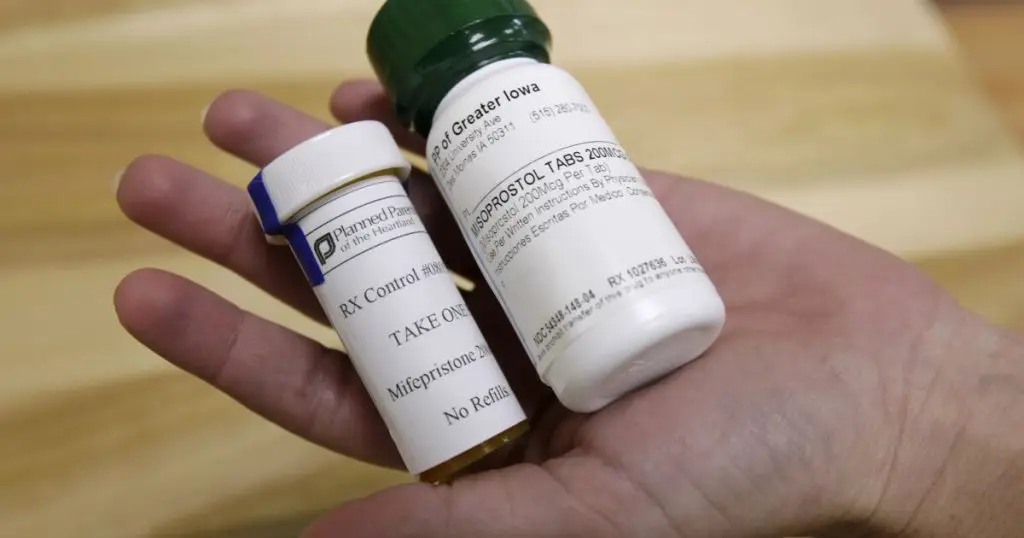
In revoking regulatory approval of the widely used drug mifepristone, U.S. District Judge Matthew Kacsmaryk said that the Food and Drug Administration failed to study the psychological effects of its use and ruled that it should be pulled from shelves while the drug agency conducts a comprehensive evaluation of the pill’s safety.
In response to his ruling, a federal appeals court late Wednesday preserved access to mifepristone, though only for up to seven weeks of pregnancy and not by mail.
“Considering the intense psychological trauma and post-traumatic stress women often experience from chemical abortion,” Kacsmaryk wrote, the FDA’s omission is bound to cause lasting damage to women who take the pill.
On a subject as deeply personal as abortion, the balance of risks and benefits varies with every pregnant woman who considers one. But abortion’s aggregated mental health effects on women who have terminated their pregnancies have been studied extensively — and the most rigorous research does not support Kacsmaryk’s assertions.
Differences in study design, the limits of available data and researchers’ political leanings have produced a range of findings that encourage cherry-picking. That, critics suggest, is what Kacsmaryk did in citing an odd assortment of studies to bolster his views.
With so much excellent scholarship on abortion and mental health, “it’s lost on me why that research wasn’t used in the judge’s decision,” said Julia R. Steinberg, a professor of family science at the University of Maryland who studies the interplay between reproductive and mental health.
Indeed, several of the studies Kacsmaryk highlighted have been widely criticized for faulty methodology.
Among them was a 2011 “study of studies” that said women who had an abortion had an 81% increased risk of mental health problems, with nearly 10% of them directly attributable to their procedures. After its publication in the British Journal of Psychiatry, no fewer than 11 published critiques cast doubt on those findings by pointing out a raft of “fatal flaws.” They noted that half of the 22 papers included in the analysis were conducted by the author herself — a serious conflict of interest — while several relevant studies by other researchers were omitted from the analysis. Detractors also pointed out statistical errors that falsely implied a causal relationship between abortion and mental health woes.
Also cited by Kacsmaryk was a 2002 study written by David C. Reardon, an associate scholar at the Charlotte Lozier Institute, an antiabortion organization. That study combed through Medicaid records of low-income women in California and found that over eight years, suicide rates among women who had an abortion in 1989 were 2.5 times higher than among women who delivered babies that year.
Critics have faulted such medical record studies for drawing a direct line between abortion and suicide without considering other factors that could explain the relationship. Because Medicaid records are incomplete, studies that use them fail to account for the effects of poverty, domestic violence and preexisting mental health challenges, all of which can contribute to unwanted pregnancies and abortions. They’re all risk factors for suicide as well.
In addition, many such studies compare the mental health of women who seek abortions with women who complete wanted pregnancies — two very different populations.
In an interview, Reardon said 11 studies have found elevated short-term mortality rates among women who had abortions. Such evidence should be reviewed by the FDA, he said.
“I realize this is highly contested,” Reardon said. But he defended his findings, saying he does not argue that abortion is the only cause of elevated death rates.
“These outcomes have multiple factors of causation,” said Reardon, who also directs the antiabortion Elliot Institute. “But abortion is a factor.”
In his 67-page ruling, Kacsmaryk drew from a published “case study” of women who anonymously shared their regrets on an internet site devoted to “healing from abortion.” And he made repeated reference to a 2001 study that identifies ways to reduce patients’ discomfort in British abortion facilities. That report found that 56% of women undergoing an abortion believed they had seen the aborted fetus during the procedure, an occurrence “which can be distressing, bring home the reality of the event, and may influence later emotional adaptation,” according to its authors.
This observation prompted Kacsmaryk to warn that “women who have aborted a child — especially through chemical abortion drugs that necessitate her seeing her aborted child once it passes — often experience shame, regret, anxiety, depression, drug abuse, and suicidal thoughts because of the abortion.”
Much of the research cited by Kacsmaryk was published decades ago, apparently bolstering his case that the FDA could have considered it when evaluating mifespristone. But other studies available at the time could have prompted the FDA to conclude that a close examination of abortion’s effect on women’s psyches was unnecessary.
A comprehensive review undertaken by the American Psychological Assn. in 1989, for instance, concluded that “severe negative reactions after legal, nonrestrictive, first-trimester abortion are rare and can best be understood in the framework of coping with a normal life stress.” Some women experience severe distress or mental illness after abortion, the APA team wrote, but it cautioned that a causal link was not clear.
Ten years later, an APA task force expanded on that conclusion. “The majority of adult women who terminate a pregnancy do not experience mental health problems,” the members wrote. Citing a 2000 study of women’s mental health after abortion, the task force said those who do experience depression, anxiety and regret “tend to be women with a prior history of depression.”
Researchers at UC San Francisco launched an effort to generate more rigorous research on the mental and physical health of women after they received an abortion. Funded by grants from private philanthropies including the David and Lucile Packard Foundation and the William and Flora Hewlett Foundation, the Turnaway Study recruited about 1,000 women who had sought care at 30 abortion facilities in 21 states across the country between 2008 and 2010.
The researchers made a point of comparing women in similar circumstances — bearing an unwanted pregnancy — but whose trajectories were different. Some got the abortion they wanted, others were turned away because their pregnancies were too far along to be terminated at the clinic. Some of these women went on to get an abortion elsewhere. Unless they miscarried, the rest carried their pregnancies to term.
Whatever their circumstance, the women answered questions about their physical and mental health, childbearing experiences and intentions, history of traumatic life events and a host of other biographical details. Until 2016, those interviews were repeated every six months for five years.
The resulting trove of data has generated 52 published studies that allowed direct comparisons between women who got abortions and those who gave birth.
Collectively, those studies tell a story of abortion-receiving women initially shaken by their ordeal, but no more depressed or anxious five years later than those who completed an unwanted pregnancy. By the five-year mark, 95% of women who ended an unwanted pregnancy were very confident that they had made the right choice. And women who received abortions were no more likely to contemplate suicide than those who carried their pregnancies to term.
Indeed, recent research from the Turnaway Study suggests it isn’t so much whether a woman terminates an unwanted pregnancy or carries it to term that predicts whether she’ll suffer psychological distress in the next two years. A key predictor of whether an abortion-seeking woman develops depression or anxiety is whether she perceives stigma around abortion among her family and community.
“We’ve long lived in an environment that shames women for wanting healthcare, and I worry that the current political environment is just increasing the shame people have for wanting an abortion,” said study leader M. Antonia Biggs, a reproductive health researcher at UC San Francisco.
Women who worry that others would think less of them may not dare to seek support, Biggs added. The isolation of concealing such a decision “can last a very long time,” and internalizing feelings of shame “can have an impact on your mental health.”
[ad_2]
Source link
Trending Topics

Features
- Drive Toolkit
Download and distribute powerful vaccination QI resources for your community.
- Health Champions
Sign up now to support health equity and sustainable health outcomes in your community.
- Cancer Early Detection
MCED tests use a simple blood draw to screen for many kinds of cancer at once.
- PR
FYHN is a bridge connecting health information providers to BIPOC communities in a trusted environment.
- Medicare
Discover an honest look at our Medicare system.
- Alliance for Representative Clinical Trials
ARC was launched to create a network of community clinicians to diversify and bring clinical trials to communities of color and other communities that have been underrepresented.
- Reducing Patient Risk
The single most important purpose of our healthcare system is to reduce patient risk for an acute event.
- Jessica Wilson
- Jessica Wilson
- Jessica Wilson