











- By FYH News Team
[ad_1]
Question
Are there racial and ethnic differences in the prevalence of major depressive disorder (MDD), and have mental health treatment disparities persisted among adolescents with MDD?
Findings
In this cross-sectional analysis of nationally representative survey data of 10 743 US adolescents, adolescents of more than 1 race or ethnicity had the highest rates of MDD. Among those with MDD, relative to White adolescents, adolescents who were Latinx and of more than 1 race or ethnicity had the lowest MDD treatment rates, followed by Black adolescents; Asian and Latinx adolescents had lower virtual mental health treatment rates compared with White adolescents.
Meaning
These findings suggest that US federal policy should target adolescents as a whole, and racial and ethnic minority populations in particular, to ensure timely and equitable access to high-quality mental health treatment.
Importance
The COVID-19 pandemic has contributed to poorer mental health and a greater need for treatment. Nationally representative estimates of major depressive disorder (MDD) and mental health treatment among US adolescents during the pandemic are needed.
Objective
To estimate MDD prevalence among adolescents, evaluate mental health treatment use among adolescents with MDD, and assess differences by race and ethnicity.
Design, Setting, and Participants
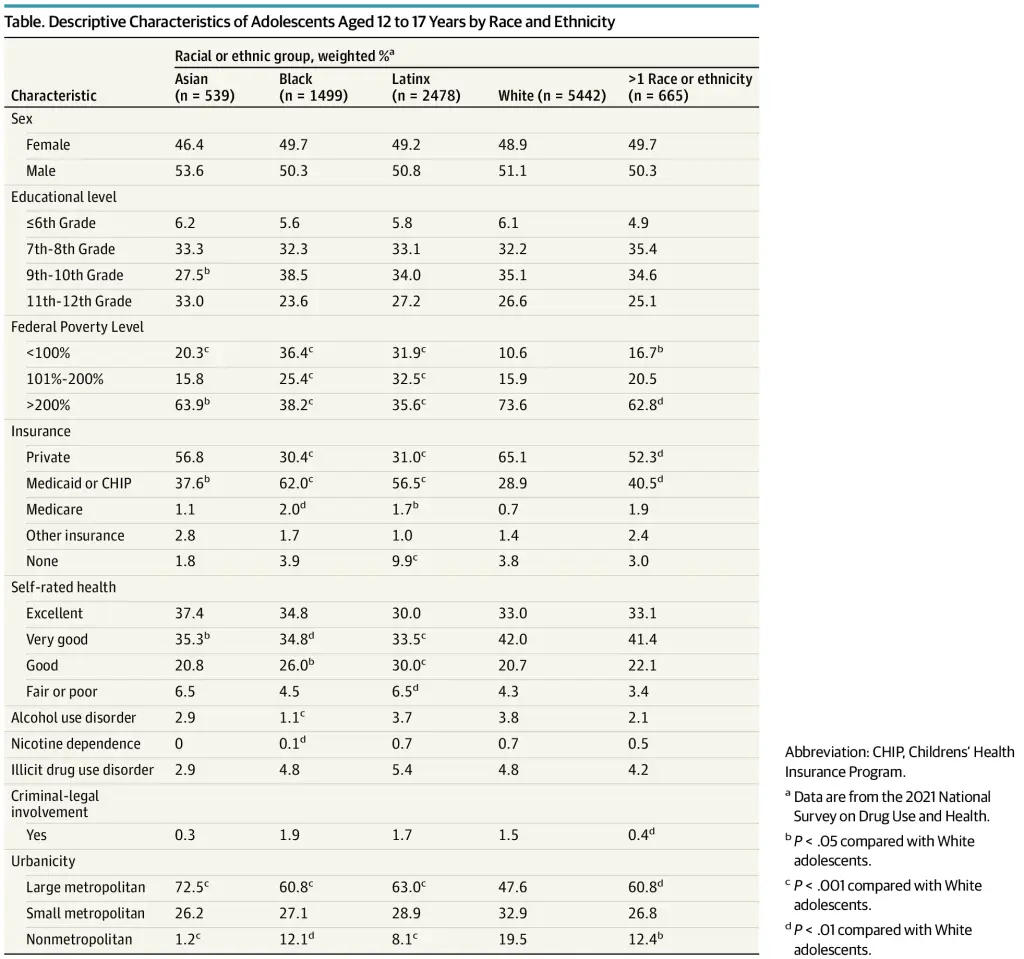
This cross-sectional analysis of the nationally representative 2021 National Survey on Drug Use and Health included noninstitutionalized US adolescents between the ages of 12 and 17 years (n = 10 743). Analytic weights were applied to all rates and model estimates to be nationally representative and account for sample design and survey nonresponse. Data were collected from January 14 to December 20, 2021, and analyzed from February 11 to April 3, 2023.
Exposures
Self-reported race and ethnicity.
Main Outcomes and Measures
Dichotomous outcomes of MDD as defined by the Diagnostic and Statistical Manual of Mental Disorders (Fifth Edition), MDD-specific mental health treatment, any type of mental health treatment, telehealth visits, and delays in mental health treatment.
Results
The sample included 10 743 adolescents (51.1% male). Self-reported race and ethnicity included 5.1% Asian, 14.1% Black, 23.3% Latinx, 51.2% White, and 6.3% more than 1 race. Ages were evenly distributed: 34.0% aged 12 to 13 years; 33.3% aged 14 to 15 years; and 32.7% aged 16 to 17 years. Adolescents of more than 1 race or ethnicity had the highest MDD rate (26.5%). Compared with White adolescents, the lowest rates of any MDD treatment overall were found among Latinx adolescents (29.2% [95% CI, 22.2%-36.2%]) and those of more than 1 race or ethnicity (21.1% [95% CI, 11.6%-30.7%]). Similar results were found for treatment by any clinician (Latinx, 25.6% [95% CI, 18.8%-32.4%]; >1 race or ethnicity, 19.1% [95% CI, 9.7%-28.6%]), treatment by a mental health specialist (Latinx, 22.9% [95% CI, 16.9%-28.9%]; >1 race or ethnicity, 16.7% [95% CI, 7.1%-26.3%]), treatment by a nonspecialist clinician (Latinx, 7.3% [95% CI, 3.3%-11.3%]; >1 race or ethnicity, 4.8% [95% CI, 1.9%-7.7%]), and use of any psychotropic medication prescription (Latinx, 11.6% [95% CI, 7.3%-15.9%]; >1 race or ethnicity, 8.3% [95% CI, 2.8%-13.7]). Compared with White adolescents, Black adolescents had lower rates of MDD treatment by any clinician (31.7% [95% CI, 23.7%-39.8%]) and by nonspecialist clinicians (8.4% [95% CI, 3.8%-13.2%]) and experienced lower prescription rates for any psychotropic medication (12.6 [95% CI, 4.6%-20.6%]). Asian (16.0% [95% CI, 5.0%-27.2%]) and Latinx (17.8% [95% CI, 12.6%-23.0%]) adolescents had lower rates of virtual mental health treatment compared with White adolescents. Black (19.1% [95% CI, 14.1%-24.2%]) and Latinx (17.9% [95% CI, 15.0%-21.1%]) adolescents had lower rates of appointments transition to telehealth, while Black adolescents (14.1% [95% CI, 10.7%-17.4%]) experienced delays getting their prescriptions.
Conclusions and Relevance
During the first full calendar year of the pandemic, approximately 1 in 5 adolescents had MDD, and less than half of adolescents who needed treatment had any mental health treatment. Adolescents in racial and ethnic minority groups, particularly Latinx, experienced the lowest treatment rates. Federal policy should target adolescents as a whole, and minority populations in particular, to ensure equitable treatment access. Efforts should consider the social, racial, ethnic, and cultural determinants of health.
[ad_2]
Source link
Trending Topics

Features
- Drive Toolkit
Download and distribute powerful vaccination QI resources for your community.
- Health Champions
Sign up now to support health equity and sustainable health outcomes in your community.
- Cancer Early Detection
MCED tests use a simple blood draw to screen for many kinds of cancer at once.
- PR
FYHN is a bridge connecting health information providers to BIPOC communities in a trusted environment.
- Medicare
Discover an honest look at our Medicare system.
- Alliance for Representative Clinical Trials
ARC was launched to create a network of community clinicians to diversify and bring clinical trials to communities of color and other communities that have been underrepresented.
- Reducing Patient Risk
The single most important purpose of our healthcare system is to reduce patient risk for an acute event.
- Jessica Wilson
- Victor Mejia
- Jessica Wilson