









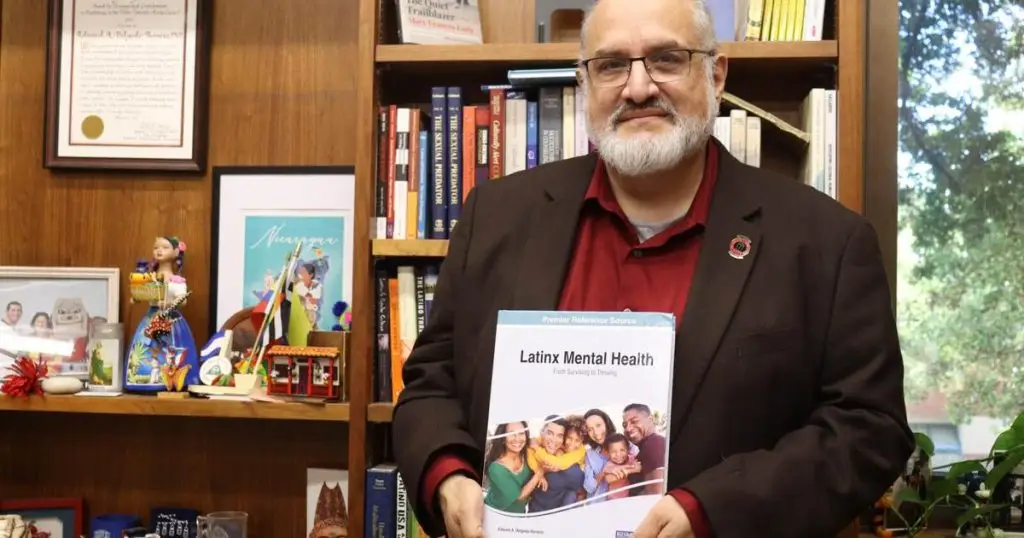
Edward Anthony Delgado-Romero, the founder of La Clínica in LaK’ech, has been asking himself “If we don’t help someone, then who will?” for the last eight years. He wanted the clinic to provide mental health services for Latinx communities, as well as to train bilingual people to work with these communities. A clinic with a legacy as big as its name came from it.
La Clínica in LaK’ech, from a Mayan moral code greeting that means “you are my other me,” was built to be a mutually beneficial experience for everyone involved. Students got experience, and the community got services that they would otherwise not be able to afford or find.
“For us, it really is a realization that when we work with the community — they are us and we are them,” said Delgado-Romero.
Despite the clinic’s legacy and reputation, it is saying goodbye to Athens due to a lack of Spanish speaking therapists, which caused low staffing issues. The closure is estimated to be in May 2024.
Before starting the clinic, Delgado-Romero was on the board of directors at the Athens Latino Center for Education and Success. Whilst there, he found that access to mental health care was consistently missing. Especially, he said, access to anyone who could provide counseling in Spanish.
Jocelyn Jimenez-Ruiz, co-coordinator for La Clínica in LaK’ech, has been working at the clinic as a clinician for three years. She said that a lot of places have services provided, such as interpreters, however a lot of things get missed or are misinterpreted.
“It’s not the same effect when you’re having an interpreter versus when you’re able to speak to someone directly in your own native language,” Jimenez said.
According to CEO and co-founder of the nonprofit Ser Familia, Belisa Urbina, there are less than 100 fully licensed Spanish speaking mental health providers in Georgia. With over 1 million Latinos currently living in the state, the lack of providers creates a heavy workload for those professionals that can help.
“There aren’t that many providers who are providing services in language or aware of the culture in a way that Latinx people will feel included or want to go,” Romero-Delgado said. “Once you remove those barriers … we found that people will come, and they’re not as concerned about the stigma at all.”
Delgado-Romero said that the clinic focuses on helping those who need help, but it also works to raise awareness of mental health issues in the Latinx community.
“Part of it is just kind of really getting people to talk about and think about mental health in the Latinx community and breaking down these barriers to getting help,” Delgado-Romero said.
Jimenez said that being able to see and hear from someone that understands your culture, can connect to you and has a similar background to you helps clients feel represented and validated with their experiences.
“You can see the relief with a lot of these clients,” Jimenez said. “I think they are very appreciative of what we’ve been able to do. But also for us, I think being able to see a community that is very underserved or underrepresented being taken care of is [very] rewarding work for sure.”
Alejandra Martínez Villalba, co-coordinator for La Clínica in LaK’ech, has been working at the clinic since 2021. She said that she is proud of everything the clinic has done.
“I feel sad but also very proud,” Martínez Villalba said. “I think that the clinic has done amazing work.”
The clinic has been successful over the eight years of serving and has had a waitlist for over a year.
Martínez Villalba, while reflecting on her time at the clinic, said that just talking to the clients about the clinic closing, she can tell how sad they are because of how much it has helped them.
“Everything that we have done has been because we have wanted — because there is this connection that we have with our roots, with our community,” Martínez Villalba said. “I think that message should be continued.”
Delgado-Romero said that he has talked to various schools about recruitment and investment in bilingual mental health providers. While the population is there, he said it hasn’t come together.
“So I think in a way that I guess if that’s a priority, or if that’s something that will be helpful to both the community and UGA students, which I believe it is, there’s just going to have to be a different way to do it that doesn’t depend on one person,” Delgado-Romero said.
Communities have to decide if this is something they want to provide. According to Delgado-Romero, they provided the model, and it certainly can be done, but it’s up to communities to put time into.
“I think it’s very rewarding to also be able to provide therapy in Spanish, as that’s something that’s very rare nationwide,” Jiminez said.
The clinic is doing their best to have active resources the community can access, even once they close. They’re hoping to create a podcast as well as post videos of resources.
“I really hope it [continues] to create an example for other programs as well to maybe create their own clinics that are bicultural and bilingual and continue these services for the community because I do think we’re very desperate for that resource,” Jiminez said. “Hopefully that’s the legacy that the clinic does moving forward and for many years to come as well.”