













Nearly a decade after the Flint water crisis first captured national attention, the city continues to grapple with the profound aftermath of one of America’s most significant environmental disasters.
While infrastructure improvements have been made, the physical, psychological, and social scars remain deeply embedded in this predominantly African American community of approximately 81,000 residents.
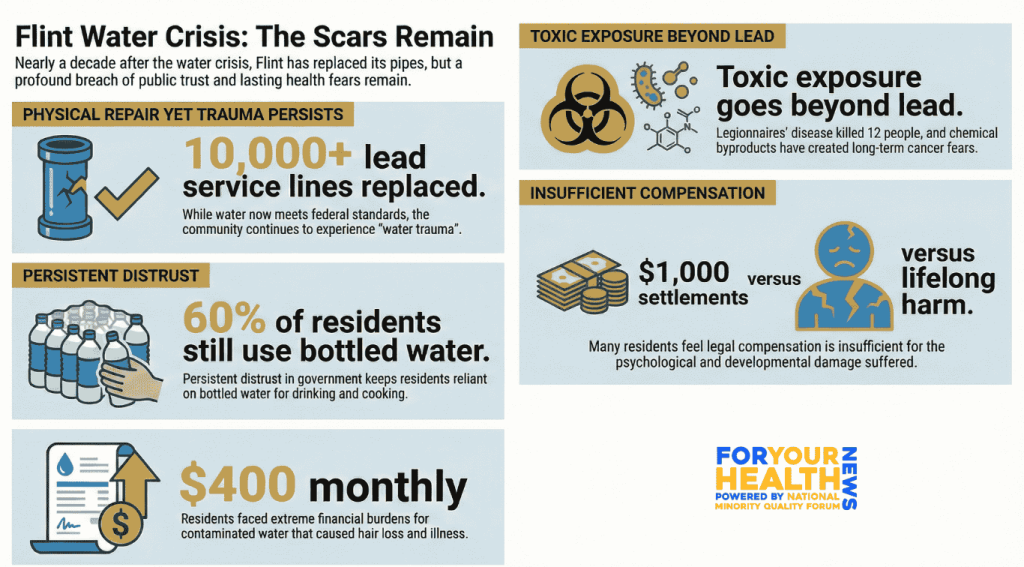
The economic toll coupled with the health and environmental risks has taken an unnecessary toll on Flint residents. As Blair Snider states, “I live on the east side of Flint, and for years my water bill was consistently $47.47 every month. Over time, the bill increased multiple times, but by 2014 it had reached $400 a month.”
The immediate crisis began when Flint switched its water source from Lake Huron to the Flint River as a cost-saving measure. The corrosive river water, inadequately treated, leached lead from aging pipes into residents’ drinking water. By 2015, elevated blood-lead levels in children had been documented, and Legionnaires’ disease outbreaks were linked to the contaminated water system.
Today, Flint’s water technically meets federal standards for lead levels. The city completed replacing over 10,000 lead service lines by 2020 through a massive infrastructure undertaking funded through state and federal resources.
According to the Michigan Department of Environment, Great Lakes, and Energy, recent water quality tests show lead levels well below the federal action level of 15 parts per billion. However, these technical improvements have not restored community trust.
According to Ward 1 City Councilman Leon Elamin, “While we have begun distributing settlement funds to property owners, I understand the frustrations of our residents who feel that the compensation they are set to receive—approximately $1,000 for adults—is insufficient given the extent of the harm suffered. It’s crucial that we work together to ensure that all affected individuals receive fair compensation and support.”
Research published in the Journal of Public Health reveals that despite infrastructure upgrades, many Flint residents continue to rely exclusively on bottled water for drinking and cooking. A 2022 study by Kruger et al. found that approximately 60% of surveyed residents reported still using bottled water as their primary drinking water source, citing persistent distrust in government assurances about water safety. This reliance on bottled water creates ongoing financial burdens for families already facing economic hardship in a city where the poverty rate exceeds 30%.
East side resident Snider shares that, “During the crisis, I was buying large quantities of bottled water just to make baby bottles and protect my family. I also experienced significant hair loss from showering in the contaminated water, which was both physically and emotionally distressing. While free water was sometimes available, accessing it was often difficult. Long lines, inconsistent availability, and the way residents were treated added to the trauma.”

The psychological impact of the crisis has been particularly devastating. Residents describe experiencing “water trauma”—a persistent anxiety about water safety that affects daily life.
Parents report bathing their children in bottled water and experiencing panic when their children accidentally ingest tap water. This collective trauma extends beyond rational risk assessment; it represents a fundamental breach of trust between citizens and the institutions meant to protect them.
The relationship between Flint’s water contamination and cancer risk has become a significant concern among residents, though the scientific evidence remains complex and evolving. Lead exposure is not directly classified as a carcinogen, but the water crisis involved multiple contaminants beyond lead, including trihalomethanes—disinfection byproducts that are associated with increased cancer risk.
Research by Pauli et al. published in Environmental Health Perspectives documented elevated levels of total trihalomethanes in Flint’s water during the crisis period, with levels occasionally exceeding EPA maximum contaminant levels. These compounds have been linked to bladder cancer and potentially other malignancies through long-term exposure. Additionally, the Legionnaires’ disease outbreaks, which killed at least twelve people, demonstrated that the water contamination had immediate life-threatening consequences beyond lead exposure.
Community perceptions about cancer risk reflect deep-seated concerns about long-term health impacts. Qualitative research by Heard-Garris et al. in the Journal of Racial and Ethnic Health Disparities found that many Flint residents believe their exposure to contaminated water has increased their family’s cancer risk, particularly for children exposed during critical developmental periods. These beliefs are not unfounded; while establishing direct causation is scientifically challenging, the multi-year exposure to various contaminants creates plausible biological mechanisms for increased disease risk.
However, definitively linking specific cancer cases to the water crisis requires long-term epidemiological studies that are still ongoing. The latency period for many cancers means that potential increases in cancer incidence may not become statistically apparent for years or decades.
This uncertainty creates additional anxiety for residents who feel they are living in a state of suspended anticipation, waiting to discover the full health consequences of their exposure.
The legal aftermath of the Flint water crisis has been extensive, involving both criminal prosecutions and civil litigation. Community awareness of these proceedings is high, though opinions about whether justice has been served remain deeply divided and largely pessimistic.
In 2021, former Michigan Governor Rick Snyder was charged with two misdemeanor counts of willful neglect of duty—charges that many residents viewed as woefully inadequate given the scale of the disaster. Several other state and city officials faced various charges, though many cases were dismissed or resulted in plea agreements. In January 2024, Snyder and other officials reached a settlement in which charges would be dismissed after completion of certain requirements, a resolution that generated significant community frustration.
The civil litigation has been more substantive from a compensation perspective. In 2021, a $641 million settlement was reached to compensate Flint residents for their injuries, with approximately 80% of the funds designated for children affected by lead exposure. However, research by Ruckart et al. in the American Journal of Public Health notes that many residents feel the settlement amount is insufficient given the lifelong health impacts and psychological trauma experienced by the community.
Community surveys reveal widespread belief that racial and economic factors influenced both the initial decision-making that led to the crisis and the inadequate accountability that followed.
Flint’s population is majority Black and has high poverty rates—factors that residents believe made their community vulnerable to governmental neglect and indifference. This perception is supported by research demonstrating that environmental injustices disproportionately affect communities of color and low-income populations.
The ongoing legal proceedings, while providing some measure of accountability and compensation, have not restored faith in governmental institutions. Many residents express the view that no amount of legal settlement can undo the damage to their children’s health and development, nor can criminal charges that result in minimal consequences truly represent justice for the profound betrayal of public trust.
Life in Flint, Michigan today is marked by cautious recovery amid persistent uncertainty. Infrastructure has improved, but community trust remains broken. Health concerns, particularly about cancer risk and children’s cognitive development, continue to generate anxiety. Legal proceedings have provided some accountability and compensation, but many residents feel justice remains elusive.
The Flint water crisis serves as a stark reminder of how environmental racism, economic inequality, and institutional failure can converge to devastate a community—and how recovery from such betrayal extends far beyond infrastructure repair.
As Councilman El-Alamin says, “The actions pursued to remedy the harm are there to not only alleviate current hardships but also to build back our resilient community moving forward—to full health.”
References
Heard-Garris, N., Ekono, M., & Choi, H. (2018). Association between perceived discrimination in health care and health status in Flint, Michigan. Journal of Racial and Ethnic Health Disparities, 5(6), 1313-1320. <https://link.springer.com/article/10.1007/s40615-018-0479-7>
Kruger, D. J., Cupal, S., & Kodjebacheva, G. D. (2022). Persistent distrust of tap water quality in Flint, Michigan. Journal of Public Health, 44(3), 589-595. <https://academic.oup.com/jpubhealth/article/44/3/589/6318521>
Pauli, B. J., Kolker, J. L., Bauer, M. A., & Pohl, H. R. (2020). Trihalomethanes in Flint, Michigan drinking water. Environmental Health Perspectives, 128(1), 017001. <https://ehp.niehs.nih.gov/doi/10.1289/EHP5456>
Ruckart, P. Z., Jones, R. L., Courtney, J. G., LeBlanc, T. T., Jackson, W., Karwowski, M. P., … & Brown, M. J. (2021). Update of the blood lead reference value—United States, 2021. American Journal of Public Health, 111(10), 1827-1833. <https://ajph.aphapublications.org/doi/10.2105/AJPH.2021.306470>
Also Read: Flint’s Water Crisis Isn’t Over: Health Effects Persist as Trials and Settlements Unfold
Learn more about NMQF’s Flint Forward Cancer Community Townhall
Stay Informed. Stay Empowered.