












In recent years, an urgent public health narrative has emerged in Flint, Michigan, where long-standing environmental and healthcare inequities have converged with a growing concern over cancer risk among residents. At the center of this emerging story is the National Minority Quality Forum (NMQF), a Washington, D.C.-based research, advocacy, and policy organization with a mission to reduce patient risk and advance health equity, particularly for vulnerable and historically excluded populations. Founded in 1998, NMQF has built a reputation for integrating data and research into community-focused health interventions, and its involvement in Flint reflects both the city’s persistent health challenges and broader policy efforts to address disparities in cancer care and outcomes.
The city of Flint has been prominently associated with the water crisis that began in 2014, a public health catastrophe widely interpreted as a case of environmental injustice because low-income and predominantly minority neighborhoods bore the brunt of lead-contaminated water exposure. Decades of disinvestment and structural inequities compounded the impact of that crisis, leaving residents grappling with trust, infrastructure degradation, and health concerns that extend well beyond lead exposure. These concerns include rising community anxiety about cancer incidence, fueled by questions about the long-term effects of environmental contamination and insufficient access to preventive healthcare.
In response to these concerns, NMQF has deployed resources through its Cancer Stage Shifting Initiative (CSSI), a program designed to transform how cancer screening, early detection, and care are delivered in underserved communities nationwide. Launched in partnership with the White House’s Cancer Moonshot and aligned with national efforts to reduce cancer mortality by increasing early-stage diagnosis, CSSI prioritizes culturally competent community engagement and the deployment of innovative screening technologies.

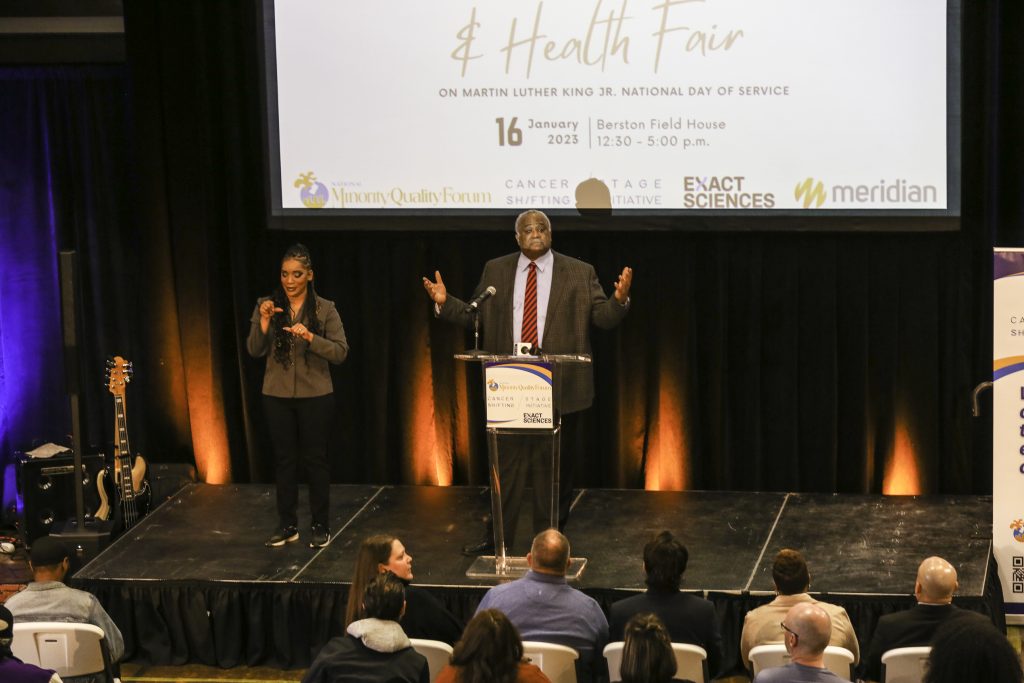
NMQF’s earliest major intervention in Flint came in January 2023, when the organization joined with Exact Sciences, Meridian of Michigan, and local partners to host the Flint Community Cancer Screening and Health Fair on the Rev. Martin Luther King Jr. National Day of Service. Held at the Berston Field House, the event offered free cancer screenings, education, and general health checks to residents who, in a NMQF survey, cited cancer as one of their top health concerns. Leaders from NMQF, the White House Cancer Moonshot team, and Flint civic offices emphasized the importance of accessible early detection as a critical strategy to reduce preventable cancer deaths, especially in communities with elevated environmental and social risks.
Beyond one-off events, NMQF’s involvement in Flint has deepened through sustained research and community engagement. In October 2023, the Michigan Department of Health and Human Services awarded the organization a $500,000 grant to conduct a feasibility assessment for an environmental epidemiology cancer study and to ensure robust community communication and participation in the planning process. Under this grant, NMQF was tasked with designing and overseeing a request for proposals to identify a subgrantee capable of executing the assessment, ensuring that local voices and concerns shaped the research questions and methodology.
By 2025, this work evolved with NMQF’s announcement of the Michigan State University Flint Community Cancer Consortium (FC3) as the principal recipient to conduct the feasibility project. With MSU’s longstanding local presence and partnerships, the consortium’s work reflects a community-based research model that integrates input from Flint residents, healthcare providers, and local organizations. The aim is to develop a framework for future research into unusual cancer patterns and potential environmental determinants, recognizing that Flint’s history of industrial pollution and water system failure has eroded confidence in conventional public health approaches.
Central to this work is Arthur Woodson, a lifelong Flint resident and community activist whose personal investigation into rare cancer cases on his own block helped galvanize national attention. After discovering eight cases of multiple myeloma within a single neighborhood, Woodson partnered with NMQF to advocate for research into cancer “hot zones” and to explore possible links between environmental exposure and disease. Through CSSI, he has championed multi-cancer early detection technologies and pushed to make advanced screenings accessible and affordable for residents who are often last to benefit from medical innovation. Representing Flint at national summits and White House briefings, Woodson has helped bridge the gap between community-level experience and federal health policy. Together, NMQF and Woodson exemplify a community-centered model of health equity—one that blends data-driven research, national advocacy, and local leadership to address the enduring health consequences of environmental injustice and to help Flint write a new chapter focused on prevention, trust, and long-term wellbeing.
The narrative of health equity in Flint is inseparable from broader national statistics on disparities in cancer care. National data have shown that racial and ethnic minorities are overrepresented in communities near environmental hazards and face higher barriers to preventive services such as cancer screening. Efforts like CSSI, which leverage new multi-cancer early detection technologies and community-trusted engagement, respond to these disparities not just with episodic events but with scalable models aimed at shifting healthcare delivery paradigms.

Community listening sessions and surveys conducted by NMQF in Flint also illuminate the depth of local concern. Residents have voiced frustration over perceived neglect of public health and environmental issues, underscoring a demand for research that not only measures disease incidence but also addresses the social determinants of health that shape outcomes across generations. These dialogues have informed NMQF’s approach to research design and outreach, reinforcing the importance of trust and culturally relevant engagement in achieving meaningful health improvements.
As NMQF continues its work in Flint, including public forums like the CSSI town hall and mini clinic designed to bring resources directly to North Flint, the organization’s efforts illustrate a broader shift toward community-centered models of health equity. These initiatives aim to bridge gaps in awareness, access, and intervention by combining cutting-edge science with local leadership and empowerment.
In a city still grappling with the legacy of environmental injustice and health disparities, NMQF’s sustained engagement underscores the urgency of equitable health solutions. By centering Flint’s concerns in national conversations about cancer prevention and care, the organization is helping to write a new chapter in the city’s ongoing struggle for justice and wellbeing, even as researchers and community advocates acknowledge that much work remains to be done.
Stay Informed. Stay Empowered.



