













- By Victor Mejia

- By Victor Mejia
Artificial intelligence is rapidly reshaping healthcare, offering new ways to detect disease earlier, reduce administrative burden, and help clinicians make better-informed decisions. But as these technologies become more widely adopted, an important question remains: Who will benefit first?
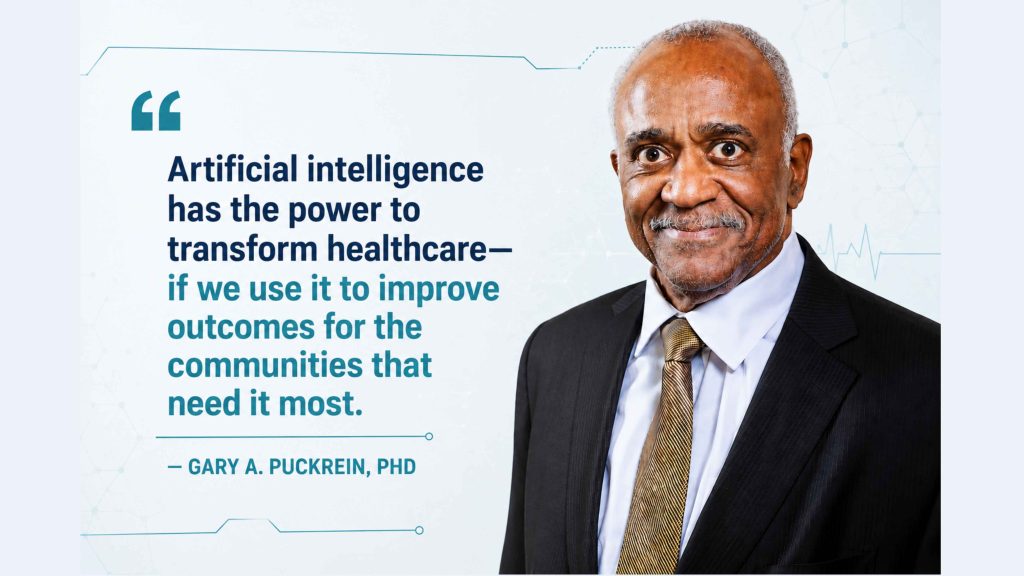
In this guest opinion, National Minority Quality Forum President and CEO Gary A. Puckrein, PhD, argues that artificial intelligence should be deployed where it has the greatest potential to save lives—within the community health centers, safety-net hospitals, and minority-serving health systems that care for patients experiencing the highest burden of disease. Drawing on real-world examples and decades of work advancing health equity, Dr. Puckrein makes the case that the success of AI in healthcare should be measured not only by technological innovation, but by its ability to improve outcomes for the communities that have historically waited the longest for medical progress.
By Gary A. Puckrein, PhD
Artificial intelligence is rapidly transforming healthcare, and its potential to extend the quality and length of human life is undeniable. But there is reason to worry that, once again, a promising technology will not reach the communities that need it most.
Across America, minority-serving health systems and community clinics carry a disproportionate share of the nation’s disease burden. They care for patients with higher rates of cancer, diabetes, heart disease, kidney disease, and maternal mortality while simultaneously facing persistent physician shortages, workforce burnout, fragmented data systems, and growing administrative demands.
They are overburdened. Every day, they must make critical decisions while navigating incomplete information, disconnected systems, staffing shortages, and thousands of administrative tasks that compete with patient care. The result is predictable: delayed diagnoses, missed follow-up appointments, fragmented care, and patients who disappear between screening and treatment.
AI offers an opportunity to fundamentally change that equation. Technology available today can integrate enormous amounts of clinical, operational, financial, and population health data to help health systems identify high-risk patients, improve care coordination, optimize hospital operations, and reduce administrative burden. These systems give clinicians better information at the moment decisions matter most.
The proof already exists – in health systems that look a lot like the ones we are fighting for. Lifepoint Health operates 60 acute care hospitals, behavioral health facilities, and rehabilitation centers serving rural and underserved communities across the country. Using Palantir’s Foundry platform, Lifepoint has deployed an AI-powered sepsis detection system that analyzes lab values, vitals, and imaging to alert physicians before time runs out. For every hour a septic patient goes without intervention, survival odds drop by 10 percent. In San Diego and Riverside counties, Neighborhood Healthcare, a federally qualified health center serving nearly 100,000 patients annually, uses Nabla’s ambient AI documentation tools that allow clinicians to spend more time with patients and less time on paperwork. The system supports 35 languages, a direct reflection of the populations these clinics serve.
Stay Informed. Stay Empowered.
These examples should be the norm, not the exception. A recent American Hospital Association survey found that 86 percent of hospitals affiliated with large health systems now use predictive AI — but only 37 percent of independent facilities do. Rural hospitals report 56 percent adoption; urban hospitals, 81 percent. The communities experiencing the greatest burden of disease are, once again, falling behind.
Fixing this will require a reordering of priorities by putting patient risk, not cost reduction, at the center of how AI gets deployed. At the National Minority Quality Forum, we call this the Physical Laws Framework. Its premise is straightforward: disease is biological disorder, and the primary objective of any health system should be reducing patient risk — not reducing cost. Lowering cost matters, but it is a secondary benefit that follows from delivering the right intervention at the right time. In our current system, savings lead and risk reduction follows — and patients absorb the difference. AI can reverse that order.
To understand what is at stake, consider cancer in the Black community. Black Americans continue to experience the highest overall cancer mortality in the United States. In many cases, the difference is not the availability of treatment — it is the timing of diagnosis. Emerging Multi-Cancer Early Detection technologies offer the possibility of identifying multiple cancers from a single blood draw before symptoms appear. But no screening technology improves survival by itself. Someone must identify eligible patients. Someone must ensure testing occurs. Someone must coordinate follow-up if abnormalities are found. And someone must make certain that patients don’t disappear between diagnosis and treatment.
A patient lost between diagnosis and treatment is not a cost the system has avoided. It is deferred — and it returns as advanced disease, higher mortality, and, only then, higher cost. The harm is paid either way. The only question is whether it is paid early, when the disease is survivable, or late, when it is not.
For a community clinic serving thousands of patients with limited staff, AI can function as an always-on clinical partner, continuously identifying care gaps, prioritizing patients at highest risk, tracking abnormal findings, supporting navigation, and reducing documentation burdens that consume valuable clinical time.
For decades, innovation has reached underserved communities last. New medicines, new diagnostics, and new technologies often arrive first in the health systems already equipped with abundant resources, while minority-serving institutions wait years for the infrastructure needed to implement them.
AI gives us an opportunity to reverse that pattern. If AI can reduce administrative burden, minority-serving clinics should receive it first. If AI can help identify cancer months earlier, communities with the highest cancer mortality should benefit first. If AI can prevent patients from being lost to follow-up, safety-net providers should have access before anyone else.
That is not preferential treatment. It is intelligent public policy.
The promise of AI in healthcare is not found in its algorithms, but instead when an overwhelmed physician catches cancer earlier, when a nurse reconnects with a patient who would otherwise disappear, and when a community clinic delivers the same level of coordinated care as the nation’s most sophisticated academic medical centers.
The communities that have always waited longest for medical progress cannot afford to wait longest for artificial intelligence.
Stay Informed. Stay Empowered.
Trending Topics
Features
- Drive Toolkit
Download and distribute powerful vaccination QI resources for your community.
- Health Champions
Sign up now to support health equity and sustainable health outcomes in your community.
- Cancer Early Detection
MCED tests use a simple blood draw to screen for many kinds of cancer at once.
- PR
FYHN is a bridge connecting health information providers to BIPOC communities in a trusted environment.
- Medicare
Discover an honest look at our Medicare system.
- Alliance for Representative Clinical Trials
ARC was launched to create a network of community clinicians to diversify and bring clinical trials to communities of color and other communities that have been underrepresented.
- Reducing Patient Risk
The single most important purpose of our healthcare system is to reduce patient risk for an acute event.
- Jessica Wilson
- Subash Kafle


