











Column: In one America, a righteous stand against racism. In another, racist violence and death | Featured Stories Update

[ad_1]

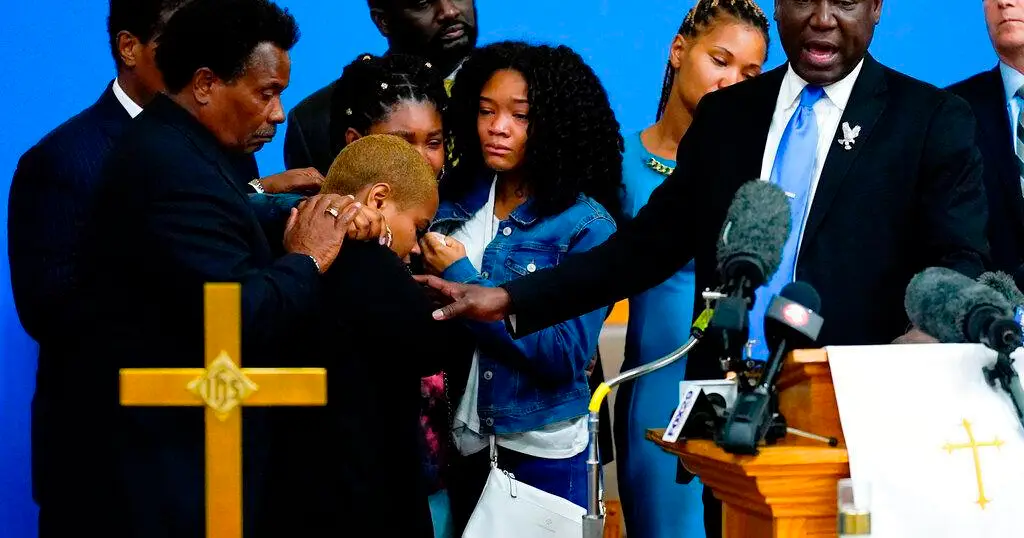
On Saturday, at the very hour that the people of Chestertown, on Maryland’s Eastern Shore, gathered to remember the Black man lynched there by a white mob in 1892, police say a white teenager fueled by racist hatred started shooting people at a supermarket in a Black neighborhood of Buffalo, New York.

He is accused of shooting 13 people in all, 11 of them Black. Ten of his victims died.

It was the latest mass shooting in a violent nation that has more guns than people — and 46% of all privately held guns in the world — and the latest in a sickening series of hate crimes.

I relate the racist massacre in Buffalo with the lynching memorial in Chestertown because I had just come from there when news bulletins started arriving from New York, and because it demonstrates — if such a thing was needed — that our reckoning with racism, earnest as it might be in some quarters, is far from complete.

In some places, it hasn’t even started.

In too many places, racism thrives.

We’ve taken down Confederate monuments. We’ve started to erect historical markers telling of the racist hangings that occurred while long-gone Americans watched and cheered. In Kent County’s seat, the better angels have supported anti-racism programs under the banner, “Chestertown Unites Against Racism.”

But the past is present. The challenge today is what it has been for centuries — getting white supremacy, racial hatred and paranoia out of the nation’s bloodstream.

Americans on the right mock efforts at racial reckoning. They ridicule “wokeness.” Andy Harris, the Eastern Shore’s Republican congressional representative, says he’s “done apologizing for America,” though it’s hard to think of him expressing regrets about anything, much less the nation’s failures on race.

The people of Chestertown on Saturday confronted the failures that led to the lynching of 23-year-old James Taylor on May 17, 1892. The town on that date was “united in failure,” said Mayor David Foster.

“It was a failure of our justice system, a failure of our police, of our media and common citizens,” he told the audience seated at Emmanuel Episcopal Church for Justice Day 2022. “It was not outside agitators who came in. It was our town. It was our very community. It was the proverbial butcher, baker, candlestick maker. All of our town was united in failure.”

No one was ever held responsible for the murder of Taylor, who was accused of sexually assaulting the 10-year-old daughter of his employer, a Kent County farmer. According to the history compiled by Chestertown researchers, Taylor was hanged by a mob just five days after the girl identified him as her attacker.

Sumner Hall, the Chestertown museum dedicated to Black soldiers in the Civil War and beyond, provided an account of the atrocity culled from reports in local newspapers and The Baltimore Sun.

“A group of the lynchers met at a hotel on Spring Street to discuss their plan to lynch Taylor,” it states. “A town official met with them to ask that the lynching be held outside the town limits and to ask that the body not be mutilated. After the meeting, about 60 armed and masked men forced their way into the jail, broke into Taylor’s cell, and tied a rope around his neck. They dragged him over Cross Street to a small maple tree. The rope was thrown over a branch about 10 feet high and Taylor was pulled up and down repeatedly until he was strangled to death. His body was left hanging for a couple hours until it was taken down and later buried in an unmarked grave at the county Alms House on Broad Neck Road.”

Taylor maintained his innocence until his last hour. “I am an innocent man,” he told a Sun reporter, “and I am not afraid to say so even while I am expecting to meet my God in a few minutes.”

On Saturday, Justice Day, there were speeches and song, readings of poetry and an essay, all part of the reckoning with racist history taken seriously in Chestertown and promoted these last few years by the Maryland Lynching Memorial Project. Other communities have taken these important steps to face the past, and the effort at truth and reconciliation continues. Between 1854 and 1933, there were at least 44 lynchings in Maryland, and some are now memorialized with historic markers.

“Healing begins where the wound was made,” wrote the author Alice Walker.

But no sooner had the healing started in Chestertown, another wound opened in Buffalo.

“Black people were lynched yesterday,” Derrick Johnson, president of the NAACP, tweeted on Sunday.

The suspect in the supermarket shooting was a one-man firing squad, according to law enforcement, an executioner, killing people because of their skin color, apparently provoked by the racist complaint that whites are being replaced by immigrants and other people of color. It’s an old paranoia in resurgence, spread by pundits and politicians who see angry, bitter whites as their customer base and who exploit, in subtle and obvious ways, racial fears for the sake of ratings and votes. Some of their incited customers — and probably many of them — have guns.

Given that reality, and given what happened in Buffalo on Saturday, how are today’s race baiters any different than the mob leaders who lynched Black men in the bad old days?

Past is present. The country will suffer more racism and violence until the better angels, like those in Chestertown, become the dominant voices in our politics and our culture.

Dan Rodricks is a Baltimore Sun columnist.

[ad_2]

Source link

Trending Topics

Features

Download and distribute powerful vaccination QI resources for your community.

Sign up now to support health equity and sustainable health outcomes in your community.

MCED tests use a simple blood draw to screen for many kinds of cancer at once.

FYHN is a bridge connecting health information providers to BIPOC communities in a trusted environment.

Discover an honest look at our Medicare system.

ARC was launched to create a network of community clinicians to diversify and bring clinical trials to communities of color and other communities that have been underrepresented.

The single most important purpose of our healthcare system is to reduce patient risk for an acute event.

Related Posts
Early Cancer Detection Is Entering a New Era. Flint Is Helping Lead the Way.
Why Your “Ozempic” May Not Be Ozempic: FDA Warnings Highlight Growing Risks of Unregulated GLP-1 Drugs
The Communities Most Burdened by Disease Should Be the First to Benefit from Artificial Intelligence
Scroll to Top
Featured Articles
Early Cancer Detection Is Entering a New Era. Flint Is Helping Lead the Way.
Why Your “Ozempic” May Not Be Ozempic: FDA Warnings Highlight Growing Risks of Unregulated GLP-1 Drugs
Why Your “Ozempic” May Not Be Ozempic: FDA Warnings Highlight Growing Risks o...
The Communities Most Burdened by Disease Should Be the First to Benefit from Artificial Intelligence
The Communities Most Burdened by Disease Should Be the First to Benefit from ...
Cancer Pain Care Access Gap Hits Black, Asian Patients
Black and Asian Cancer Patients Wait Longer for Pain Relief in New Study
What Is Cyclosporiasis Symptoms, Food Safety, and Reasons
What Is Cyclosporiasis? The Foodborne Illness Showing Up in the News
Why Minority Mental Health Awareness Month Matters More Than Ever
Categories
AI
ATTR-CM
BIPOC News
Cancer
Clinical Trials
Covid19
Diseases of the Body
Environment
Health Data
Health Equity Events
Health Policy
Health Tips
Subscribe to our newsletter to receive our latest news​
All Stories
Early Cancer Detection Is Entering a New Era. Flint Is Helping Lead the Way.
Why Your “Ozempic” May Not Be Ozempic: FDA Warnings Highlight Growing Risks of Unregulated GLP-1 Drugs
Why Your “Ozempic” May Not Be Ozempic: FDA Warnings Highlight Growing Risks o...
The Communities Most Burdened by Disease Should Be the First to Benefit from Artificial Intelligence
The Communities Most Burdened by Disease Should Be the First to Benefit from ...
BIPOC News
Early Cancer Detection Is Entering a New Era. Flint Is Helping Lead the Way.
The Communities Most Burdened by Disease Should Be the First to Benefit from Artificial Intelligence
The Communities Most Burdened by Disease Should Be the First to Benefit from ...
Why Minority Mental Health Awareness Month Matters More Than Ever
Environment
UV Safety Awareness Month Raises Urgency on Skin Cancer Prevention and Sun Protection Equity
UV Safety Awareness Month Raises Urgency on Skin Cancer Prevention and Sun Pr...
Extreme Heat Safety Tips 5 Ways to Protect Your Health This Summer fyh.news
5 Heat Safety Tips That Could Protect Your Health This Summer
Lupus Awareness Event in Baltimore Aims to Support Research and Shine a Light on Health Disparities
Lupus Awareness Event in Baltimore Aims to Support Research and Shine a Light...
Work Force
A multigenerational Black and Hispanic family sitting together in a park, showing how Social Security helps support older adults, people with disabilities, and families across generations.
Millions of Older Americans Could Face Smaller Social Security Checks by 2032...
dreamstime_s_243253251
The Caregiver Journey: The Hidden Backbone of American Healthcare
Families gather at a Bronx community festival with live music, kids’ activities, and health booths sharing SOMOS social care resources and free screenings.
Celebrating Hispanic heritage while learning about health care

[xyz-ips snippet=”Output-Source-Name”]

Clinical Trials
Early Cancer Detection Is Entering a New Era. Flint Is Helping Lead the Way.
Why Your “Ozempic” May Not Be Ozempic: FDA Warnings Highlight Growing Risks of Unregulated GLP-1 Drugs
Why Your “Ozempic” May Not Be Ozempic: FDA Warnings Highlight Growing Risks o...
Clinical Trial Diversity Remains a Critical Challenge in Alzheimer’s Research
Vaccines and Outbreaks
A parent checking a child's temperature during summer, illustrating the changing RSV patterns and year-round respiratory virus risks.
Can You Get RSV During the Summer?
Michelle Lam, MBA, of NYC Health + Hospitals/Elmhurst & Amy Harris of NYC Health + Hospitals/Elmhurst
Healthcare Leaders Spotlight Vaccine Equity and Adult Immunization Strategies...
Measles Outbreaks Surge: Essential Facts and Prevention Strategies
Other Categories
AI
Read the latest AI News stories trending around the world
ATTR-CM
Cancer
Read the latest Cancer stories trending around the world
Covid19
Diseases of the Body
Read about the latest Diseases of the Body trending around the world
Friday Webinars
Every Friday, we bring you insightful webinars covering critical topics in healthcare, data equity, and policy reform.
Health Data
Read the latest Health Data stories trending around the world
Health Equity Events
Read the best Health Equity Events around the country.
Health Policy
Read the latest Health Policy stories trending around the world
Health Tips
Heart Health
Read the latest on Heart Health News, Stories and Tips.
kidney Health
Read more trending News about Kidney Health, Stories and Tips.