








- By Subash Kafle
A surprising discovery in a university anatomy lab could help doctors better understand hip pain and improve future surgical procedures.
Two students at Tulane University in New Orleans have identified a previously undocumented muscle attachment deep within the human pelvis, offering new insight into the body’s anatomy and potentially opening the door to more precise hip treatments.
The discovery, made by Dominic Roy and Cooper Bruce while studying donated human bodies, was detailed in the medical journal Clinical Anatomy. Researchers believe the newly identified structure could play a role in supporting the hip and may eventually help surgeons better understand certain causes of discomfort.
What Did the Students Discover?
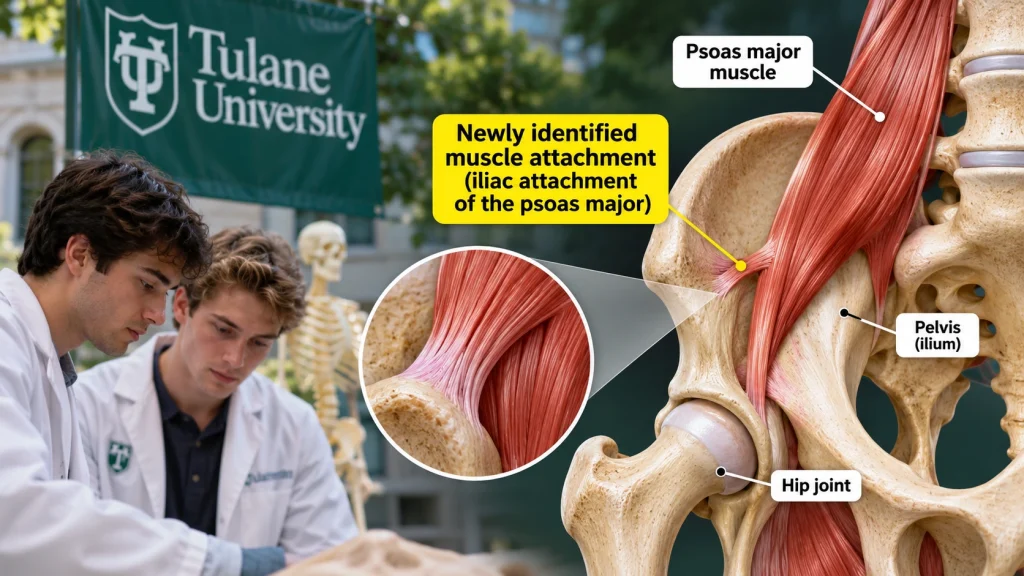
The new hip muscle attachment, called the iliac attachment of the psoas major, is located near the front of the hip joint.
The psoas major is an important muscle that helps people bend their hips, lift their legs and maintain stability while moving.
While examining anatomical specimens in 2024, Roy and Bruce noticed an unusual muscular structure that did not match the descriptions in their anatomy textbooks.
With guidance from R. Shane Tubbs, PhD, a professor of neurosurgery and director of surgical anatomy at Tulane University School of Medicine, the students began investigating the finding.
Researchers later examined 200 hip sides from 100 donated human bodies and found the additional muscle attachment in approximately 28% of the sides studied.
The finding suggests that the attachment is an anatomical variation present in some individuals rather than a structure everyone has.
Why Could This Discovery Matter for Hip Surgery?
Understanding how muscles connect and function is especially important during orthopedic procedures, including hip surgery.
Researchers believe the newly identified attachment may help stabilize the psoas major muscle. Its position near the front of the hip could also make it relevant to conditions involving irritation, pain or unusual movement.
One possible area of interest is snapping hip syndrome, a condition that can cause a clicking or snapping sensation when a person moves their hip.
Recognizing this additional muscle attachment could eventually help surgeons better understand individual anatomical differences when evaluating or treating hip problems.
However, researchers have not established whether the attachment causes hip pain or whether treating it improves surgical outcomes.
What Researchers Still Need to Learn
Although the discovery is promising, scientists emphasize that additional research is necessary before it can influence routine medical care.
The study involved donated human bodies rather than living patients. Researchers were unable to determine exactly how the muscle attachment functions during movement or whether it contributes to hip-related symptoms.
Future studies may use MRI scans, ultrasound imaging and biomechanical testing to investigate the attachment’s function and possible clinical significance.
Scientists will also need to examine more diverse populations to better understand how frequently the structure occurs.
What Does This Mean for Patients?
For people experiencing hip pain, stiffness or snapping sensations, the discovery offers another potential avenue for future research.
It does not mean that everyone with hip discomfort has this attachment or that existing treatments should change.
Patients experiencing persistent hip symptoms should continue working with qualified healthcare professionals to determine the underlying cause and appropriate treatment.
The research also highlights why understanding anatomical differences is important for providing individualized medical care.
A Reminder That the Human Body Still Holds Surprises
Despite centuries of medical research, scientists continue to uncover previously undocumented details about human anatomy.
For Roy and Bruce, a routine laboratory experience became an opportunity to contribute to medical knowledge.
Their discovery demonstrates how curiosity, hands-on education and scientific investigation can advance researchers’ understanding of the human body.
While it remains unclear whether this particular attachment will change how doctors perform hip surgery, the research could help inform future approaches to diagnosing and treating hip conditions.
Sources: Original research in Clinical Anatomy | Tulane University School of Medicine
Trending Topics

Features
- Drive Toolkit
Download and distribute powerful vaccination QI resources for your community.
- Health Champions
Sign up now to support health equity and sustainable health outcomes in your community.
- Cancer Early Detection
MCED tests use a simple blood draw to screen for many kinds of cancer at once.
- PR
FYHN is a bridge connecting health information providers to BIPOC communities in a trusted environment.
- Medicare
Discover an honest look at our Medicare system.
- Alliance for Representative Clinical Trials
ARC was launched to create a network of community clinicians to diversify and bring clinical trials to communities of color and other communities that have been underrepresented.
- Reducing Patient Risk
The single most important purpose of our healthcare system is to reduce patient risk for an acute event.
- Jessica Wilson
- Subash Kafle
- Jessica Wilson