










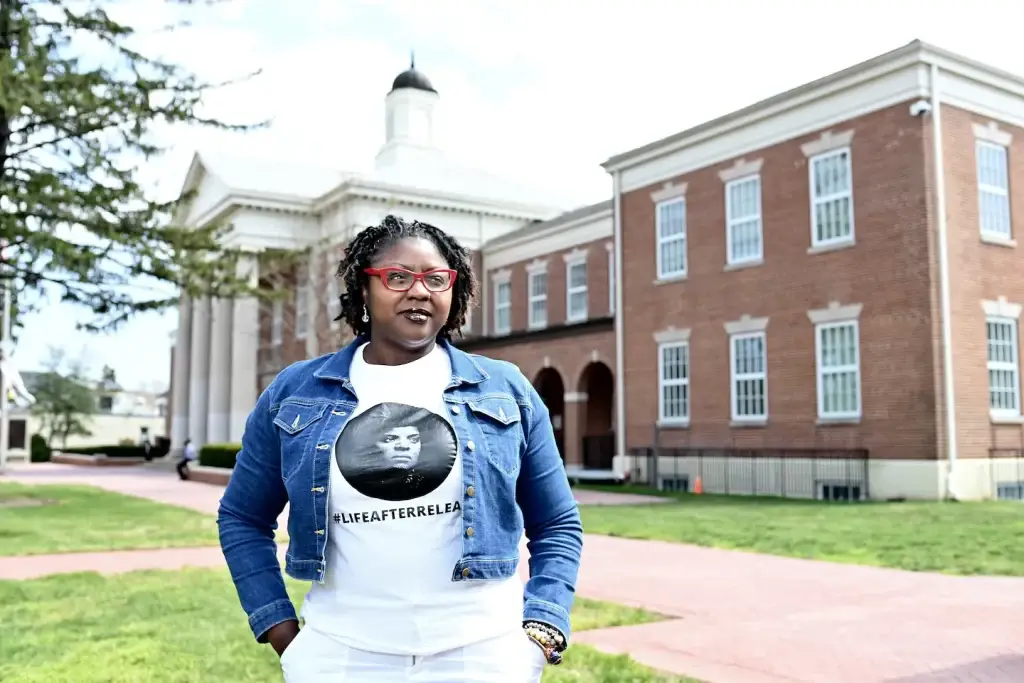
Qiana Johnson stood at the microphone in the Eaton House, a forward-thinking co-working space in downtown DC, and described what she saw as the most important aspect of a courtroom: the void. According to Johnson, a court is a place where powerful actors — the judge, the prosecutors — have ample latitude to do as they please and little threat of liability.
[ad_1]
Johnson, 41, saw it for herself after she was convicted of theft and other charges in 2015 and separated from her two sons. After her release two years later, she began working on courtroom liability and the abolition of prison. Now Johnson is the executive director of Life After Release, director of the legal defense of Harriet’s Wildest Dreams, and the founder of Courtwatch PG. Johnson said she wants people to see injustice for themselves and launched a DC branch of Courtwatch on Saturday.
“As I went through the criminal justice system, I realized it had nothing to do with right or wrong, right or wrong,” Johnson said. “It felt like I was having an out-of-body experience. I thought, ‘People won’t believe what I’m going through. I need to find a way to get people to see this for themselves.” Now she wants “a community-based program that would entice people to come to court, watch the courts and report back.”
Marshals Service employees have been claiming racism for decades. Their case can finally be heard.
A core principle of Courtwatch is to address the arbitrary nature of the legal system. One of the approximately 40 in attendance on Saturday quoted a woman she knew who had been hospitalized with bleeding legs, but was taken to court anyway. The public has videoed several DC hearings and pointed out issues, such as one defendant’s lack of a microphone, which made them difficult to hear.
“Judges in DC are not responsible for their communities,” Johnson said. “What we’re watching the courts in DC for is to show the inconsistencies in how the police are showing up. By looking at the courts in DC, we can establish actual police brutality.
To restore humanity to the defendants, Johnson and others called the defendants “loved ones” at the event. One participant, JT Todd, who has lived in the district for three years, thought court viewings could protect one from being “placed in the system.”
“I wanted to get involved in community activism and help increase harm reduction,” said Todd, 22. “I want to avoid putting people in jail and replacing them with something more human.”
Johnson said she hopes Courtwatch can shine a light and show people how much leeway a prosecutor has. She asks volunteers — about 100 a month, she says — to watch hearings, live or remote, for careless judges, overzealous prosecutors and other assaults that punish defendants.
“Judges and prosecutors have more power than the president, if you ask me,” Johnson said.
Holding courts accountable – with help from students, retirees and Fiona Apple
Johnson said Courtwatch conducts rigorous tracking through spreadsheets and forms and has a contractor writing software to collect its findings. Watchers record the names of each attorney and judge, the charges, the type of recommendation offered by the state, what the judge recommended or ordered, and other measures. A note on the file can be caused by, for example, visible signs that the defendant felt uncomfortable or looked abused, she said. In a video at the event, viewers saw a man struggling to walk. Johnson said she wants to produce a robust annual report that will analyze everything and hold judges to account.
“Nobody knows what goes on in these courtrooms, and it’s some of the most egregious things, but judges don’t have to report that,” Johnson said. “Everyone should report on what is happening in their office. Judges don’t have to do that.”
Johnson said court guards — 70 trained in DC — take two hours of training to understand legal language, what to do and what not to do in a courtroom, and how a court of law works. They are sometimes recruited through non-profit organizations such as Harriet’s Wildest Dreams. She also said the training helps potential viewers learn how to process grief: “It’s brutal and horrifying to hear what people are going through.”
Johnson said her work shows how courtrooms unjustly affect people of color. Through organizing and activism, she hopes to turn Courtwatch’s findings into policies and bills that could come before the DC council, such as a measure that ensures the court remains accessible to all.
[ad_2]
Source link
Trending Topics

Features
- Drive Toolkit
Download and distribute powerful vaccination QI resources for your community.
- Health Champions
Sign up now to support health equity and sustainable health outcomes in your community.
- Cancer Early Detection
MCED tests use a simple blood draw to screen for many kinds of cancer at once.
- PR
FYHN is a bridge connecting health information providers to BIPOC communities in a trusted environment.
- Medicare
Discover an honest look at our Medicare system.
- Alliance for Representative Clinical Trials
ARC was launched to create a network of community clinicians to diversify and bring clinical trials to communities of color and other communities that have been underrepresented.
- Reducing Patient Risk
The single most important purpose of our healthcare system is to reduce patient risk for an acute event.
Related Posts
Xavier Ochsner Medical School Earns Accreditation
- Victor Mejia
GLP-1 Bridge 2026 What Medicare Patients Need to Know.
- Jessica Wilson
Illinois Infant Mortality Is Declining, but Racial Disparities Remain
- Jessica Wilson




