












As U.S. diabetes numbers remain near record highs, researchers in West Texas are warning that a closer look at nutrition and mental health could sharpen how clinicians understand risk in older adults, especially in rural Hispanic communities. The Centers for Disease Control and Prevention estimates 38.4 million people in the United States had diabetes in 2021, about 11.6% of the population, and 8.7 million adults were living with diabetes but were undiagnosed. CDC New findings from Project FRONTIER, a long-running rural cohort, add to growing evidence that diabetes can cluster with depression symptoms and low vitamin D status—overlaps that may be shaped by ethnicity and access to care.
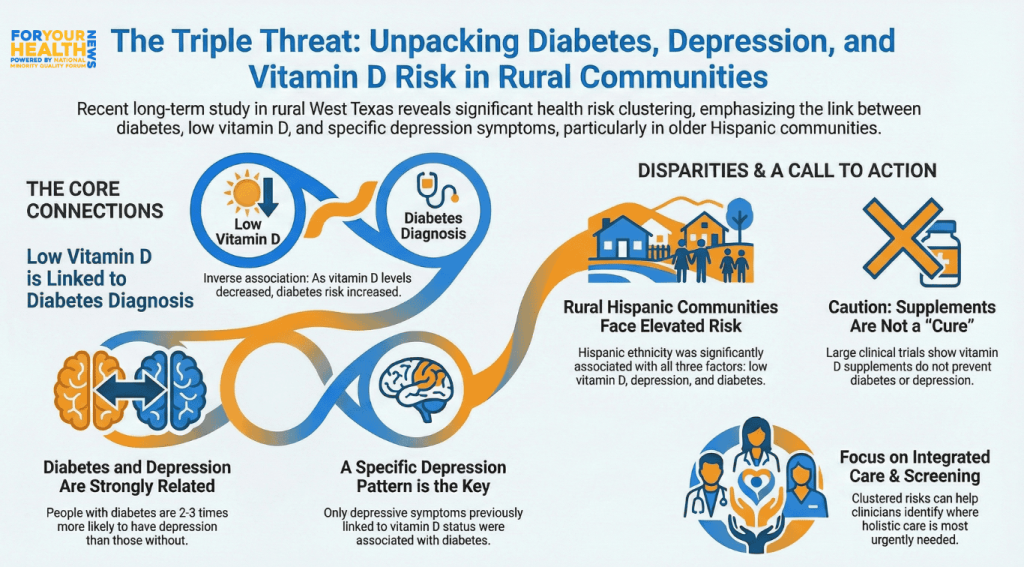
The study, published online January 3, 2026 in the journal Nutrition & Diabetes, examined relationships between diabetes, vitamin D status, depression, and Hispanic ethnicity in a sample of 299 aging adults from Parmer County, Texas. Researchers reported that vitamin D levels were inversely associated with diabetes diagnosis, while a set of depressive symptoms most strongly tied to vitamin D status was positively associated with diabetes diagnosis. Hispanic ethnicity, the authors found, was linked with higher HbA1c and fasting blood glucose, along with higher scores on that vitamin D–sensitive depression measure.

Those patterns land amid persistent national disparities. CDC age-adjusted data for 2019–2021 show the prevalence of diagnosed diabetes was 11.7% among adults of Hispanic origin, compared with 6.9% among non-Hispanic White adults. Public health officials have also stressed that mental health frequently complicates diabetes management. “People with diabetes are 2 to 3 times more likely to have depression than people without diabetes,” the CDC notes, adding that only “25% to 50%” of people with diabetes who have depression are diagnosed and treated.
A rural cohort offers a sharper look at intersecting risks
Project FRONTIER, managed through Texas Tech University Health Sciences Center, began in 2006 to follow adults and elders in rural West Texas and study how chronic disease affects physical, cognitive, and social functioning over time. For the new analysis, investigators used baseline data collected during Visit 1 from 2009 to 2011 in Parmer County, the only county in the cohort where vitamin D measurements were available. The participants’ average age was 62.6, about 71% were women, and roughly 40.5% identified as Hispanic. The team combined diabetes-related lab results, measured blood levels of 25-hydroxyvitamin D, and depression screening scores from the Geriatric Depression Scale.
Vitamin D deficiency and insufficiency were common in the sample. Vitamin D levels ranged from 7.2 to 91.0 ng/mL, and 61.5% of participants were classified as vitamin D deficient or insufficient, with an overall mean level of 28.5 ng/mL. The paper used Endocrine Society definitions that describe vitamin D deficiency as a 25(OH)D level of 20 ng/mL or lower and insufficiency as 21–29 ng/mL. Those thresholds are broadly consistent with federal guidance that many clinicians use to interpret lab results: the NIH Office of Dietary Supplements says people are at risk of deficiency at levels below 12 ng/mL, may be at risk of inadequacy at 12–20 ng/mL, and that 20 ng/mL or higher is sufficient for most people. Office of Dietary Supplements

Against that backdrop, the researchers found that lower vitamin D tended to travel with worse diabetes signals. In the paper’s summary results, vitamin D level was negatively associated with diabetes diagnosis, while the study’s “vitamin D–sensitive” depression score was positively associated with diabetes diagnosis. That vitamin D–sensitive depression measure was built from nine depression-screening questions that had previously shown a significant relationship with vitamin D levels in this cohort, while the remaining 21 questions formed a “vitamin D–insensitive” score. The researchers reported that differences in vitamin D–sensitive depression scores emerged between people in the “no diabetes range” and the “diabetes range,” while the vitamin D–insensitive depression score and total depression score did not show significant differences across diabetes-status groups in the same way.
The analysis also highlighted ethnic disparities that mirror national patterns but add local specificity. In multivariate models, Hispanic ethnicity was significantly associated with lower vitamin D, higher vitamin D–sensitive depression scores, and higher HbA1c and fasting blood glucose. The authors argue that focusing on rural communities is essential because these populations, and the inequities within them, are often missing from the evidence base that shapes guidelines. In the introduction, they describe “a critical knowledge gap” in understanding whether vitamin D could function as a proxy marker tied to diabetes and comorbid conditions in older adults, particularly in rural West Texas communities with a large Hispanic population.
While the results point to meaningful relationships between diabetes, vitamin D status, depression, and Hispanic ethnicity, the paper does not claim that vitamin D supplements prevent diabetes or depression. That caution matters because large randomized trials have largely reported null results for prevention, even when observational studies suggested a link. In the NIH-funded D2d trial, adults at high risk for type 2 diabetes who took 4,000 IU of vitamin D3 daily did not see a statistically significant reduction in progression to diabetes compared with placebo. National Institutes of Health (NIH) The NIH release quoted Myrlene Staten, a project scientist at the National Institute of Diabetes and Digestive and Kidney Diseases: “Observational studies have reported an association between low levels of vitamin D and increased risk for type 2 diabetes,” but whether supplementation could prevent or delay diabetes “was not known.” For depression, a large randomized clinical trial published in JAMA found vitamin D3 supplementation did not produce statistically significant differences in depression outcomes compared with placebo over more than five years of follow-up, concluding the findings “do not support” vitamin D3 for depression prevention.
Taken together, the new West Texas results underscore a practical challenge for health equity: even when a single supplement is not a stand-alone fix, the clustering of low vitamin D status, depressive symptom patterns, and elevated diabetes biomarkers can signal where screening and follow-up may be falling short. In rural regions where clinical resources are thinner and travel distances longer, clinicians often have less time and fewer referral options to address diabetes and mental health together, even though public health agencies say the conditions frequently overlap.
The Project FRONTIER paper adds to the case for integrated care approaches that do not treat diabetes, nutrition, and depression as separate lanes—especially for older Hispanic adults who face both higher diabetes prevalence nationally and higher risk of unmet healthcare needs in many rural settings. For readers looking for community-centered health information and equity-focused reporting, NMQF publishes resources and updates at https://nmqf.org. The study’s central message is not that vitamin D is destiny, but that relationships between diabetes, vitamin D status, depression, and Hispanic ethnicity may help identify where prevention and care can be better matched to the realities of rural communities in West Texas.
Also Read: Mental Health During the Holidays and Winter Months: What Experts Are Warning About