


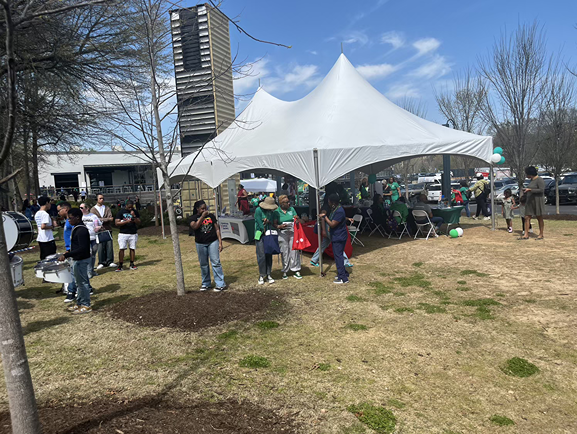







In early 2025, the National Minority Quality Forum (NMQF) hosted a Baltimore listening session to strengthen ATTR-CM awareness among community members through faith-based dialogue and clinical education. Held in a church setting, the discussion highlighted both the urgent need for education and the power of trusted community partnerships.
Dr. Jannae White, DNP, a nurse practitioner at the Heart Failure Center at St. Agnes Hospital in Baltimore, joined Bishop J.L. Carter, a longtime pastor of Ark Church and leader of NMQF’s Faith Health Alliance, to speak directly with community members about ATTR-CM.
Bridging Medicine and Ministry

Dr. White treats patients with heart failure, so participating in the listening session felt like a natural extension of the work she does every day. “My heart is in the community,” she explained. “We have to go where people are. It was an honor to hear directly from community members about their concerns and how we, as medical professionals, can help.”
Bishop Carter, who has led his congregation for 39 years, sees health outreach as an essential part of holistic ministry. “Ministry is not just spiritual—it’s physical,” he said, noting that his community is experiencing far too many strokes, heart attacks, and other serious heart problems. “We have to address that.”
Although Baltimore is home to world-renowned medical institutions like Johns Hopkins, Bishop Carter acknowledged that historical distrust has kept many community members from seeking care there, making the church’s role in connecting people to health information and resources even more vital.
Stay Informed. Stay Empowered.
Why the Church Setting Matters
According to both leaders, the church remains one of the most trusted institutions in Black communities. Bishop Carter, who has led his congregation for nearly four decades, said that trust carries tremendous influence. “For 39 years, this congregation has trusted me with their lives,” he explained. “They listen to what I say. That’s why bringing this information into the church is so important.”
He pointed to the COVID-19 pandemic as a powerful example of how faith institutions can mobilize communities. When vaccination rates lagged in Black and brown communities, state leaders partnered with churches, which quickly stepped in to help encourage vaccination and share accurate information. As a result, Maryland’s vaccination rates improved significantly. “If we could do that with COVID vaccines,” he said, “why can’t we address hypertension, diabetes, heart disease, and cancer in the same way?”
Dr. White shared that perspective, noting that faith communities create an environment where people feel comfortable engaging with health information. “The church is a trusted space,” she said. “When healthcare providers collaborate with faith leaders, it shows the community that we care enough to meet them where they are.”
A Major Awareness Gap
When asked how much participants knew about ATTR-CM before the session, Bishop Carter was candid, noting that many in the room had never even heard of the disease. “Many didn’t even know this disease existed,” he said.
Dr. White explained that the knowledge gap extends beyond the community and into the medical field itself. “Even many healthcare providers are still learning about ATTR-CM,” she said, adding that while significant progress has been made in understanding the condition over the past six years, there is still much more to learn.
Part of the challenge, she noted, is that ATTR-CM is frequently overlooked because its symptoms resemble those of more common conditions. Patients experiencing these symptoms are often told they stem from diabetes, atrial fibrillation, or general heart failure, and the possibility of ATTR-CM may never be investigated further. “It’s not the community’s fault,” Dr. White emphasized. “If a provider says, ‘This isn’t ATTR-CM,’ most patients will accept that. We, as healthcare professionals, need to do a better job recognizing and testing for it.”
The Misinformation Challenge
Both speakers also addressed the growing influence of social media, artificial intelligence, and celebrity endorsements in spreading health misinformation. Bishop Carter described a troubling example involving a community member who purchased ineffective supplements promoted online, highlighting how easily people can be misled. “There’s no regulation,” he said. “People are thirsting for education, but they’re often getting misinformation.”
Dr. White added that misinformation creates a difficult dynamic in communities, where some individuals accept everything they see online while others become so skeptical that they distrust all information, including legitimate medical guidance. In that environment, she explained, trusted relationships between healthcare professionals and community institutions become even more critical.
What Warning Signs Should People Watch For?
From a clinical perspective, Dr. White highlighted several symptoms that should prompt a conversation with a healthcare provider about the possibility of ATTR-CM. These include:
Potential early warning signs:
-
Bilateral carpal tunnel syndrome (numbness or tingling in both hands)
-
Peripheral neuropathy (numbness or tingling in the feet)
-
Spinal stenosis
-
Gastrointestinal issues such as unexplained diarrhea or constipation
-
A diagnosis of heart failure combined with the symptoms above
Additional cardiac warning signs:
-
Irregular heart rhythms or atrial fibrillation
-
Heart palpitations
-
Swelling in the legs
-
Shortness of breath during mild activity
-
Difficulty climbing stairs or walking short distances
“If these symptoms are present,” Dr. White said, “it’s worth asking your provider whether ATTR-CM should be evaluated.”

The Health Literacy Gap
One of the most powerful takeaways from the listening session was the sense among participants that they were not always being heard. Dr. White noted that many community members leave medical appointments feeling their concerns have been dismissed. “They feel dismissed,” she said. “We need to listen more and talk less. Even if we don’t have all the answers, we should explain the next steps clearly.”
She also emphasized the importance of communicating in clear, accessible language rather than relying on technical medical terminology. Instead of telling a patient, “You have transthyretin cardiac amyloidosis and need a technetium pyrophosphate scan,” providers can explain that abnormal proteins may be affecting the heart and that imaging tests can help doctors better understand what is happening. Communicating in plain language, she noted, helps patients feel informed and respected. Clear communication builds trust, while dismissal can quickly erode it.
The Future of Faith–Health Partnerships
When asked how healthcare organizations can better partner with faith leaders, Bishop Carter spoke candidly about some of the barriers that still exist. He noted that certain institutions are sometimes hesitant to share resources, particularly when it comes to funding programs designed to support underserved communities. “Some institutions may not want to share resources,” he said.
Despite those challenges, he remains optimistic about the role faith institutions can play in improving community health. “The role of the church is unlimited,” Bishop Carter explained. “We can serve spiritually on Sunday and address health needs during the week.”
Dr. White shared a similar perspective, emphasizing that meaningful engagement requires intention and outreach from healthcare organizations. Rather than expecting communities to seek out information on their own, she said providers should actively bring resources and education directly to the places people already trust. “We have to be intentional,” she said. “Don’t make the community come to us. Bring the information to them.”
A Call for Continued Engagement
The listening session was never intended to be a one-time event. Bishop Carter noted that the community’s response made that clear almost immediately. “Even now,” he shared, “people are asking when Dr. White is coming back.”
Moments like that reflect something deeper than a successful meeting—they point to the importance of sustained engagement. Building trust within communities requires more than one-time outreach; it requires ongoing presence, conversation, and partnership.
As both leaders emphasized, improving outcomes for conditions like ATTR-CM will take more than clinical advances alone. It will also require listening, strong partnerships, cultural humility, and a willingness to meet communities where they already gather. In Baltimore, that gathering place is often the church.
For more information and free resources for ATTR-CM, visit AskAboutATTR.org.
This work is conducted in partnership with BridgeBio.
Also Read: 10 Emergency Medical Items Every Home Should Have That Never Expire
Stay Informed. Stay Empowered.