











Healthcare Jobs Are Powering the Economy and Creating Opportunity in Local Communities
Diverse group of healthcare workers providing care in a community setting, representing job growth and economic opportunity in underserved neighborhoods

Quick Answer: Where can I find information about healthcare career paths and training programs?

You can explore healthcare career options through resources like the U.S. Bureau of Labor Statistics Occupational Outlook Handbook, local community colleges, workforce development programs, and organizations like the National Institutes of Health and Health Resources and Services Administration, which provide guidance on training, certifications, and job outlooks in healthcare fields.

Healthcare is quietly becoming the backbone of the U.S. economy, driving job growth at a time when other industries are slowing down or being reshaped by technology.

Recent labor data shows a striking trend. Over the past year, the U.S. added about 156,000 jobs overall, yet healthcare alone accounted for roughly 375,000 new positions. This means that without the medical sector, the broader economy would have lost jobs during that period. The numbers reflect a major shift in where economic growth is happening.

Federal data supports this pattern. The U.S. Bureau of Labor Statistics projects that healthcare and social assistance will remain the fastest-growing sector over the next decade, fueled largely by rising demand for care.

For communities of color, this shift carries significant implications. Many traditional high-paying industries remain geographically distant or require advanced degrees that are not always accessible. Healthcare jobs, however, are expanding within neighborhoods, offering more immediate and local pathways to employment.
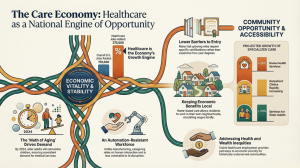
An infographic titled "The Care Economy," illustrating healthcareโ€™s role as a primary economic driver. Key visuals include a comparison showing healthcare added 375,000 jobs in a year while the broader economy slowed, a timeline marking 2034 as the year older adults will outnumber children, and a map highlighting the shift of jobs from hospitals to local home health and outpatient clinics
The Care Economy: Healthcare as the Engine of Opportunity.

Experts say this trend is tied to a major demographic change. By 2034, older adults are expected to outnumber children in the United States, according to Census Bureau projections. As the population ages, the need for healthcare services continues to grow regardless of economic conditions.

This shift has been described by economists as a โ€œcare economy,โ€ driven by what some call the โ€œmath of aging.โ€ Older populations require more consistent care, from routine medical visits to long-term support. Unlike other industries, this demand does not depend on global markets, trade policy, or technological disruption.

That stability makes healthcare a critical economic safeguard. While sectors like retail and manufacturing are affected by automation and artificial intelligence, caregiving jobs rely on human interaction. The Bureau of Labor Statistics notes that demand for healthcare workers will remain strong because aging populations require more hands-on care and support.

Stay Informed. Stay Empowered.

This reliability is especially important for communities that have historically faced economic instability. Workers of color are often among the first to be affected during downturns. In contrast, healthcare offers a more consistent source of employment that is less vulnerable to sudden job losses.

At the same time, the nature of healthcare jobs is changing. Much of the growth is no longer centered in hospitals. Instead, it is shifting toward lower-cost settings like home health services and outpatient clinics. Federal labor projections show that services for older adults and people with disabilities are among the fastest-growing segments, with increases exceeding 20 percent in some areas.

nmqf40under40Desktopversion-ezgif.com-optimize

This shift matters because these roles are often more accessible. Many positions, such as home health aides and medical assistants, require certifications rather than four-year degrees. This creates faster entry points into the workforce, especially for young people who may not have the resources for extended education.

The impact extends beyond employment. Public health research consistently shows that economic stability is closely linked to health outcomes. The Centers for Disease Control and Prevention identifies stable income and employment as key factors that influence physical and mental health.

In communities of color, where disparities in income and access to care persist, the expansion of healthcare jobs can help address both economic and health inequities at the same time.

There is also a growing need for culturally competent care. As the population ages, many older adults prefer providers who understand their language, culture, and lived experiences. Yet workforce shortages remain, particularly in communities of color.

Federal workforce projections warn of gaps across multiple healthcare roles in the coming years, including behavioral health and long-term care positions. Expanding the workforce within these communities could help close those gaps while improving care quality.

Another key factor is where the economic benefits are felt. Many healthcare jobs, especially in home-based care, are performed locally. Workers are employed within their own neighborhoods, reducing long commutes and keeping wages circulating in the community.

This local impact is significant. When residents earn income close to home, they are more likely to spend money at nearby businesses, supporting broader economic activity.

However, challenges remain. Many healthcare services in underserved communities depend heavily on Medicaid funding. Policy changes or funding cuts could reduce reimbursement rates and affect job stability. In addition, a large share of home healthcare workers are immigrants, and changes in immigration policy could lead to workforce shortages.

Despite these risks, the overall trend is clear. Healthcare is doing much of the heavy lifting in the U.S. economy, creating jobs at a scale that few other sectors can match.

For communities of color, this moment represents a shift in how opportunity is defined. Healthcare is no longer just a system people rely on in times of need. It is becoming a pathway to stable careers, stronger local economies, and improved health outcomes.

As the demand for care continues to grow, the sector is positioned to play an even larger role in shaping the economic future of underserved communities.

Stay Informed. Stay Empowered.

Trending Topics

Features

Download and distribute powerful vaccination QI resources for your community.

Sign up now to support health equity and sustainable health outcomes in your community.

MCED tests use a simple blood draw to screen for many kinds of cancer at once.

FYHN is a bridge connecting health information providers to BIPOC communities in a trusted environment.

Discover an honest look at our Medicare system.

ARC was launched to create a network of community clinicians to diversify and bring clinical trials to communities of color and other communities that have been underrepresented.

The single most important purpose of our healthcare system is to reduce patient risk for an acute event.

Related Posts
As GLP-1 Shortages Ease, Patient Safety Concerns Shift to Unsafe Copies
Healthcare Leaders Spotlight Vaccine Equity and Adult Immunization Strategies at 2026 National Summit
The New Cancer Question at ASCO 2026: Can GLP-1 Drugs Reduce Cancer Spread?
Scroll to Top
Featured Articles
Unsafe Compounded GLP-1 Drugs Raise FDA Concern
As GLP-1 Shortages Ease, Patient Safety Concerns Shift to Unsafe Copies
Michelle Lam, MBA, of NYC Health + Hospitals/Elmhurst & Amy Harris of NYC Health + Hospitals/Elmhurst
Healthcare Leaders Spotlight Vaccine Equity and Adult Immunization Strategies...
cancer research related to GLP-1 drugs and metabolic health at a medical conference
The New Cancer Question at ASCO 2026: Can GLP-1 Drugs Reduce Cancer Spread?
High Cholesterol Is Common, Quiet and Treatable: What Patients Should Know
Should I Test My Baby for High Cholesterol?
Diverse patients and healthcare workers in a clinic reviewing demographic health data and intake forms representing updated SPD 15 race and ethnicity standards.
New Federal Data Standards Could Change How Communities of Color Are Counted ...
Categories
AI
ATTR-CM
BIPOC News
Cancer
Clinical Trials
Covid19
Diseases of the Body
Environment
Health Data
Health Equity Events
Health Policy
Health Tips
Subscribe to our newsletter to receive our latest newsโ€‹
All Stories
Unsafe Compounded GLP-1 Drugs Raise FDA Concern
As GLP-1 Shortages Ease, Patient Safety Concerns Shift to Unsafe Copies
Michelle Lam, MBA, of NYC Health + Hospitals/Elmhurst & Amy Harris of NYC Health + Hospitals/Elmhurst
Healthcare Leaders Spotlight Vaccine Equity and Adult Immunization Strategies...
cancer research related to GLP-1 drugs and metabolic health at a medical conference
The New Cancer Question at ASCO 2026: Can GLP-1 Drugs Reduce Cancer Spread?
BIPOC News
Should I Test My Baby for High Cholesterol?
PCOS Has a New Nameโ€ฆ and Itโ€™s About Time
new multi-cancer blood test with an older Black patient during a healthcare visit.
New Cancer Blood Test Law Could Change How Americans Find Cancer Early
Environment
Microplastics in Water Fyh.news
HHS and EPA Launch Landmark Initiatives for Microplastics-Free Drinking Water
69c2f4108da0f.image_.jpg
Organizers assist homeless amidst record heat | City News

thefoothillsfocus

Public health scientist collecting wastewater sample to test for viral concentrations as part of community disease surveillance in the United States.
What Wastewater Testing Reveals About Viruses Spreading in Your Community
Work Force
dreamstime_s_243253251
The Caregiver Journey: The Hidden Backbone of American Healthcare
Families gather at a Bronx community festival with live music, kidsโ€™ activities, and health booths sharing SOMOS social care resources and free screenings.
Celebrating Hispanic heritage while learning about health care

msn

Racial/Ethnic Minorities have Greater Declines in Sleep Duration with Higher Risk of Cardiometabolic Disease
Racial/Ethnic Minorities have Greater Declines in Sleep Duration with Higher ...

pubmed

Clinical Trials
dreamstime_s_174488289
PCOS to PMOS: Why the 2026 Name Change Matters for Womenโ€™s Health

Lupus Awareness Month Highlights Ongoing Gaps in Clinical Trials for Black and Brown Communities
Lupus Awareness Month Highlights Ongoing Gaps in Clinical Trials for Black an...
Black Family Wellness Expo 2026 Atlanta
Black Family Wellness Expo Brings Healing, Resources, and Community Together
Vaccines and Outbreaks
Michelle Lam, MBA, of NYC Health + Hospitals/Elmhurst & Amy Harris of NYC Health + Hospitals/Elmhurst
Healthcare Leaders Spotlight Vaccine Equity and Adult Immunization Strategies...
Measles Outbreaks Surge: Essential Facts and Prevention Strategies
U.S. measles cases 2026: Outbreaks Spread as MMR Coverage
2026 Measles Spike: U.S. Cases Rise Fast as Outbreaks Grow
Other Categories
AI
Read the latest AI News stories trending around the world
ATTR-CM
Cancer
Read the latest Cancer stories trending around the world
Covid19
Diseases of the Body
Read about the latest Diseases of the Body trending around the world
Friday Webinars
Every Friday, we bring you insightful webinars covering critical topics in healthcare, data equity, and policy reform.
Health Data
Read the latest Health Data stories trending around the world
Health Equity Events
Read the best Health Equity Events around the country.
Health Policy
Read the latest Health Policy stories trending around the world
Health Tips
Heart Health
Read the latest on Heart Health News, Stories and Tips.
kidney Health
Read more trending News about Kidney Health, Stories and Tips.