






The Current State of Life in Flint, Michigan: Water, Health, and Justice
Flint Water Crisis Aftermath Health, Trauma, and Trust Fyh.news
Editor Notes

By: Crystallee Crain, Ph.D

Nearly a decade after the Flint water crisis first captured national attention, the city continues to grapple with the profound aftermath of one of Americaโ€™s most significant environmental disasters.ย 

While infrastructure improvements have been made, the physical, psychological, and social scars remain deeply embedded in this predominantly African American community of approximately 81,000 residents.

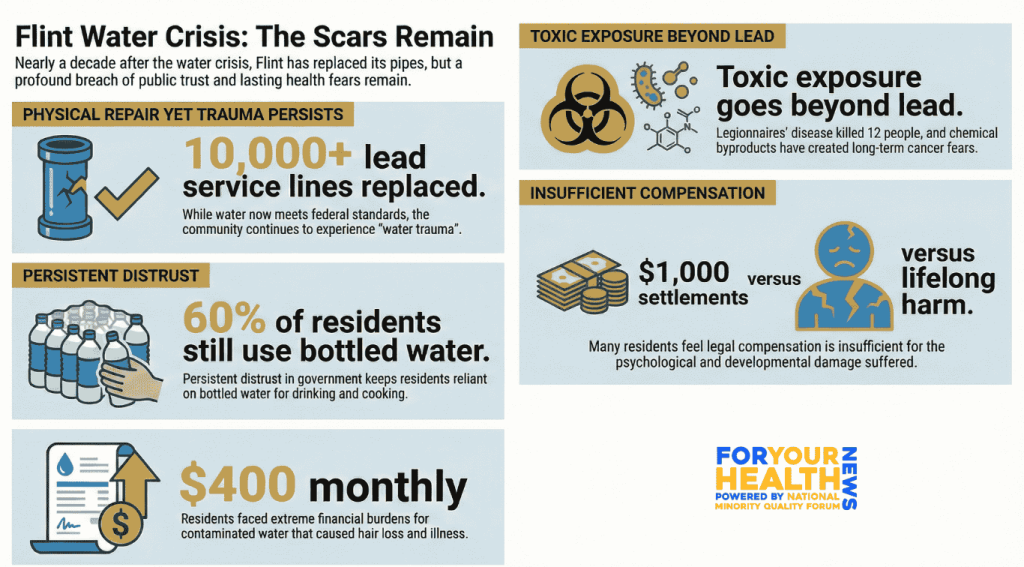
The economic toll coupled with the health and environmental risks has taken an unnecessary toll on Flint residents. As Blair Snider states, โ€œI live on the east side of Flint, and for years my water bill was consistently $47.47 every month. Over time, the bill increased multiple times, but by 2014 it had reached $400 a month.โ€

Flint Water Crisis Aftermath Health, Trauma, and Trust fyh.news

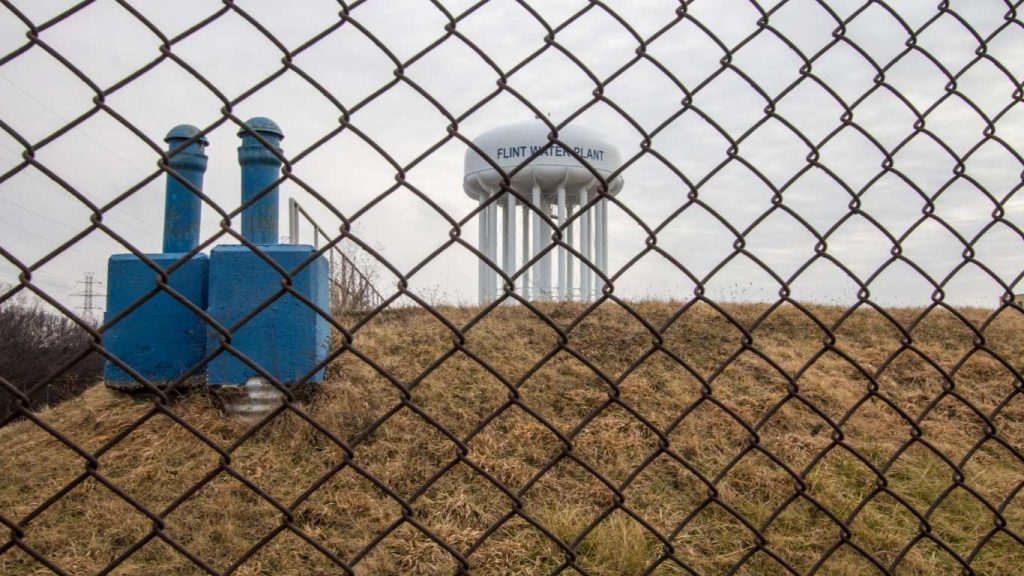
The immediate crisis began when Flint switched its water source from Lake Huron to the Flint River as a cost-saving measure. The corrosive river water, inadequately treated, leached lead from aging pipes into residentsโ€™ drinking water. By 2015, elevated blood-lead levels in children had been documented, and Legionnairesโ€™ disease outbreaks were linked to the contaminated water system.

Today, Flintโ€™s water technically meets federal standards for lead levels. The city completed replacing over 10,000 lead service lines by 2020 through a massive infrastructure undertaking funded through state and federal resources.ย 

According to the Michigan Department of Environment, Great Lakes, and Energy, recent water quality tests show lead levels well below the federal action level of 15 parts per billion. However, these technical improvements have not restored community trust.

According to Ward 1 City Councilman Leon Elamin, โ€œWhile we have begun distributing settlement funds to property owners, I understand the frustrations of our residents who feel that the compensation they are set to receiveโ€”approximately $1,000 for adultsโ€”is insufficient given the extent of the harm suffered. It’s crucial that we work together to ensure that all affected individuals receive fair compensation and support.โ€

Research published in the Journal of Public Health reveals that despite infrastructure upgrades, many Flint residents continue to rely exclusively on bottled water for drinking and cooking. A 2022 study by Kruger et al. found that approximately 60% of surveyed residents reported still using bottled water as their primary drinking water source, citing persistent distrust in government assurances about water safety. This reliance on bottled water creates ongoing financial burdens for families already facing economic hardship in a city where the poverty rate exceeds 30%.

East side resident Snider shares that, โ€œDuring the crisis, I was buying large quantities of bottled water just to make baby bottles and protect my family. I also experienced significant hair loss from showering in the contaminated water, which was both physically and emotionally distressing. While free water was sometimes available, accessing it was often difficult. Long lines, inconsistent availability, and the way residents were treated added to the trauma.โ€

The psychological impact of the crisis has been particularly devastating. Residents describe experiencing โ€œwater traumaโ€โ€”a persistent anxiety about water safety that affects daily life.ย 

Parents report bathing their children in bottled water and experiencing panic when their children accidentally ingest tap water. This collective trauma extends beyond rational risk assessment; it represents a fundamental breach of trust between citizens and the institutions meant to protect them.

The relationship between Flintโ€™s water contamination and cancer risk has become a significant concern among residents, though the scientific evidence remains complex and evolving. Lead exposure is not directly classified as a carcinogen, but the water crisis involved multiple contaminants beyond lead, including trihalomethanesโ€”disinfection byproducts that are associated with increased cancer risk.

Research by Pauli et al. published in Environmental Health Perspectives documented elevated levels of total trihalomethanes in Flintโ€™s water during the crisis period, with levels occasionally exceeding EPA maximum contaminant levels. These compounds have been linked to bladder cancer and potentially other malignancies through long-term exposure. Additionally, the Legionnairesโ€™ disease outbreaks, which killed at least twelve people, demonstrated that the water contamination had immediate life-threatening consequences beyond lead exposure.

Community perceptions about cancer risk reflect deep-seated concerns about long-term health impacts. Qualitative research by Heard-Garris et al. in the Journal of Racial and Ethnic Health Disparities found that many Flint residents believe their exposure to contaminated water has increased their familyโ€™s cancer risk, particularly for children exposed during critical developmental periods. These beliefs are not unfounded; while establishing direct causation is scientifically challenging, the multi-year exposure to various contaminants creates plausible biological mechanisms for increased disease risk.

However, definitively linking specific cancer cases to the water crisis requires long-term epidemiological studies that are still ongoing. The latency period for many cancers means that potential increases in cancer incidence may not become statistically apparent for years or decades.ย 

This uncertainty creates additional anxiety for residents who feel they are living in a state of suspended anticipation, waiting to discover the full health consequences of their exposure.

The legal aftermath of the Flint water crisis has been extensive, involving both criminal prosecutions and civil litigation. Community awareness of these proceedings is high, though opinions about whether justice has been served remain deeply divided and largely pessimistic.

In 2021, former Michigan Governor Rick Snyder was charged with two misdemeanor counts of willful neglect of dutyโ€”charges that many residents viewed as woefully inadequate given the scale of the disaster. Several other state and city officials faced various charges, though many cases were dismissed or resulted in plea agreements. In January 2024, Snyder and other officials reached a settlement in which charges would be dismissed after completion of certain requirements, a resolution that generated significant community frustration.

The civil litigation has been more substantive from a compensation perspective. In 2021, a $641 million settlement was reached to compensate Flint residents for their injuries, with approximately 80% of the funds designated for children affected by lead exposure. However, research by Ruckart et al. in the American Journal of Public Health notes that many residents feel the settlement amount is insufficient given the lifelong health impacts and psychological trauma experienced by the community.

Community surveys reveal widespread belief that racial and economic factors influenced both the initial decision-making that led to the crisis and the inadequate accountability that followed.

Flintโ€™s population is majority Black and has high poverty ratesโ€”factors that residents believe made their community vulnerable to governmental neglect and indifference. This perception is supported by research demonstrating that environmental injustices disproportionately affect communities of color and low-income populations.

The ongoing legal proceedings, while providing some measure of accountability and compensation, have not restored faith in governmental institutions. Many residents express the view that no amount of legal settlement can undo the damage to their childrenโ€™s health and development, nor can criminal charges that result in minimal consequences truly represent justice for the profound betrayal of public trust.

Life in Flint, Michigan today is marked by cautious recovery amid persistent uncertainty. Infrastructure has improved, but community trust remains broken. Health concerns, particularly about cancer risk and childrenโ€™s cognitive development, continue to generate anxiety. Legal proceedings have provided some accountability and compensation, but many residents feel justice remains elusive.ย 

The Flint water crisis serves as a stark reminder of how environmental racism, economic inequality, and institutional failure can converge to devastate a communityโ€”and how recovery from such betrayal extends far beyond infrastructure repair.

As Councilman El-Alamin says, โ€œThe actions pursued to remedy the harm are there to not only alleviate current hardships but also to build back our resilient community moving forwardโ€”to full health.โ€

References

Heard-Garris, N., Ekono, M., & Choi, H. (2018). Association between perceived discrimination in health care and health status in Flint, Michigan. Journal of Racial and Ethnic Health Disparities, 5(6), 1313-1320. <https://link.springer.com/article/10.1007/s40615-018-0479-7>

Kruger, D. J., Cupal, S., & Kodjebacheva, G. D. (2022). Persistent distrust of tap water quality in Flint, Michigan. Journal of Public Health, 44(3), 589-595. <https://academic.oup.com/jpubhealth/article/44/3/589/6318521>

Pauli, B. J., Kolker, J. L., Bauer, M. A., & Pohl, H. R. (2020). Trihalomethanes in Flint, Michigan drinking water. Environmental Health Perspectives, 128(1), 017001. <https://ehp.niehs.nih.gov/doi/10.1289/EHP5456>

Ruckart, P. Z., Jones, R. L., Courtney, J. G., LeBlanc, T. T., Jackson, W., Karwowski, M. P., โ€ฆ & Brown, M. J. (2021). Update of the blood lead reference valueโ€”United States, 2021. American Journal of Public Health, 111(10), 1827-1833. <https://ajph.aphapublications.org/doi/10.2105/AJPH.2021.306470>โ€‹โ€‹โ€‹โ€‹โ€‹โ€‹โ€‹โ€‹โ€‹โ€‹โ€‹โ€‹โ€‹โ€‹โ€‹โ€‹

Also Read: Flintโ€™s Water Crisis Isnโ€™t Over: Health Effects Persist as Trials and Settlements Unfold

Learn more about NMQFโ€™s Flint Forward Cancer Community Townhall

Stay Informed. Stay Empowered.

Trending Topics

Features

Download and distribute powerful vaccination QI resources for your community.

Sign up now to support health equity and sustainable health outcomes in your community.

MCED tests use a simple blood draw to screen for many kinds of cancer at once.

FYHN is a bridge connecting health information providers to BIPOC communities in a trusted environment.

Discover an honest look at our Medicare system.

ARC was launched to create a network of community clinicians to diversify and bring clinical trials to communities of color and other communities that have been underrepresented.

The single most important purpose of our healthcare system is to reduce patient risk for an acute event.

Related Posts
The Current State of Life in Flint, Michigan: Water, Health, and Justice
Flintโ€™s Water Crisis Isnโ€™t Over: Health Effects Persist as Trials and Settlements Unfold
A New Year, A Fresh Start for Health
Scroll to Top
Featured Articles
Flint Water Crisis Aftermath Health, Trauma, and Trust Fyh.news
The Current State of Life in Flint, Michigan: Water, Health, and Justice
Nearly a decade after the Flint water crisis health impacts became a national warning about government failure, many Flint residents say they are still living with the consequences. Sen. Elissa Slotkin told the U.S. Senate this month that families continue to report health problems and long-term disruption as court cases and settlements continue Sen. Elissa Slotkin took to the U.S. Senate floor last week to deliver a message Flint residents have been repeating for nearly a decade: the crisis may no longer dominate headlines, but the harm has not ended. โ€œAn American city was poisoned,โ€ Slotkin said, describing families who reported discolored water, rashes, seizures, hair loss, and chronic health problems as officials insisted the tap water was safe. The Flint water crisis began in April 2014, when the city switched its water source to the Flint River without adding corrosion-control treatment, a safeguard that helps prevent lead from leaching out of aging pipes. Public health officials later warned that tens of thousands of residents were exposed to elevated lead levels, and President Barack Obama declared a federal emergency in January 2016. Health officials say families concerned about lead exposure should follow clinical guidance on testing and follow-up care from the Centers for Disease Control and Prevention. Flint is a majority-Black city with high poverty rates, and the crisis quickly became a national symbol of how infrastructure failures and government neglect can compound longstanding racial and economic inequities. Lead exposure is especially dangerous for children. The Centers for Disease Control and Prevention has warned that lead can damage childrenโ€™s brains and nervous systems and contribute to learning and behavioral problemsโ€”harms that can be irreversible. Research examining pediatric blood lead testing patterns in Flint underscores how the crisis altered health behavior and monitoring, even years after the worst contamination became public. The long road to accountability, including the courtroom While the physical infrastructure is improving, Flintโ€™s search for accountability has played out in courtrooms for years. In a highly watched civil โ€œbellwetherโ€ trial in 2022, jurors could not reach a verdict in a case involving engineering firms accused of failing to prevent or mitigate the crisis, leading a judge to declare a mistrial. Since then, major civil settlements have continued to reshape what โ€œjusticeโ€ looks like for many familiesโ€”often less about a single guilty verdict than about whether compensation and long-promised services actually reach affected residents. In February 2025, Michigan Attorney General Dana Nessel announced a $53 million civil settlement with Veolia North America tied to allegations that the companyโ€™s work contributed to prolonging the crisis; the settlement was described as a way to provide closure after years of litigation. The settlement added to earlier agreements, including the stateโ€™s broader $626 million class-action settlement framework meant to compensate people harmed by lead exposure. A court-supervised claims process has approved tens of thousands of claims, but residents have faced long waits as payments move from approval to distribution. The criminal cases tied to the crisis, meanwhile, largely collapsed. A Michigan judge formally dismissed misdemeanor charges against former Gov. Rick Snyder in 2023 after appellate rulings ended the prosecutions, effectively closing that chapter of the legal response. For many Flint families, that outcome deepened the sense that high-level decision-makers escaped meaningful consequences. Health and education impacts also remain a pressing concern. A New York Times report in 2019 described Flint schools struggling with rising needs for individualized education plans and behavioral supports for children who were exposed to leadโ€”needs that educators and parents say require sustained resources, not short-term attention. Separate academic work has linked the crisis to measurable setbacks in educational outcomes, adding to evidence that environmental disasters can shape childrenโ€™s trajectories long after the immediate emergency fades. There has been visible progress on the cityโ€™s pipes. Michigan reported in 2025 that Flint had completed replacement of nearly 11,000 lead water service lines under a legal settlement that required free replacement offers to residents, a milestone that public health leaders framed as nationally significant. Pediatrician Mona Hannaโ€”one of the early voices warning the public about the crisisโ€”told The Washington Post that when water runs through lead pipes, it is โ€œflowing through a straw that is a poison and has no safe level.โ€ Still, Slotkinโ€™s Senate speech captured what many residents say is the unresolved heart of the crisis: trust. She pointed to families who felt dismissed when they first complained, and she said Flint residents are still seeking justiceโ€”including through legal action involving federal regulatorsโ€”while living with the long-term health, educational, and economic consequences of a disaster they did not cause. As Flint marks another year since the emergency declaration, the question for public health and policy leaders is not only how to prevent another Flint, but how to support a community living with the aftershocksโ€”through healthcare access, developmental and educational services, and timely delivery of promised compensationโ€”so that recovery is more than a milestone on paper. Also Read: A New Year, A Fresh Start for Health fyh.news
Flintโ€™s Water Crisis Isnโ€™t Over: Health Effects Persist as Trials and Settlem...
A New Year, A Fresh Start for Health
President Donald J. Trump speaking at a podium during the announcement of the Great Health Care Plan in January 2026, featuring the White House seal.
President Trump Unveils "The Great Healthcare Plan"
Heart Disease and Heart Health in the Black Community: What the Latest Data Show
the importance of childhood immunization and public health
When Childhood Vaccines Become a Personal Choice, Public Health Pays the Price
Categories
AI
BIPOC News
Cancer
Clinical Trials
Covid19
Diseases of the Body
Environment
Health Data
Health Equity Events
Health Policy
Heart Health
kidney Health
Subscribe to our newsletter to receive our latest newsโ€‹
All Stories
Flint Water Crisis Aftermath Health, Trauma, and Trust Fyh.news
The Current State of Life in Flint, Michigan: Water, Health, and Justice
Nearly a decade after the Flint water crisis health impacts became a national warning about government failure, many Flint residents say they are still living with the consequences. Sen. Elissa Slotkin told the U.S. Senate this month that families continue to report health problems and long-term disruption as court cases and settlements continue Sen. Elissa Slotkin took to the U.S. Senate floor last week to deliver a message Flint residents have been repeating for nearly a decade: the crisis may no longer dominate headlines, but the harm has not ended. โ€œAn American city was poisoned,โ€ Slotkin said, describing families who reported discolored water, rashes, seizures, hair loss, and chronic health problems as officials insisted the tap water was safe. The Flint water crisis began in April 2014, when the city switched its water source to the Flint River without adding corrosion-control treatment, a safeguard that helps prevent lead from leaching out of aging pipes. Public health officials later warned that tens of thousands of residents were exposed to elevated lead levels, and President Barack Obama declared a federal emergency in January 2016. Health officials say families concerned about lead exposure should follow clinical guidance on testing and follow-up care from the Centers for Disease Control and Prevention. Flint is a majority-Black city with high poverty rates, and the crisis quickly became a national symbol of how infrastructure failures and government neglect can compound longstanding racial and economic inequities. Lead exposure is especially dangerous for children. The Centers for Disease Control and Prevention has warned that lead can damage childrenโ€™s brains and nervous systems and contribute to learning and behavioral problemsโ€”harms that can be irreversible. Research examining pediatric blood lead testing patterns in Flint underscores how the crisis altered health behavior and monitoring, even years after the worst contamination became public. The long road to accountability, including the courtroom While the physical infrastructure is improving, Flintโ€™s search for accountability has played out in courtrooms for years. In a highly watched civil โ€œbellwetherโ€ trial in 2022, jurors could not reach a verdict in a case involving engineering firms accused of failing to prevent or mitigate the crisis, leading a judge to declare a mistrial. Since then, major civil settlements have continued to reshape what โ€œjusticeโ€ looks like for many familiesโ€”often less about a single guilty verdict than about whether compensation and long-promised services actually reach affected residents. In February 2025, Michigan Attorney General Dana Nessel announced a $53 million civil settlement with Veolia North America tied to allegations that the companyโ€™s work contributed to prolonging the crisis; the settlement was described as a way to provide closure after years of litigation. The settlement added to earlier agreements, including the stateโ€™s broader $626 million class-action settlement framework meant to compensate people harmed by lead exposure. A court-supervised claims process has approved tens of thousands of claims, but residents have faced long waits as payments move from approval to distribution. The criminal cases tied to the crisis, meanwhile, largely collapsed. A Michigan judge formally dismissed misdemeanor charges against former Gov. Rick Snyder in 2023 after appellate rulings ended the prosecutions, effectively closing that chapter of the legal response. For many Flint families, that outcome deepened the sense that high-level decision-makers escaped meaningful consequences. Health and education impacts also remain a pressing concern. A New York Times report in 2019 described Flint schools struggling with rising needs for individualized education plans and behavioral supports for children who were exposed to leadโ€”needs that educators and parents say require sustained resources, not short-term attention. Separate academic work has linked the crisis to measurable setbacks in educational outcomes, adding to evidence that environmental disasters can shape childrenโ€™s trajectories long after the immediate emergency fades. There has been visible progress on the cityโ€™s pipes. Michigan reported in 2025 that Flint had completed replacement of nearly 11,000 lead water service lines under a legal settlement that required free replacement offers to residents, a milestone that public health leaders framed as nationally significant. Pediatrician Mona Hannaโ€”one of the early voices warning the public about the crisisโ€”told The Washington Post that when water runs through lead pipes, it is โ€œflowing through a straw that is a poison and has no safe level.โ€ Still, Slotkinโ€™s Senate speech captured what many residents say is the unresolved heart of the crisis: trust. She pointed to families who felt dismissed when they first complained, and she said Flint residents are still seeking justiceโ€”including through legal action involving federal regulatorsโ€”while living with the long-term health, educational, and economic consequences of a disaster they did not cause. As Flint marks another year since the emergency declaration, the question for public health and policy leaders is not only how to prevent another Flint, but how to support a community living with the aftershocksโ€”through healthcare access, developmental and educational services, and timely delivery of promised compensationโ€”so that recovery is more than a milestone on paper. Also Read: A New Year, A Fresh Start for Health fyh.news
Flintโ€™s Water Crisis Isnโ€™t Over: Health Effects Persist as Trials and Settlem...
A New Year, A Fresh Start for Health
BIPOC News
President Donald J. Trump speaking at a podium during the announcement of the Great Health Care Plan in January 2026, featuring the White House seal.
President Trump Unveils "The Great Healthcare Plan"
Heart Disease and Heart Health in the Black Community: What the Latest Data Show
Cervical Health Awareness in Communities of Color Highlights Persistent Cancer Disparities
Cervical Health Awareness in Communities of Color Highlights Persistent Cance...
Environment
Nearly a decade after the Flint water crisis health impacts became a national warning about government failure, many Flint residents say they are still living with the consequences. Sen. Elissa Slotkin told the U.S. Senate this month that families continue to report health problems and long-term disruption as court cases and settlements continue Sen. Elissa Slotkin took to the U.S. Senate floor last week to deliver a message Flint residents have been repeating for nearly a decade: the crisis may no longer dominate headlines, but the harm has not ended. โ€œAn American city was poisoned,โ€ Slotkin said, describing families who reported discolored water, rashes, seizures, hair loss, and chronic health problems as officials insisted the tap water was safe. The Flint water crisis began in April 2014, when the city switched its water source to the Flint River without adding corrosion-control treatment, a safeguard that helps prevent lead from leaching out of aging pipes. Public health officials later warned that tens of thousands of residents were exposed to elevated lead levels, and President Barack Obama declared a federal emergency in January 2016. Health officials say families concerned about lead exposure should follow clinical guidance on testing and follow-up care from the Centers for Disease Control and Prevention. Flint is a majority-Black city with high poverty rates, and the crisis quickly became a national symbol of how infrastructure failures and government neglect can compound longstanding racial and economic inequities. Lead exposure is especially dangerous for children. The Centers for Disease Control and Prevention has warned that lead can damage childrenโ€™s brains and nervous systems and contribute to learning and behavioral problemsโ€”harms that can be irreversible. Research examining pediatric blood lead testing patterns in Flint underscores how the crisis altered health behavior and monitoring, even years after the worst contamination became public. The long road to accountability, including the courtroom While the physical infrastructure is improving, Flintโ€™s search for accountability has played out in courtrooms for years. In a highly watched civil โ€œbellwetherโ€ trial in 2022, jurors could not reach a verdict in a case involving engineering firms accused of failing to prevent or mitigate the crisis, leading a judge to declare a mistrial. Since then, major civil settlements have continued to reshape what โ€œjusticeโ€ looks like for many familiesโ€”often less about a single guilty verdict than about whether compensation and long-promised services actually reach affected residents. In February 2025, Michigan Attorney General Dana Nessel announced a $53 million civil settlement with Veolia North America tied to allegations that the companyโ€™s work contributed to prolonging the crisis; the settlement was described as a way to provide closure after years of litigation. The settlement added to earlier agreements, including the stateโ€™s broader $626 million class-action settlement framework meant to compensate people harmed by lead exposure. A court-supervised claims process has approved tens of thousands of claims, but residents have faced long waits as payments move from approval to distribution. The criminal cases tied to the crisis, meanwhile, largely collapsed. A Michigan judge formally dismissed misdemeanor charges against former Gov. Rick Snyder in 2023 after appellate rulings ended the prosecutions, effectively closing that chapter of the legal response. For many Flint families, that outcome deepened the sense that high-level decision-makers escaped meaningful consequences. Health and education impacts also remain a pressing concern. A New York Times report in 2019 described Flint schools struggling with rising needs for individualized education plans and behavioral supports for children who were exposed to leadโ€”needs that educators and parents say require sustained resources, not short-term attention. Separate academic work has linked the crisis to measurable setbacks in educational outcomes, adding to evidence that environmental disasters can shape childrenโ€™s trajectories long after the immediate emergency fades. There has been visible progress on the cityโ€™s pipes. Michigan reported in 2025 that Flint had completed replacement of nearly 11,000 lead water service lines under a legal settlement that required free replacement offers to residents, a milestone that public health leaders framed as nationally significant. Pediatrician Mona Hannaโ€”one of the early voices warning the public about the crisisโ€”told The Washington Post that when water runs through lead pipes, it is โ€œflowing through a straw that is a poison and has no safe level.โ€ Still, Slotkinโ€™s Senate speech captured what many residents say is the unresolved heart of the crisis: trust. She pointed to families who felt dismissed when they first complained, and she said Flint residents are still seeking justiceโ€”including through legal action involving federal regulatorsโ€”while living with the long-term health, educational, and economic consequences of a disaster they did not cause. As Flint marks another year since the emergency declaration, the question for public health and policy leaders is not only how to prevent another Flint, but how to support a community living with the aftershocksโ€”through healthcare access, developmental and educational services, and timely delivery of promised compensationโ€”so that recovery is more than a milestone on paper. Also Read: A New Year, A Fresh Start for Health fyh.news
Flintโ€™s Water Crisis Isnโ€™t Over: Health Effects Persist as Trials and Settlem...
Cold Weather Safety: Preventing Hypothermia, Frostbite, and Winter Injuries
Cancer Inequity Is Structuralโ€”and Preventable fyh.news
The Hidden Geography of Cancer: Why Minority Communities Face Higher Burdens ...
Work Force
dreamstime_s_243253251
The Caregiver Journey: The Hidden Backbone of American Healthcare
Families gather at a Bronx community festival with live music, kidsโ€™ activities, and health booths sharing SOMOS social care resources and free screenings.
Celebrating Hispanic heritage while learning about health care

msn

Racial/Ethnic Minorities have Greater Declines in Sleep Duration with Higher Risk of Cardiometabolic Disease
Racial/Ethnic Minorities have Greater Declines in Sleep Duration with Higher ...

pubmed

Clinical Trials
Cervical Health Awareness in Communities of Color Highlights Persistent Cancer Disparities
Cervical Health Awareness in Communities of Color Highlights Persistent Cance...
U.S. Vaccine Schedule Changes Under RFK Jr. Raise Concerns for Communities of Color
U.S. Vaccine Schedule Changes Under RFK Jr. Raise Concerns for Communities of...
Illustration depicting heart failure interventionsโ€”remote monitoring, valve therapies, revascularization, and cardiogenic shockโ€”framed within a health equity roadmap.
90% Problem: Why Minorities Are Shut Out of Advanced Valve Procedures and Lif...
Vaccines and Outbreaks
the importance of childhood immunization and public health
When Childhood Vaccines Become a Personal Choice, Public Health Pays the Price
New Yearโ€™s Eve Safety Tips Driving, Fireworks, CO Risks fyh.news
New Yearโ€™s Eve Safety Tips: Driving, Fireworks, CO Risks
FYH NEWS FLU SEASON STATS
Severe Flu Season Echoes Pandemic-Era Losses as Pediatric Deaths Rise
Other Categories
AI
Cancer
Read the latest Cancer stories trending around the world
Covid19
Diseases of the Body
Read about the latest Diseases of the Body trending around the world
Friday Webinars
Every Friday, we bring you insightful webinars covering critical topics in healthcare, data equity, and policy reform.
Health Data
Read the latest Health Data stories trending around the world
Health Equity Events
Read the best Health Equity Events around the country.
Health Policy
Read the latest Health Policy stories trending around the world
Heart Health
Read the latest on Heart Health News, Stories and Tips.
kidney Health
Read more trending News about Kidney Health, Stories and Tips.
LGBTQ Health
Read the latest LGBTQ Health stories trending around the world
Lift Every Voice Patient Network