[ad_1]
Sign up for The Brief, our daily newsletter that keeps readers up to date on the most essential Texas news.
UVALDE — At their heart, corridos are about preserving a story. The traditional songs are intended to introduce the folklore into the present and capture the stories of people, travel and in the case of “El Corrido de Los Angeles de Uvalde” of tragedy.
The corrido already written for the children who died at Robb Elementary School tells of the day when darkness enveloped the land of trees. The quatrains capture gunshots that reverberate in a quiet neighbourhood, and the painful 90 minutes that children and their teachers had to wait.
“Pero, no one came to the rescue,” sang the folk ballad.
In music and paint, words and color, artists have already started looking for ways to make the victims of the Uvalde shooting eternal — perhaps somehow preserving a piece of the earth — after they’re gone.
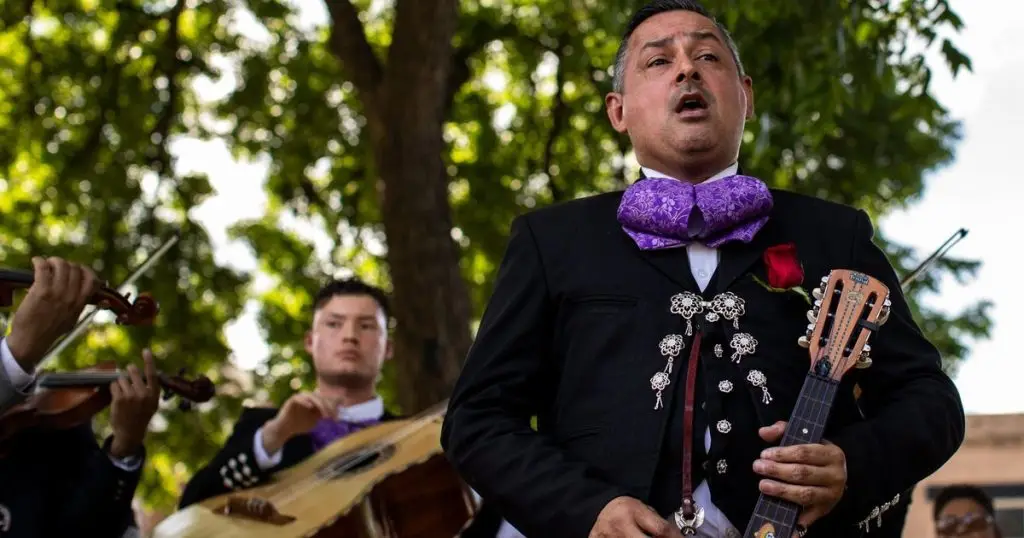
The verses of the corrido for the “Angels of Uvalde” made their way into the town square this week when a nearly 50-piece mariachi ensemble from San Antonio arrived to perform mourning songs. The strumming of the violins and the strumming of the guitarrones filled the air as Latino musicians and performers began to process their grief over the events that devastated this predominantly Latino city into art so it can be remembered, so people won’t. to forget.
The mariachis were dressed in a medley of charro outfits and bows as the musicians from different groups were brought together in a quick attempt to serenade the people of Uvalde. The call to nurture the community through timeless songs has reached the point where mariachis showed up from other predominantly Latino communities such as Del Rio and Eagle Pass and even some from the Mexican border town of Piedras Negras, organizers said.
Faced with an ever-growing memorial of crosses, they offered a ranchera repertoire that they didn’t have to rehearse because they’re so often performed in times of grief.
“We bring music, our soundtrack to the events of life,” said Anthony Medrano, a San Antonio mariachi violinist who co-organized the musical outing. “In the good times and in the bad times and the worst times, we are called to serve in a way almost.”
The ensemble arrived in a traumatized community stuck in a relentless march of overlapping funeral services and burials for the 19 children and two teachers who died at Robb Elementary. For Mexicans and many Mexican Americans, mariachi music serves as a guide to life landmarks, from the beginnings of romances through serenatas to celebrations of love at weddings to the end of life.
But towards the end of their short set list — after they’d gone through the familiar sombre notes of “Amor Eterno” and the riveting choruses of “Un Día a la Vez” — some of the performers were used to drawing tears from their audiences. , crying themselves.
Some of the musicians who played at Uvalde are instructors who teach young Mexican-American children the art of mariachi, giving them a tool to connect with their culture, often starting at the same age as the 19 children who died at Robb. Others are primary school teachers like Robb, where most of the students are Latinos.
“As a musician, it was an honor to bring comfort and peace to the community,” said Celia Sauceda, an elementary school teacher in San Antonio who plays the violin and has been a mariachi since 1996. was devastating to ingest. I am heartbroken. I’m afraid. I am angry. Innocent lives were taken too quickly. This cannot continue.”
“El Corrido de Los Angeles de Uvalde” was left unplayed as it has yet to be set to music, but the lyrics — written by San Antonio-based contemporary artist Cruz Ortiz and translated into mostly Spanish by Medrano and his wife — were distributed in the town square, hand-printed as broadsheet posters titled in the graphic, dreamy painting style Ortiz is known for.
/https://static.texastribune.org/media/files/83be565e51d2d7964fd11087b6a67d7b/Corrido%20KGB%20TT%2001.jpg)
On the town square, posters were handed out to those present in the town square on Wednesday.
Credit:
Kaylee Greenlee Beal for The Texas Tribune
Medrano will be responsible for creating the accompanying music with Juan Ortiz, the musical director of the Mariachi Campanas de America. They started by sketching out different tempos and the instrumentation. If the story is to be passed down through generations, Medrano said, it has to be humble enough to be able to record it on a lone guitar.
But they also need a rhythm section to serve as a bed for the song—the accordion fits in well with this style, Medrano offered—so parts of it can be recited almost like a poem. The melody will have to make room for pauses and breaths to allow the rawness of his words, a staple of corridos, to be absorbed after each devastating punch.
“It shows the power of art, the power of cultura,” said Cruz Ortiz, the other organizer of Wednesday’s musical tribute. “This is how we do things, this is how we react, this is how we heal, this is what we know.”
On the road from where the mariachis performed, in recent days local artist Abel Ortiz-Acosta used a long wooden brush to carefully draw a maroon border on white block letters that read “UVALDE ES AMOR” and “MUY STRONG” on the windows of the small art gallery he owns.
/https://static.texastribune.org/media/files/b8c2df0749dfc46040ba8bc2ffa25a67/Window%20Paint%20KGB%2001.jpg)
Abel Ortiz-Acosta, 55, put the finishing touches on a window message for his company in Uvalde on Sunday. Ortiz-Acosta said he plans to work with several Texas artists to create murals of all 21 victims in the city.
Credit:
Kaylee Greenlee Beal for The Texas Tribune
The painted messages reflected what had become a common theme on glass shop windows in the city, but he wanted at least one in Spanish, he said.
In the coming months, Ortiz-Acosta hopes to make the messages permanent through a series of murals honoring those lost with Robb. The art professor has been calling out money for a week since the shooting and is trying to reach out to artists from across the state to participate. Help has already come through community organizations supporting artists of color in Austin and Houston.
The first of the Uvalde Strong Unidos 21 murals may be placed on the side of his building if approved by the conservation commission that oversees historic districts. Perhaps the murals will capture the children’s faces, but not without getting the blessing of their families first.
Like just about everyone in town, Ortiz-Acosta has some families grieving for their lost children. Among his students was the mother of Lexi Rubio, a 10-year-old straight A student who wanted to become a lawyer. His wife, Evelin, a Zumba and fitness instructor, regularly teamed up with another student’s father, Ellie Garcia, when they collaborated on local quinceañeras. Ellie, who would have turned 10 Saturday, was already planning her own dance for her celebration in five years.
Ortiz-Acosta, a longtime resident of Uvalde, knows that his city will be changed forever. The healing process will be slow because the scar “will reopen every time something like this happens,” he said.
But art can serve as a balm. Besides, he said, they don’t want anyone to forget what happened here.
“We want them to be monumental,” Ortiz-Acosta said in Spanish. “Because those lives should have been monumental.”
[ad_2]
Source link